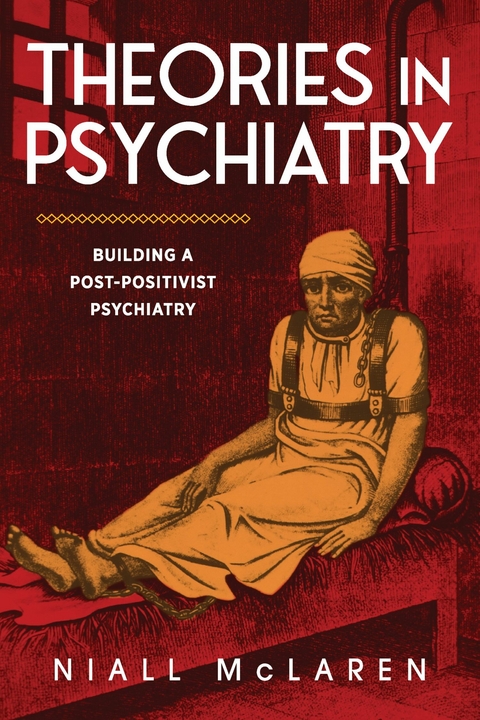
Theories in Psychiatry (eBook)
356 Seiten
Modern History Press (Verlag)
978-1-61599-824-1 (ISBN)
Psychiatry has to be taken seriously. An ever-increasing proportion of the population are prescribed long-term, powerful psychiatric drugs on opinions only, with no evidence of brain pathology. People who have broken no laws can be taken from their homes, locked in cells, stripped and drugged indefinitely, leaving them no practical means of regaining their civil rights. Niall McLaren shows that modern psychiatry is in a state of theoretical disarray. By analysing and comparing all current theories of mental disorders, he shows that either they don't exist in a scientific form or they are incapable of being developed to that point. Further, he shows that theories of mind in philosophy cannot fill psychiatry's theoretical void. Anybody with an interest in mental disorders will be greatly assisted by seeing just how the various attempts at theories fit together, and why they all fail.
'Contemporary psychiatry is in theoretical crisis. This book brilliantly critiques the misguided theories presently leading the profession into a philosophical and practical quagmire. It shows how the profession's obsession with biological determinism is a serious danger to patients, as well as to the profession's future. By exposing the philosophical errors that undermine contemporary psychiatry's fundamental duty to heal anguished minds, it makes a profound case for transforming psychiatry from a reductive medical science into an effective human science. This book deserves a very wide readership.'
-- Dr Allan Patience, University of Melbourne
'I consider Niall McLaren's work a very valuable contribution. It fills a major gap in the theory of mental disorders and will appeal to anybody with an interest in the field.'
-- Assoc. Prof. Carolyn Quadrio, University of New South Wales
From Future Psychiatry Press
Preface.
You never change something by fighting the existing reality. To change something, build a new model that makes the existing model obsolete.
Richard Buckminster Fuller (1895-1983),
In my other work, Natural Dualism and Mental Disorder: the biocognitive model for psychiatry, I build a dualist model to replace the existing, reductionist-biological concept of mental disorder [1]. My goal in this book is to provide the intellectual basis to dispose of biological psychiatry forever.
This book replaces my four earlier books with a tighter focus on theories in the field of mental disorder. In the fifteen years since the first volume was published, there have been many developments which need to be brought into any discussion of psychiatry, psychology and social work. However, the field of mental disorder is so large that all I can hope to do is start a long-overdue debate, one that psychiatry itself has carefully avoided throughout its history.
My starting position is that mental disorder is real, which also meanst the mind is real. Mental disorder means something yet, despite anything you may see in the media, there is no explanation. Most psychiatrists today believe mental disorder is always and only caused by a disturbance of brain function at the level of neurotransmitters, hence the widespread trope, “a chemical imbalance of the brain.” After a hundred and fifty years, this remains an unproven hypothesis. Most emphatically, do not be swayed by biological psychiatrists who proclaim that we are “on the cusp of a breakthrough in mental disorder.” That’s just public relations.
There are still a few psychiatrists who say mental disorder is wholly a matter of psychology, including faulty learning, faulty parenting or faulty life experiences. The remainder hedge their bets by saying it is caused by a mix of biological, psychological and social factors, but they can’t be more specific than that. In an ideal world, treatment would flow from the model of mental disorder but because there isn’t an agreed model, almost all mentally-troubled people who come in contact with psychiatry will be given drugs and other physical forms of treatment. Why? Because drugs (and the belief system that goes with them) now define psychiatry, separating it from psychology.
Despite this lack of a formal theory of mental disorder, psychiatrists have a peculiar grip on the public mind. Thirty years ago, the lawyer and historian, Eric Dean raised the question of psychiatrists as “moral entrepreneurs.” The term comes from the 1963 book, Outsiders: Studies in the Sociology of Deviance, by the sociologist Howard Becker. He defined a moral entrepreneur as “an individual, group or organization that seeks to influence a group or society to maintain a particular norm or adopt a new one, the goal being either to reinforce or alter the boundaries of morality, including altruism, deviance, duty or compassion.” Dean continued:
This impression of scientific certitude in the midst of substantial and potentially crippling problems is a tribute to the ability of psychologists and the psychiatric profession to acquire and wield power ... the salient point is that the mental health professions have a track record of advancing diagnostic categories that lack clear underlying unity based on scientific evidence, but that, nonetheless, have the effect of responding to popular needs and aggrandizing the power and authority of mental health professionals [2, pp200-202]
In his series entitled Can’t get you out of my head, the remarkable documentary maker, Adam Curtis (2021, BBC Film), looks at the life of a man in the 1970s who decided on the then-radical step of transitioning from male to female. Having already lived as a woman for some time, she was referred to a psychiatrist for assessment and management. After endless delays and fiddling around, she decided to have breast implants performed privately. At the next appointment, when she revealed the operation, the psychiatrist was furious. Starting at about 23 minutes, the unseen psychiatrist speaks in a cold and demeaning voice, bitterly critical of his patient’s action, before abruptly terminating the interview. His parting words were “Come back and see me in a month,” the clear implication being “... when I’ve had time to get over your effrontery.”
What comes through loud and clear is the psychiatrist’s fury at the patient taking things into her own hand, of not doing exactly as she was told. It was about the psychiatrist’s anger over not being in control, over not getting what he wanted—in other words, the psychiatrist’s personality disorder on full display. People who have seen this shrug dismissively: “Yeah, so what? All shrinks are like that, control freaks one and all.” And they’re right. The history of psychiatry is one of very gross abuse of the civil process [3]. All too often, mentally-disturbed people are grabbed without warning from the streets or from their own homes, handcuffed, thrown in a police van and taken to a mental hospital. There, they are wrestled to the ground, stripped, injected and locked in solitary confinement, sometimes before anybody has actually asked why they are there.
Once in the system, psychiatric patients have essentially no civil rights, or certainly fewer than convicted prisoners. They are detained after a quasi-judicial process which admits unsworn and hearsay evidence; they generally they have no knowledge of the material on the application forms; they are usually denied the right of cross-examination of the hospital staff or police who signed the application; most have no legal representation; and they have practically no rights of appeal, even if they knew of them, which most don’t, and could afford it, which they can’t. Caught in the machinery of the psychiatry industry, it is all but impossible for detained people to extricate themselves. Everything they do, every time they object or resist, is taken as evidence of mental disorder and therefore leads to more, not less, “treatment.” In particular, people caught up in the forensic system can effectively kiss their lives goodbye.
Even though this is legally permissible, it represents the most profound and widespread breach of human rights. It takes place every day in every country of the world, in systems that operate outside public sight—and far from public concern. All this is done by order of “a caring community working within the moral constraints of the science of mental disorder for the benefit of the patient.” So how is this justified? Is this just tradition, akin to the way we butcher animals or we used to treat slaves or, all too often, still treat indigenous populations and women, or is it rational, justified by some science of mental disorder? If tradition, it needs to be examined right now but if we claim it’s rational, it needs to be irreproachable, far more so than even the scientific justification of Covid restrictions.
Part I of this book starts by looking at the fundamental belief systems which underlie discusssions of mental life, the Cartesian dualist model and the positivist reaction to dualism (see Part II Preface). These set the scene for psychiatry as it is practised, specifically the theoretical authority for the various forms of treatment. My goal is to find an articulated, publicly-available model of mental disorder of a form that permits predictions to be made and tested. We look at each “brand” of psychiatry to see what it says about the nature of mental disorder and how it arises in the normal course of events. What we find is that, stripped of its self-justifying verbiage, psychiatry has no theory or model of mental disorder that justifies either today’s forms of treatment of the mentally-troubled, or the wholesale and indefinite removal of their civil and human rights when they have broken no laws.
Since psychiatrists are manifestly operating in a theoretical vacuum, Part II looks at a range of philosophies of mind to see if any of them can be developed to the point of justifying society’s treatment of mental disorder. At many points, I emphasise that any model for psychiatry must show a mechanism that can explain mental disorder. In the final analysis, the activity and output of any complex system is governed by three features: by the mechanism by which the physical structure does its job (the matter-energy interchanges of its workings); by the medium in which that activity takes place; and by whatever its managers have planned for it (the informational states governing its physical activity). To understand mental disorder, we need solid explanations of each of these points.
Of course, this is also true of the question of the nature of mind. People may object: “Oh but the question of mind is entirely metaphysical, it can’t be resolved by empirical facts.” True, but empirical facts set the boundaries of discussion. Because they tell us firmly what can’t be the case, they soon eliminate some ideas. Facts tell us the mechanism by which we can expect the mind to emerge or be reduced (the question remains open for now), and the medium in which mental activity is implemented. Just as the heart functions as a pump, the liver functions as a chemical factory, and skin functions as a barrier, so the brain works as a high-speed, multi-modal information processor. That’s its role, that’s what it does. Our job is to relate that role to the emergence of mental properties, and thence the development of mental disorder.
Given this role and the macro- and microstructure of the brain, any theory of mind must start with, and ultimately be defined within, a theory of information. Apart...
| Erscheint lt. Verlag | 1.9.2024 |
|---|---|
| Sprache | englisch |
| Themenwelt | Geisteswissenschaften ► Philosophie |
| Schlagworte | Crisis • Criticism • General • History • Medical • Modern • Philosophy • Psychiatry • Surveys |
| ISBN-10 | 1-61599-824-1 / 1615998241 |
| ISBN-13 | 978-1-61599-824-1 / 9781615998241 |
| Informationen gemäß Produktsicherheitsverordnung (GPSR) | |
| Haben Sie eine Frage zum Produkt? |
 EPUB (Ohne DRM)
Digital Rights Management: ohne DRM
Dieses eBook enthält kein DRM oder Kopierschutz. Eine Weitergabe an Dritte ist jedoch rechtlich nicht zulässig, weil Sie beim Kauf nur die Rechte an der persönlichen Nutzung erwerben.
Dateiformat: EPUB (Electronic Publication)
EPUB ist ein offener Standard für eBooks und eignet sich besonders zur Darstellung von Belletristik und Sachbüchern. Der Fließtext wird dynamisch an die Display- und Schriftgröße angepasst. Auch für mobile Lesegeräte ist EPUB daher gut geeignet.
Systemvoraussetzungen:
PC/Mac: Mit einem PC oder Mac können Sie dieses eBook lesen. Sie benötigen dafür die kostenlose Software Adobe Digital Editions.
eReader: Dieses eBook kann mit (fast) allen eBook-Readern gelesen werden. Mit dem amazon-Kindle ist es aber nicht kompatibel.
Smartphone/Tablet: Egal ob Apple oder Android, dieses eBook können Sie lesen. Sie benötigen dafür eine kostenlose App.
Geräteliste und zusätzliche Hinweise
Buying eBooks from abroad
For tax law reasons we can sell eBooks just within Germany and Switzerland. Regrettably we cannot fulfill eBook-orders from other countries.
aus dem Bereich