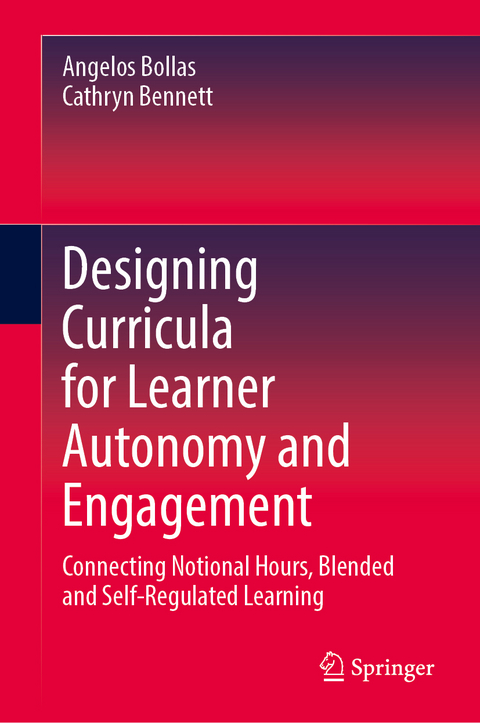
Designing Curricula for Learner Autonomy and Engagement
Springer International Publishing (Verlag)
978-3-032-13519-3 (ISBN)
- Noch nicht erschienen - erscheint am 04.02.2026
- Versandkostenfrei
- Auch auf Rechnung
- Artikel merken
Designing Curricula for Learner Autonomy and Engagement examines how higher education can be reimagined to empower learners as active, self-regulated participants in their own development. Across seven interconnected chapters, the book integrates theory, research, and practice to explore how autonomy and engagement can be systematically fostered in curriculum design, teaching strategies, and institutional policy. Starting with the conceptual foundations of learner autonomy and self-regulated learning, the book situates these ideas within the realities of contemporary higher education, including digital transformation, flexible delivery, and post-pandemic pedagogical change. It repositions notional hours as a learner-centred design tool and illustrates their application through a case study of an undergraduate module redesigned to enhance engagement and independent learning. Building on these principles, the book offers evidence-based frameworks for blended and interactive learning design, showing how Constructive Alignment, Self-Determination Theory, and Universal Design for Learning can be translated into practical strategies for fostering motivation, reflection, and meaningful interaction. Subsequent chapters address the measurement and enhancement of student engagement, introducing ethical, inclusive, and data-informed approaches to assessing behavioural, emotional, and cognitive participation. The discussion extends to institutional and policy levels, exploring how quality assurance systems, curriculum governance, and professional development can support autonomy-oriented innovation. Throughout, the book emphasises the integration of technological and human dimensions of learning, including the emerging influence of generative AI, and advocates for pedagogy that is both evidence-based and responsive to learners diverse needs. Bridging conceptual insight with actionable guidance, Designing Curricula for Learner Autonomy and Engagement provides educators, curriculum designers, and policymakers with a coherent framework for creating learning environments that cultivate agency, criticality, and sustained engagement in an evolving educational landscape.
Angelos Bollas is an independent scholar. His research focuses on education as well as men and masculinity from literary, cultural, and social perspectives. He has authored and edited 8 books including Contemporary Irish Masculinities (Routledge, 2024), Sexualised Governmentalities (Springer, 2024), Fashionable Queerness (Emerald, 2024), HIV/AIDS in Memory, Culture and Society (Palgrave Macmillan, 2024), The Routledge Companion to Sally Rooney (Routledge, 2025), Designing Curricula for Student Autonomy and Engagement (Springer, 2026), Voices of Resistance (Emerald, 2026), and Health and Care in Crisis in Sally Rooney s Literary Universe (Palgrave Macmillan, 2026). Angelos has a PhD in Cultural Studies, five master s degrees including a MA in Learning Design and Technologies, and two bachelor s degrees. He is currently studying for his third bachelor s degree in Philosophy.
Cathryn Bennett is a researcher in corpus literacy development, virtual exchange in task design, and pragmatics. She obtained her PhD in Applied Linguistics from Trinity College Dublin in 2023, focusing on training in-service EFL practitioners to become corpus literate and design classroom materials with corpora. Currently, she is the Scholarly Writing Specialist at Penn State University, United States and continues to publish in several areas: corpus literacy development of in-service teacher education, intercultural virtual exchange and corpus materials design.
Chapter 1. Understanding Learner Autonomy and Self-Regulated Learning.- Chapter 2. The Role of Notional Hours in Curriculum Design.- Chapter 3. Rethinking Notional Hours for Greater Learner Autonomy and Engagement.- Chapter 4. Principles and Learning Theories Behind Blended Learning.- Chapter 5. Designing Interactive and Engaging Learning Experiences.- Chapter 6. Assessing and Enhancing Student Engagement.- Chapter 7. Policy and Institutional Support for Innovative Education.
| Erscheint lt. Verlag | 4.2.2026 |
|---|---|
| Zusatzinfo | IV, 190 p. 7 illus. in color. |
| Verlagsort | Cham |
| Sprache | englisch |
| Maße | 155 x 235 mm |
| Themenwelt | Geisteswissenschaften ► Psychologie ► Pädagogische Psychologie |
| Medizin / Pharmazie ► Medizinische Fachgebiete ► Psychiatrie / Psychotherapie | |
| Schlagworte | Blended Learning • Curriculum Design • Educational Innovation • Educational Policy • Flexible Learning • higher education • Institutional support • Instructional Design • Interactive Learning • Learner autonomy • Learning Assessment • Learning Design • Learning Environments • learning outcomes • Notional Hours • Online Learning • student-centred learning • Student Engagement • Teaching Strategies • Technology in education |
| ISBN-10 | 3-032-13519-2 / 3032135192 |
| ISBN-13 | 978-3-032-13519-3 / 9783032135193 |
| Zustand | Neuware |
| Informationen gemäß Produktsicherheitsverordnung (GPSR) | |
| Haben Sie eine Frage zum Produkt? |
aus dem Bereich