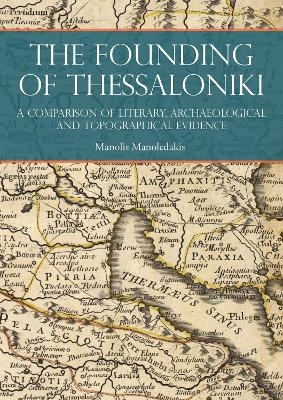
The Founding of Thessaloniki
Casemate Publishers (Verlag)
979-8-88857-257-3 (ISBN)
- Titel nicht im Sortiment
- Artikel merken
The book examines the founding of Thessaloniki, one of the most important and enduring Hellenistic cities. It brings together various topics relating to Cassander’s foundation, some of them reconsidered and others examined for the first time, and is informed by the results of the archaeological research of the region around modern Thessaloniki that has taken place in the last 40 years and significant topographical observations that result from them, including the huge impact that the foundation of Thessaloniki had on the settlement map around the Thermaic Gulf.
Most important is the examination of the data on the founding of Thessaloniki that may be derived from Strabo’s work, the only ancient source that describes the event. The two relevant fragments are discussed in detail. Finally, the book examines some issues relating to the founding of Thessaloniki that were not touched upon by Strabo, including the motivations and ambitions behind Cassander’s founding of the new city, as well as the outcomes and general impact of its establishment.
In this monograph, all the components of both the textual and the current archaeological evidence are analytically and comparatively examined, while comparisons with other cases of synoecism, especially within the same timeframe, that are described in the ancient literature are made, in an effort to shed more light on the topography around Thessaloniki before and immediately after its founding. Among the main objectives of the book are: to produce an original contribution to modern scholarship by advancing our understanding of the way an important Hellenistic city was founded through the procedure of synoecism; to demonstrate that when it comes to historical/archaeological questions of a topographical nature, the literary and archaeological evidence is deficient if it is not supplemented by topographical data, something for which there are many more convenient tools available today than there were some decades ago; to encourage further research on key aspects of the archaeology and ancient history of central Macedonia.
Manolis Manoledakis is Professor of Classical Archaeology at the International Hellenic University in Thessaloniki. His research concentrates on the archaeology and ancient history of the Black Sea as well as central Macedonia, the ancient topography and geography of these areas, ancient Greek religion, Greek mythology in its historical context, and ancient Greek painting and vase-painting. He is the director of two post-graduate programmes of the International Hellenic University’s School of Humanities, the MA in Black Sea and Eastern Mediterranean Studies and the MA in the Classical Archaeology and the Ancient History of Macedonia, as well as the director of the university’s excavation in Neo Rysio, near Thessaloniki.
List of illustrations
Preface
Introduction
Part I. The Evidence from Strabo’s Work
1. The relevant fragments and a comparison of the two epitomes
1.1. Generally
1.2. Some minor differences
1.3. On the fate of the synoecised settlements after the synoecism
1.4. On the number of synoecised settlements
1.5. On the urban status of the synoecised settlements
1.6. On the names of the synoecised settlements
1.7. Conclusion
2. Defining the area of the twenty-six synoecised settlements
3. The known ancient sites within the area that gave population to Thessaloniki
4. The settlements mentioned by Strabo
4.1. Apollonia
4.2. Chalastra
4.3. Gareskos and Aeneia
4.4. Kissos
5. Which were the other twenty settlements?
Part II. The Case of Therme
6. Thracian, Greek, or Macedonian?
7. Where was Therme located?
7.1. The theories that have been put forward
7.2. The archaeological evidence
7.2.1. Thermi
7.2.2. Toumba
7.2.3. Karabournaki
7.2.4. Thessaloniki
7.3. The textual evidence
7.4. Concluding remarks
8. Was Therme organised kata komas?
8.1. Briefly on the term kome
8.2. The meaning of the expressions komedon and kata komas in the ancient Greek literature
8.3. Attested or possible kata komas settlements in Greece
8.4. Komai in Macedonia
8.5. About Therme
8.5.1. Topographical remarks
8.5.2. Historical remarks
Part III. The Founding of Thessaloniki: Motivations and Impact
9. Synoecisms in the Hellenistic period
10. Cassander’s synoecisms
11. The role of the harbour in the synoecism of Thessaloniki
12. The impact of Thessaloniki’s founding on the wider region
13. Some thoughts on the status of settlements remaining after the synoecism
Conclusions
Bibliography
Index
| Erscheint lt. Verlag | 15.5.2026 |
|---|---|
| Sprache | englisch |
| Maße | 170 x 240 mm |
| Themenwelt | Geisteswissenschaften ► Archäologie |
| Geschichte ► Allgemeine Geschichte ► Vor- und Frühgeschichte | |
| Geschichte ► Allgemeine Geschichte ► Altertum / Antike | |
| Geschichte ► Allgemeine Geschichte ► Mittelalter | |
| ISBN-13 | 979-8-88857-257-3 / 9798888572573 |
| Zustand | Neuware |
| Informationen gemäß Produktsicherheitsverordnung (GPSR) | |
| Haben Sie eine Frage zum Produkt? |
aus dem Bereich