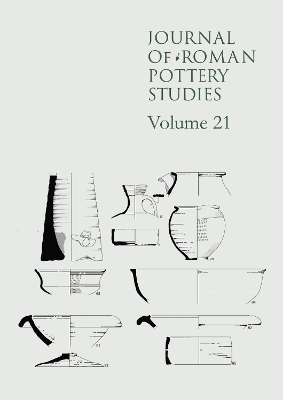
Journal of Roman Pottery Studies, Volume 21
Casemate Publishers (Verlag)
979-8-88857-244-3 (ISBN)
- Titel nicht im Sortiment
- Artikel merken
This issue of the Journal of Roman Pottery Studies focuses primarily on new data for early Roman pottery production and techniques. Three early Roman kilns were discovered at Longford, Gloucestershire associated with an originally Iron Age enclosure that was remodelled. Unusual features of the kilns included the use of ceramic tubes in one, and stacked pots to form the walls probably in all three. The associated pottery is closely linked to products of kilns known in Gloucester itself and is consistent with production for military-related communities rather than the wider Romano-British population of the region. The production may relate to an early stage of exploitation of the landscape consequent on establishment of the colonia at Gloucester by AD 98 if not rather earlier. Production probably did not continue after c. AD 120 at the very latest. At Brampton, Cambridgeshire in 2016, a cluster of eight previously unknown early Roman pottery kilns was recorded and subsequently published. Further analysis identified intriguing variation within the pottery assemblage, which provided an opportunity to investigate the chaîne opératoire. Technical and stylistic groups were examined in hand-specimen, thin-section petrography determined the fabric groups present and portable X-ray fluorescence helped to establish the geochemical composition of the sample. The data collected allowed for glimpses at the choices made by the potters and helped to unpick their making process, from which a characterising assessment of the organisation of production and its variations emerged. A kiln complex discovered at Elmswell, Suffolk close to the suggested course of a Roman road included two adjacent, single flue kilns associated with pottery forms dating to the later 1st–early 2nd centuries AD. The large pottery assemblage comprised primarily buff coloured flagons and black-surfaced jar forms and wasters, together with fragments of kiln furniture and associated environmental evidence and is discussed here in relation to the contemporary pattern of early Roman pottery production in this area of East Anglia, with particular regard to the question of itinerant, immigrant potters working out of Colchester.
A new study of Upper Nene Valley Wares employed ceramic radiography to examine the embedding of potter’s wheel technology in the British craft. The data show that among certain Upper Nene Valley Wares the potter’s wheel was used to its greatest potential, to throw pots, thus marking a step-change relative to the heterogenous forming practices evident in earlier traditions. Discussion of the significance of this new understanding focuses on implications for narrative accounts of technological change during the Late Iron Age and early Roman periods and uses the development of parallel technological trajectories as a framework for understanding the emergence of diversity in early Roman pottery assemblages.
Pottery associated with a Late Roman kiln of mid-3rd to early 4th century date in New Marston, Oxford was associated with large amounts of Oxfordshire white ware mortaria and red/brown slipped wares. A nummus of Constantine I (AD 310–313) recorded in the backfill of the kiln suggests that it is likely to have been retired during the early 4th century AD.
Alice Lyons holds a PhD from the University of East Anglia. She is currently Managing Editor for East Anglian Archaeology having previously worked in commercial archaeology in the UK for 35 years. She specialises in Iron Age and Roman pottery and is the President of the Study Group for Roman Pottery. Edward Biddulph is a Senior Project Manager with Oxford Archaeology responsible for managing post-excavation projects, delivering reports for clients, and bringing the results of archaeological fieldwork to publication. He holds an MA from UCL’s Institute of Archaeology, London. His research interests include Roman pottery, Roman cemeteries and cultural evolution. Charlotte Burn is a senior pottery specialist (Iron Age and Roman) at Museum of London Archaeology (MOLA) where she has worked with pottery since 2013. She has experience of recording and analysing large and small assemblages from London and other counties in South-East England. Kayt Hawkins has worked in the UK development-led archaeology sector for over 25 years, primarily as a Romano-British pottery specialist. She currently works for Archaeology South-East, part of the Institute of Archaeology, UCL, London, and is also a PhD candidate at University of Leicester.
Editorial: Working together to get the job done
A.L. Lyons, E. Biddulph, K. Hawkins and C. Burn
Obituaries
Brenda Dickinson by G. Monteil
Malcolm Lyne by S. Willis
Phil Mills by J. Evans
Geoff Dannell by J.P. Wild and F. Wild
1. Retrospective [title TBC]
M. Ward
2. From Towcester to Oudenburg (and many other places along the way): a retrospective
R. Symonds
3. Early Roman pottery production at Longford, Gloucestershire
P. Booth and M. Allen
4. New data on the development of potting techniques in the early Roman period: the case of Upper Nene Valley wares
A. Sutton
5. Examining the early Roman ceramic chaîne opératoire at RAF Brampton, Cambridgeshire
T. Levermore
6. Early Roman pottery production at Elmswell, Suffolk
K. Hawkins and K. Heard
7. A Late Roman pottery kiln at Swan School and Meadowbrook College, New Marston, Oxford
P. Banks and J. Barker
8. Sarmizegetusa kilns
M. Dawson
9. Book review: Making Flour the German Way in Roman Britain
S. Watts
| Erscheint lt. Verlag | 17.4.2026 |
|---|---|
| Sprache | englisch |
| Maße | 210 x 297 mm |
| Themenwelt | Geisteswissenschaften ► Archäologie |
| Geschichte ► Allgemeine Geschichte ► Vor- und Frühgeschichte | |
| Geschichte ► Allgemeine Geschichte ► Altertum / Antike | |
| Geschichte ► Allgemeine Geschichte ► Mittelalter | |
| Geisteswissenschaften ► Geschichte ► Regional- / Ländergeschichte | |
| ISBN-13 | 979-8-88857-244-3 / 9798888572443 |
| Zustand | Neuware |
| Informationen gemäß Produktsicherheitsverordnung (GPSR) | |
| Haben Sie eine Frage zum Produkt? |
aus dem Bereich