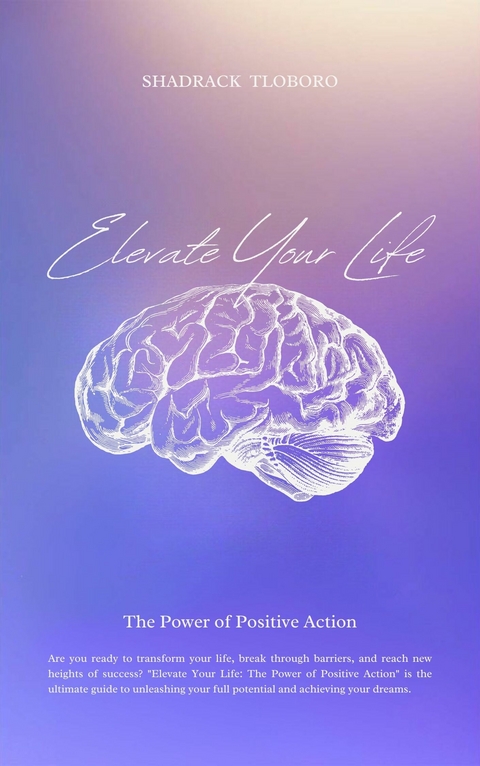
Elevate Your Life (eBook)
125 Seiten
Publishdrive (Verlag)
978-0-00-108139-0 (ISBN)
In 'Elevate Your Life,' Shadrack Tloboro takes you on a transformative journey through his personal experiences, offering profound insights into personal growth and self-discovery. This compelling narrative not only equips you with the tools needed for change but also ignites a deep desire to succeed. The vivid illustrations within awaken your inner potential, inspiring you to embrace your true capacity. From the very first sentence, you'll be captivated by its life-changing wisdom. Unlock the secrets to success and discover the keys to a fulfilling life with this extraordinary guide.
Chapter 2: Charting the Inner Seas
Elara’s journey inward began not with a grand pronouncement or a sudden, dramatic upheaval, but with a quiet, almost reverent act of turning her gaze upon herself. The world outside the lighthouse, with its predictable rhythms and its wild, untamed beauty, had served its purpose. It had been the catalyst, the mirror reflecting back the stark reality of her stagnant existence. Now, the exploration had to shift, to delve into the less visible, yet far more intricate landscape of her own being. This was not a quest for external validation or a desperate search for a lost object; it was a deliberate expedition into the uncharted territories of her own consciousness.
She started, as any seasoned cartographer would, with the familiar landmarks. Her habits, those comfortable, worn paths etched into the terrain of her days, were the first to be meticulously mapped. She observed them not with judgment, but with a detached curiosity, as if studying a species of bird or the migratory patterns of the sea. The early morning ritual of brewing tea, the precise way she organized the lighthouse logbook, the familiar comfort of a worn armchair by the fire – these were not just actions, but indicators of underlying needs and patterns. Were they serving her, nurturing her growth, or were they subtle forms of self-imposed confinement, anchors tethering her to a past that no longer fit? She noted the automatic responses, the almost unconscious transitions from one activity to the next, and began to question the ‘why’ behind each one. This was not about eradicating habits, but about understanding their origins and their present-day function. It was about distinguishing between habits that were supportive and those that were simply habitual, a testament to inertia rather than intentionality.
Next, she turned her attention to the more formidable obstacles: her fears. These were the jagged peaks that loomed in the distance, casting long shadows over her inner world. They were not always rational, not always logical, but they were undeniably powerful. The fear of failure, a constant companion, manifested in a thousand subtle ways – the reluctance to try new things, the tendency to stick to what was safe and predictable, the inner voice that whispered doubts and criticisms before any venture could even begin. Then there was the fear of judgment, the unspoken anxiety of what others might think, a fear that had kept her from truly expressing herself for years. She also recognized a more primal fear, a deep-seated dread of vulnerability, of exposing the tender parts of herself that felt too fragile for the harshness of the world. Mapping these fears involved more than just identifying them; it meant tracing their roots, understanding where they had taken hold, and recognizing the triggers that brought them to the surface. It was like descending into a deep cavern, armed with only a flickering torch, illuminating the stalactites of apprehension and the chasms of self-doubt.
The bedrock of her inner landscape, she discovered, was formed by her ingrained beliefs. These were the deep-seated assumptions about herself, about others, and about the world at large, which had solidified over time, shaping her perceptions and dictating her responses. Some beliefs were inherited, echoes of lessons learned in childhood or absorbed from the environment. Others were self-constructed, born from past experiences and reinforced by a selective interpretation of events. The belief that she was inherently not creative, for instance, had long dictated her avoidance of artistic pursuits. The belief that deep connection was fraught with danger had led to a life of emotional solitude. Identifying these beliefs was a delicate task, akin to sifting through layers of sediment, each one holding a story, a justification, a reason for its presence. It required a willingness to confront uncomfortable truths, to acknowledge that some of the narratives she held most dear might be outdated, inaccurate, or even detrimental to her well-being.
To aid in this cartographical endeavor, Elara rediscovered her old journals. They were no longer just dusty repositories of faded dreams and youthful aspirations. Now, they served as vital topographical maps, providing a historical perspective on the evolution of her inner terrain. Flipping through the pages, she didn't just reminisce; she analyzed. She looked for recurring themes, for the persistent hum of dissatisfaction that had been a constant undercurrent for so many years. She highlighted passages that spoke of genuine joy, those fleeting moments when she had felt truly alive, truly present. What had she been doing? Who had she been with? What was it about those experiences that had ignited her spirit? These were the fertile valleys, the sun-drenched meadows of her inner world, offering clues to what truly nourished her soul.
Equally important were the instances where she felt a distinct lack of vitality, moments of profound disconnect or a pervasive sense of apathy. These were the barren plains, the stagnant pools, signaling areas of her life that were not being tended, or perhaps were being actively neglected. She meticulously noted down negative thought patterns, those familiar, insidious loops of self-criticism and doubt that seemed to play on repeat. It was like charting the flow of underground rivers, the hidden currents that could either nourish the landscape or erode its foundations.
This process of honest self-assessment was far from easy. It was often uncomfortable, akin to navigating treacherous waters where unseen reefs threatened to tear the hull of her self-understanding. There were moments of frustration, of wanting to simply turn back to the familiar shores of denial or distraction. The sheer volume of information, the intricate web of interconnected thoughts and feelings, could feel overwhelming. It was like trying to decipher an ancient, complex language, where every symbol had multiple meanings and every sentence was a riddle.
Yet, with each entry, with each honest observation, a clearer picture began to emerge. She started to recognize the patterns that propelled her forward, the internal currents of motivation and inspiration that, however faint, were always present. And, conversely, she identified the unseen forces that held her captive, the undertow of fear and self-doubt that perpetually pulled her back towards the safety of her established routine. This was not about finding fault or assigning blame; it was about gaining a profound understanding of the existing currents, both benevolent and treacherous, that shaped her journey. This was the essential first step in charting her course, in learning to harness the winds of her own spirit and navigate the vast, often turbulent, seas of her inner world. The more she understood the terrain, the more empowered she became to choose her direction.
The voyage inward, as Elara was discovering, was less a placid cruise and more a daring expedition into waters known for their deceptive calm and hidden dangers. The smooth surface of her newfound self-awareness often belied the powerful, unseen currents that threatened to drag her off course. Among the most persistent and alluring of these were the inner sirens, whose songs, though enchanting, promised only shipwreck. These were not external forces, but voices born from the very fabric of her being, amplified by years of habit and the deep-seated human yearning for the familiar.
The most dominant of these siren voices was the relentless whisper of self-doubt. It was a constant, low hum beneath the surface of her thoughts, a insidious counter-melody to any burgeoning sense of hope or ambition. When she dared to consider a new path, to imagine a different version of herself, this voice would rise, its tone laced with a familiar, patronizing skepticism.
“And what makes you think you can do that?” it would inquire, the question dripping with the implied answer: “You can’t.” It conjured vivid, unflinching images of failure, each one meticulously crafted to instill a sense of dread. She saw herself stumbling, fumbling, utterly failing to meet expectations, her efforts met with pity or, worse, ridicule. These were not abstract possibilities; they were presented as near certainties, painted in the starkest colors of her imagination. This voice preyed on her insecurities, highlighting every past mistake, every perceived inadequacy, weaving them into a damning indictment of her potential. It reminded her of every time she had fallen short, every criticism she had ever received, transforming them into irrefutable proof of her inherent limitations. It was a master storyteller, but its tales were exclusively of defeat.
Closely allied with self-doubt was the seductive allure of her comfort zone. This was not a stark, forbidding cliff face, but a warm, inviting harbor, promising shelter from the storms of uncertainty. The siren song here was one of ease, of predictability, of effortless continuation.
“Why strive? Why risk?” it would murmur, its voice like a gentle lullaby. “You are safe here. You know this shore. The sea beyond is vast and unforgiving. Here, you are known, you are secure. The effort required to venture out, the potential for discomfort, for disappointment – is it truly worth it?” This voice played on her innate desire for peace and stability, framing the pursuit of growth as an unnecessary hardship. It whispered of the pleasures of routine, the quiet satisfaction of predictable days, the absence of the sharp edges of ambition. It suggested that contentment was found not in reaching new...
| Erscheint lt. Verlag | 17.10.2025 |
|---|---|
| Sprache | englisch |
| Themenwelt | Geisteswissenschaften ► Philosophie |
| ISBN-10 | 0-00-108139-X / 000108139X |
| ISBN-13 | 978-0-00-108139-0 / 9780001081390 |
| Informationen gemäß Produktsicherheitsverordnung (GPSR) | |
| Haben Sie eine Frage zum Produkt? |
 EPUB (Adobe DRM)
Größe: 1,3 MB
Kopierschutz: Adobe-DRM
Adobe-DRM ist ein Kopierschutz, der das eBook vor Mißbrauch schützen soll. Dabei wird das eBook bereits beim Download auf Ihre persönliche Adobe-ID autorisiert. Lesen können Sie das eBook dann nur auf den Geräten, welche ebenfalls auf Ihre Adobe-ID registriert sind.
Details zum Adobe-DRM
Dateiformat: EPUB (Electronic Publication)
EPUB ist ein offener Standard für eBooks und eignet sich besonders zur Darstellung von Belletristik und Sachbüchern. Der Fließtext wird dynamisch an die Display- und Schriftgröße angepasst. Auch für mobile Lesegeräte ist EPUB daher gut geeignet.
Systemvoraussetzungen:
PC/Mac: Mit einem PC oder Mac können Sie dieses eBook lesen. Sie benötigen eine
eReader: Dieses eBook kann mit (fast) allen eBook-Readern gelesen werden. Mit dem amazon-Kindle ist es aber nicht kompatibel.
Smartphone/Tablet: Egal ob Apple oder Android, dieses eBook können Sie lesen. Sie benötigen eine
Geräteliste und zusätzliche Hinweise
Buying eBooks from abroad
For tax law reasons we can sell eBooks just within Germany and Switzerland. Regrettably we cannot fulfill eBook-orders from other countries.
aus dem Bereich