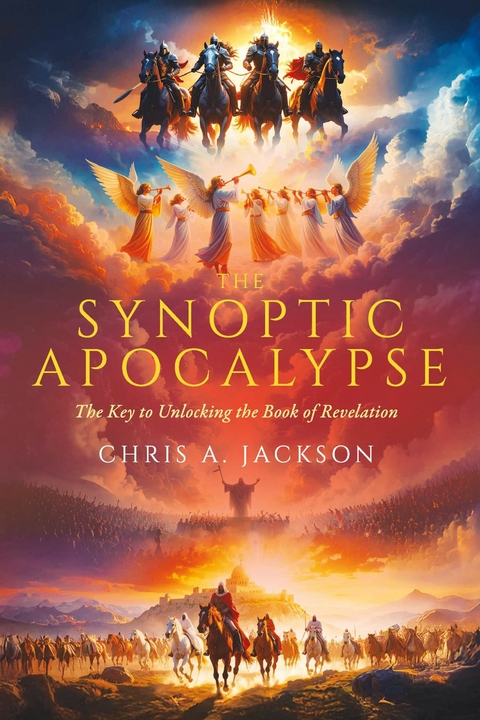
Synoptic Apocalypse: The Key to Unlocking the Book of Revelation (eBook)
268 Seiten
Bookbaby (Verlag)
979-8-3178-0541-8 (ISBN)
Chris A. Jackson As author of The Synoptic Apocalypse: The Key to Unlocking the Book of Revelation, Chris Jackson was dedicated to making Revelation more accessible to the layman. His spiritual journey began over 45 years ago, with a pivotal moment occurring at age 15-an adverse encounter with a church youth director-that set him on an intense search for God. Coming from a non-religious background, he had no doctrinal constraints and explored every religion he came across, often immersing himself in the restricted section of the school library. By the age of 17, he had already encountered Christianity's Jewish roots, and the idea resonated. In 1991, as a young adult, he discovered the Hebraic Roots movement and Messianic Judaism, which fueled an obsession with study. In 1993 alone, over 3,000 hours were dedicated to researching Christianity, Judaism, history, and archaeology. A life-changing friendship introduced Chris to the Noahides and led to his first trip to Israel in 1995. Chris then began corresponding with scholars from diverse backgrounds, engaging in deep theological discussions and received a five-year crash course in biblical studies. Chris's love for the Word of God led him to continue studying and exploring, and he developed an interest in writing, mostly notes from his research. When Covid shutdowns began in 2020, he spent time reading commentaries on Revelation but found most to be outdated and lacking biblical accuracy. Feeling called to fill this gap, he spent the next five years crafting his own in-depth commentary from his studies and discoveries-a fresh perspective unlike anything we have seen before. Current Projects & Future Works Since the completion of The Synoptic Apocalypse Chris has continued studying and writing and is currently composing a book on the Torah for gentiles, addressing one of the most misunderstood and overlooked areas of the Bible for non-Jews. His goal is to provide clarity on a topic that remains confusing for many.
The Synoptic Apocalypse: The Key to Unlocking the Book of RevelationFew books in biblical scholarship evoke as much mystery and debate as Revelation. The Synoptic Apocalypse presents a fresh, in-depth exploration of prophecy, blending a Christian-Messianic perspective with a literal, futurist approach to eschatology. Rather than relying on symbolic interpretations alone, this book combines historical accuracy, theological insight, and scriptural cross-references to uncover hidden patterns that shed new light on end-times prophecy. Deciphering Revelation: Key Themes and InsightsThis book explores four primary interpretations of Revelation preterist, historicist, futurist, and idealist examining their origins and theological impact. It also delves into:The history of rapture theories, tracing their development and evaluating pretribulation arguments. The biblical calendar's role in prophecy, including which holiday aligns with the resurrection. The significance of biblical holidays, revealing their hidden eschatological connections. The two messianic figures in Scripture and their role in God's plan. The end-times parables from Matthew's Gospel, illustrating who will be raptured. The restoration of Israel's twelve tribes and its prophetic fulfillment. The renewal of the earth, reversing plagues, death, disease, and even meat consumption to pre-cursed conditions. The leading candidates for the beast empire, narrowing down the most likely contender. A comparative analysis of the three biblical accounts of the end times, showing their direct connection to Revelation. A Unique Study Format for Clarity & DepthBeyond theology, The Synoptic Apocalypse enhances biblical study with a structured approach, featuring:A complete ASV translation of Revelation, formatted alongside commentary. Aligned text, highlighted keywords, numbered events (seals, trumpets, bowls), and cross-referenced verses. A detailed, verse-by-verse commentary, unlocking symbolism, historical context, and doctrinal insights. For Scholars, Truth Seekers, and Prophecy EnthusiastsWhether you are a seasoned theologian or seeking a deeper understanding of Revelation, this book bridges history and Scripture, offering a compelling, well-researched guide to biblical prophecy. Unlock the mysteries see Revelation as you've never seen it before!
Chapter 4:
THE RAPTURE
Britannica.com (https://www.britannica.com/topic/Rapture-the) states the rapture, in Christianity, is the eschatological (concerned with the last things and end-time) belief that both living and dead believers will ascend into heaven (sky) to meet Jesus Christ at the Second Coming (Parousia), at which time he takes the raptured back to heaven. This is a common definition found in most Bible dictionaries. From this basic definition, we can deduce three points: (1) Yeshua returns, (2) the “saved” are transformed into a new body, and (3) Yeshua takes them back to heaven for what many call “the marriage of the Lamb.” There are three main theories on the rapture: pretribulation, mid-tribulation, and post-tribulation, which are respectively named based on when the rapture takes place in regard to the start of the tribulation.
The pre-trib theory is that the Church is “restraining” the devil from initiating his plan of world domination. Once the Church is raptured, the devil, who is no longer being restrained, springs into action, bringing forth the Antichrist, who will initiate the seven-year tribulation period. It is believed by some that he will spend the first three and a half years wooing world leaders into giving him full control of the world governments and once in political control will reveal his true nature, creating the greatest era of death and destruction the world has ever known. GOD unleashes the seven trumpets and then the seven bowls/vials, annihilating the Antichrist government before the “Second Coming” of Yeshua. The rapture and Second Coming are viewed as two different events. (Moody Bible Institute. The Second Coming of Christ.
https://www.moodybible.org/beliefs/positional-statements/second-coming/.)
The mid-trib theory is the belief that the rapture will take place in the middle of the seven-year tribulation; right before or after the Antichrist shows his real intentions. Specifically, the Antichrist rules for three and a half years; the Church is then raptured before the Antichrist starts his devious plans.
The post-trib theory is that Yeshua will not return until the very end of the tribulation, or immediately after the seven years are up. Usually, in this theory there is “no rapture,” meaning, WE DO NOT GO TO HEAVEN. Many post-trib followers believe the Bible only foretells of the return of Yeshua to translate believers with a new body and then establish the Kingdom of GOD on earth. They believe that the two former theories have taken one event and created two events from it, resulting in three appearances of the Messiah: Jesus’ thirty-three-years on earth, the rapture, and the Second Coming. Also, they believe that even though we will be on earth during the seven-year tribulation, the saved will not endure the direct effects of the wrath of GOD, which is mainly directed at Satan, the Antichrist, and those who have taken the “mark” or worshipped the beast.
Pretribulation Rapture Theory
The earliest mention of the pretribulation rapture is said to be found in a sermon by Ephrem the Syrian, titled “Apocalypse of Pseudo-Ephraem” (4th–6th century Syriac version) and “On the Last Times, the Antichrist, and the End of the World (Latin version),” which states, “All the saints and elect of God are gathered together before the tribulation, which is to come, and are taken to the Lord, in order that they may not see at any time the confusion which overwhelms the world because of our sins.” Within, Pseudo-Ephraem creates an elaborate biblical eschatology, which splits the Second Coming into two events. The rapture is followed by a three-and-a-half-year-long tribulation. Oddly, if the tribulation is for seven years, Pseudo-Ephraem is really describing a mid-tribulation event. Also, Apocalypse of Pseudo-Ephraem survives today with two important versions, one in Latin and another in Syriac. Oddly, these two versions are clearly different from beginning to end. Upon close reading, both versions show that the excerpt above is taken out of context, as both versions clarify the idea of “gathered” meant “to die” before the tribulation. It is believed that both versions are forgeries, since they reference the Islamic invasion. The Latin version quotes and relies heavily on Pseudo-Methodius, which is a forgery as well. (Source: Pseudo-Ephraem does not teach the Rapture!
https://www.bible.ca/rapture-pseudo-ephraem-latin-syraic-texts.htm.)
In 1830 John Darby created the pretribulation rapture out of necessity to support another theory of his. Darby was “antinomian,” which means he thought the law of God had passed away or ended. This conflicted with the verses of sacrifices being offered in the temple during the tribulation period, which subjects Christians to God’s law once the temple is rebuilt.
Darby answered this with the creation of “ages”: the age of law ended at the cross, replaced with the age of grace for the Church but it is also thought that during the tribulation, the age of law was reinstituted. This theologically created a problem for the Church. Darby resolved this by creating the idea of a pretribulation rapture, as the Church would not be on earth during this time, subjected to the events in Revelation.
In the post–WWII era, Hal Lindsey is the great champion of the pretribulation rapture. He admits that his faith in the rapture is not based on the plain literal meaning of the scriptures and states that he cannot “point to any single verse that clearly says the rapture will occur before . . . the tribulation,” (The Rapture by Hal Lindsey, p. 32) and therefore “pretribulationism is based largely on arguments from inference and silence.” (ibid., p. 31)
Listed below are the three main sections of scripture that is thought to describe the rapture:
- 1 Thess. 4:13-18, “But we would not have you ignorant, brethren, concerning them that fall asleep; that ye sorrow not, even as the rest, who have no hope. For if we believe that Jesus died and rose again, even so them also that are fallen asleep in Jesus will God bring with him. For this we say unto you by the word of the Lord, that we that are alive, that are left unto the coming of the Lord, shall in no wise precede them that are fallen asleep. For the Lord himself shall descend from heaven, with a shout, with the voice of the archangel, and with the trump of God: and the dead in Christ shall rise first; then we that are alive, that are left, shall together with them be caught up in the clouds, to meet the Lord in the air: and so shall we ever be with the Lord. Wherefore comfort one another with these words.”
- 1 Cor. 15:51-52, “ Behold, I tell you a mystery: We all shall not sleep, but we shall all be changed, in a moment, in the twinkling of an eye, at the last trump: for the trumpet shall sound, and the dead shall be raised incorruptible, and we shall be changed.
- John 14:1-3, “Let not your heart be troubled: believe in God, believe also in me. In my Father’s house are many mansions; if it were not so, I would have told you; for I go to prepare a place for you. And if I go and prepare a place for you, I come again, and will receive you unto myself; that where I am, there ye may be also.”
1 THESS. 4
The text in 1 Thess. 4 is used by many who support a pre-trib rapture and state that the rapture is an imminent event, as Paul includes himself in the group of those who are alive, in vv. 15 and 17, when the rapture happens. Upon further study of the word “we” in the text, it becomes clear that Paul is using it throughout the book in a very generic way to refer to seasoned Christians, who were spreading the word at that time, and not to those Paul is writing to (young converts addressed as “you”).
It appears that this reading of Paul’s words (that Yeshua’s return is imminent) was misunderstood during his own lifetime as the idea of an imminent return caused quite a stir among the church of Thessaloniki. So much so that Paul had to clarify his meaning in his second letter to them.
In 2 Thess. 2:1–4 he writes, “Now we [seasoned Christians] beseech you [young converts], brethren, touching the coming of our Lord Jesus Christ, and our [we and you] gathering together unto him; [it is clear this is about the resurrection (and not a separate event) as Paul is including himself in the gathering] to the end that ye be not quickly shaken from your mind, nor yet be troubled, either by spirit, or by word, or by epistle as from us [Paul admits his words had troubled/shaken their minds], as that the day of the Lord is just at hand; [pretribulationalists clearly see this about the rapture, as the rapture precedes the Second Coming] let no man beguile...
| Erscheint lt. Verlag | 1.10.2025 |
|---|---|
| Sprache | englisch |
| Themenwelt | Geisteswissenschaften |
| ISBN-13 | 979-8-3178-0541-8 / 9798317805418 |
| Informationen gemäß Produktsicherheitsverordnung (GPSR) | |
| Haben Sie eine Frage zum Produkt? |
 EPUB (Ohne DRM)
Größe: 2,6 MB
Digital Rights Management: ohne DRM
Dieses eBook enthält kein DRM oder Kopierschutz. Eine Weitergabe an Dritte ist jedoch rechtlich nicht zulässig, weil Sie beim Kauf nur die Rechte an der persönlichen Nutzung erwerben.
Dateiformat: EPUB (Electronic Publication)
EPUB ist ein offener Standard für eBooks und eignet sich besonders zur Darstellung von Belletristik und Sachbüchern. Der Fließtext wird dynamisch an die Display- und Schriftgröße angepasst. Auch für mobile Lesegeräte ist EPUB daher gut geeignet.
Systemvoraussetzungen:
PC/Mac: Mit einem PC oder Mac können Sie dieses eBook lesen. Sie benötigen dafür die kostenlose Software Adobe Digital Editions.
eReader: Dieses eBook kann mit (fast) allen eBook-Readern gelesen werden. Mit dem amazon-Kindle ist es aber nicht kompatibel.
Smartphone/Tablet: Egal ob Apple oder Android, dieses eBook können Sie lesen. Sie benötigen dafür eine kostenlose App.
Geräteliste und zusätzliche Hinweise
Buying eBooks from abroad
For tax law reasons we can sell eBooks just within Germany and Switzerland. Regrettably we cannot fulfill eBook-orders from other countries.
aus dem Bereich