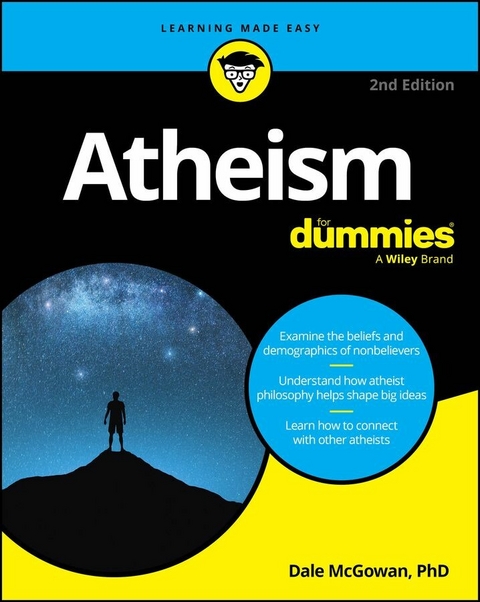
Atheism For Dummies (eBook)
503 Seiten
For Dummies (Verlag)
978-1-394-35020-9 (ISBN)
An unintimidating guide to Atheism and secular philosophy
Atheism For Dummies, 2nd Edition takes an unbiased look into the philosophical worldview of the lack of belief in gods. This approachable book showcases how atheism is a spectrum, from showing the secular values and lifestyles that resonate with many atheists to also showing how atheism can connect to other philosophical views such agnosticism, secular humanism, and more. Learn about the deep history of atheism, how atheism appears in popular culture, and how atheist philosophy and perspective can apply to topics like artificial intelligence and the climate crisis.
- Explore what atheism is and isn't
- Examine the beliefs of nonbelievers
- Discover atheist perspective on important philosophical questions
- Find out how the internet has shaped atheism and secular communities
If you're looking for a stronger understanding of religious nonbelief, Atheism For Dummies, 2nd Edition is the accessible guide for you.
Dale McGowan, PhD, is the author of Parenting Beyond Belief and Raising Freethinkers and producer of podcasts on nonreligious parenting, mortality, wonder, and the human story. His work has appeared in The Huffington Post and The Washington Post, and he co-founded the secular media company OnlySky.
An unintimidating guide to Atheism and secular philosophy Atheism For Dummies, 2nd Edition takes an unbiased look into the philosophical worldview of the lack of belief in gods. This approachable book showcases how atheism is a spectrum, from showing the secular values and lifestyles that resonate with many atheists to also showing how atheism can connect to other philosophical views such agnosticism, secular humanism, and more. Learn about the deep history of atheism, how atheism appears in popular culture, and how atheist philosophy and perspective can apply to topics like artificial intelligence and the climate crisis. Explore what atheism is and isn't Examine the beliefs of nonbelievers Discover atheist perspective on important philosophical questions Find out how the internet has shaped atheism and secular communities If you're looking for a stronger understanding of religious nonbelief, Atheism For Dummies, 2nd Edition is the accessible guide for you.
Introduction
In 2012, when I mentioned that I was working on the first edition of Atheism For Dummies, a friend replied that it’d be the skinniest book on the shelf. “Just one sentence long,” he said. “‘Atheists are people who don’t believe in God.’”
I replied by suggesting a one-sentence book on the Grand Canyon: “The Grand Canyon is a big hole in Arizona.” Of course, that sentence would miss most of what’s really worth knowing about the Grand Canyon — its geology and geography, how it came to be, its wildlife and formations, and its significance among other formations on the planet.
Likewise, a book on atheism that stops at the definition of the word would miss what’s really interesting about the startling idea that (despite what your mother and your hunches may tell you) God doesn’t actually exist. It’d be just as incomplete as saying, “Religious people believe in God,” and leaving it at that. There’s a bit more to say.
One year and 384 pages later, the first edition of Atheism For Dummies was on the shelf. It covered the long, rich history of religious disbelief; the great figures; the important works; arguments for and against its conclusions; the way it plays out in fiction, comedy, and debate and in film and on television; the way it fits into different cultures; and most importantly, how average people around the world live it every day.
In 2024, I mentioned online that I was beginning work on the second edition of Atheism For Dummies. “Is there more than one sentence on one page in that book?” commented a friend. “Because that would seem to cover it.”
Sigh.
In addition to most of the topics described in the original, this second edition tells the extraordinary story of what has happened in the 12 years since: an explosion in the numbers of the nonreligious, their greater influence in society and politics, new media bursting on the scene as others have plummeted, the rise of the most secular generation ever (with a very different approach to all this), and new ways of thinking about the future of the human species without the lens of supernatural ideas.
I’ve also changed since the first edition. Still an atheist, thank God, but like anyone who’s fascinated by a subject, I’ve kept learning and experiencing new things about religion and irreligion. I’ve always been a pretty relaxed and co-existent guy, but I’ve come to an even better understanding of the needs that religion satisfies in recent years, even if I don’t have those needs myself — and I know that a little twist of fate would’ve put me in a religious person’s shoes and them in mine. I hope that comes through as you read.
People who’ve entertained the possibility that gods don’t exist, and sometimes even said it out loud, make up a seldom-explored thread of human history that intersects with the biggest questions in human life:
- How did everything get here?
- What’s the meaning and purpose of life?
- How can you (and more importantly, that person over there) be good and moral?
- What happens when you die?
- Seriously, is somebody steering this thing?
The idea that an unseen power created and runs the universe is surely as old as the human mind. From the first time one Homo habilis saw their neighbor fall down and never get up again, the curious human neocortex would’ve demanded an explanation. Lacking any good way of figuring out what happened, that same neocortex would’ve provided an answer that seemed true.
But every guess in human history that seemed right has almost certainly been doubted by somebody in the room. When the guess is “God,” and the doubt rises to the level of strong conviction, you have yourself an atheist.
People are conditioned to flinch at certain words. When I grew up in the 1970s, communism was a flinch word. Before I could actually learn anything about it, I’d heard it hissed so many times that I couldn’t think about it at all. All I could do was flinch.
The same is true of atheism. It’s much less flinch-worthy than you may think. One purpose of this book is to bring that flinch all the way down to a shrug.
About This Book
This is a book about atheism written by an atheist. I’m also an agnostic and a humanist, which makes more sense when you finish Chapter 2. If you finish Chapter 2, I should say, because this whole book is written for dipping and diving. Skip Chapter 2 completely if you want, or any other chapters. Heck, skip them all, and the rest of us can talk about you.
Atheism For Dummies, 2nd Edition, isn’t the first book about atheism written by an atheist, but it’s different from most. Like all the books in the For Dummies series, it’s designed for people who want to know more about the topic. It does include some of the reasons atheists are atheists, but it’s not written to convince you to become one. If that’s what you’re after, other books may serve you better. And though it includes some of the complaints atheists have about religion — hey, that’s part of the picture — it’s not a broadside against religious belief, either. In fact, I spend a good deal of ink talking about the good things religion has to offer and the things believers and nonbelievers have in common. Chapters 15, 19, and 20 have a lot of that sort of thing — one of the likely surprises for readers of Atheism For Dummies.
Although many atheists spend a lot of time (and rightly so) fighting against the bad things done in the name of religion, just as many atheists are interested in co-existing with religion and religious people. And sometimes the same person goes back and forth, depending on the issue or where they are in their own development. If the idea of atheism freaks you out a bit, my hope is that this book can help you relax. Atheists are mostly perfectly normal folks, and everyone will be better off if they’re less fearful of each other.
On a personal note: You see a lot of personal notes in this book. It’s one of the differences between Atheism For Dummies and, say, Catholicism For Dummies. Atheism has no Vatican, no catechism, no scripture, so I can’t point to a central, defining authority to tell you who atheists are or what they believe. I rely on surveys, on the reports of organizations, on research, on histories, on anecdotal evidence from the thousands of atheists and humanists I’ve met during my years in the freethought movement, and on my own personal experience as an atheist and humanist.
The lack of an atheist Vatican is a good thing, in my humble opinion. Just as not all Catholics believe what the Vatican defines as “Catholic belief,” so would any central atheist authority instantly fail to represent the true diversity of opinions among those who claim one of the many labels under that great big umbrella. If three Mormons wrote three versions of Mormonism For Dummies, the books may be pretty similar, drawing as they are on a shared set of doctrines, official beliefs, and church history. But three different atheists are certain to write three wildly different versions of this book.
As you flip through, rather than a single grand procession through history, you can see religious disbelief as it really is: a collection of millions of individual voices; millions of separate stories; and millions of individual human beings asking questions, questioning answers, and finally arriving at the conclusion that God, for better and worse, is all in our heads.
Though a lot of nonbelievers capitalize atheist and humanist, many others don’t. I’m with the lower-casers: I prefer to underline our humble origins and our tiny place in the scheme of things by keeping the capitals to a minimum. The capital also feels too much like a religious designation to me. I do follow the convention of capitalizing the names of religions, and I capitalize God when used as a proper name (“they believe in God”), just like I capitalize Steve (“they believe in Steve”). But when it’s a generic god or gods (“they worship a big blue god”), no cap. I plan to be pretty inconsistent on this one to give my editors a tic.
Finally, no one should expect a complete reckoning of the world of atheism. It’s not possible or desirable — or the purpose of this book. Instead, I try to stick to the things that are most interesting and relevant to the past and present of atheism, and then give you tips for finding out more if you want to.
Foolish Assumptions
From the start, I assume a certain ideal reader. Here are the assumptions that I make about you:
- You’re probably not an atheist yourself and don’t know much about the subject, but you’re curious and want to find out more.
- If you do identify as atheist, agnostic, or secular humanist, you can still come away from this book knowing and appreciating more about the history and underpinnings of this worldview. If you can stand being relegated to the nosebleed seats for this performance, I promise to occasionally aim the KissCam at you or lob a T-shirt your way.
- You’re not actually a dummy. In fact, one of the best assumptions...
| Erscheint lt. Verlag | 11.9.2025 |
|---|---|
| Sprache | englisch |
| Themenwelt | Geisteswissenschaften ► Philosophie |
| Schlagworte | accommodationist • agnostic atheist • agnosticism • Agnostics • Antitheism • Atheism • atheism book • atheism philosophy • Atheist • atheist books • Atheist philosophy • Comparative Religion • Existentialism • freethinkers • Humanism • Metaphysics • Nihilism • nonbeliever • religious skeptic • Religious Studies • secular humanism • secular philosophy • what is atheism |
| ISBN-10 | 1-394-35020-1 / 1394350201 |
| ISBN-13 | 978-1-394-35020-9 / 9781394350209 |
| Informationen gemäß Produktsicherheitsverordnung (GPSR) | |
| Haben Sie eine Frage zum Produkt? |
 EPUB (Adobe DRM)
Kopierschutz: Adobe-DRM
Adobe-DRM ist ein Kopierschutz, der das eBook vor Mißbrauch schützen soll. Dabei wird das eBook bereits beim Download auf Ihre persönliche Adobe-ID autorisiert. Lesen können Sie das eBook dann nur auf den Geräten, welche ebenfalls auf Ihre Adobe-ID registriert sind.
Details zum Adobe-DRM
Dateiformat: EPUB (Electronic Publication)
EPUB ist ein offener Standard für eBooks und eignet sich besonders zur Darstellung von Belletristik und Sachbüchern. Der Fließtext wird dynamisch an die Display- und Schriftgröße angepasst. Auch für mobile Lesegeräte ist EPUB daher gut geeignet.
Systemvoraussetzungen:
PC/Mac: Mit einem PC oder Mac können Sie dieses eBook lesen. Sie benötigen eine
eReader: Dieses eBook kann mit (fast) allen eBook-Readern gelesen werden. Mit dem amazon-Kindle ist es aber nicht kompatibel.
Smartphone/Tablet: Egal ob Apple oder Android, dieses eBook können Sie lesen. Sie benötigen eine
Geräteliste und zusätzliche Hinweise
Buying eBooks from abroad
For tax law reasons we can sell eBooks just within Germany and Switzerland. Regrettably we cannot fulfill eBook-orders from other countries.
aus dem Bereich