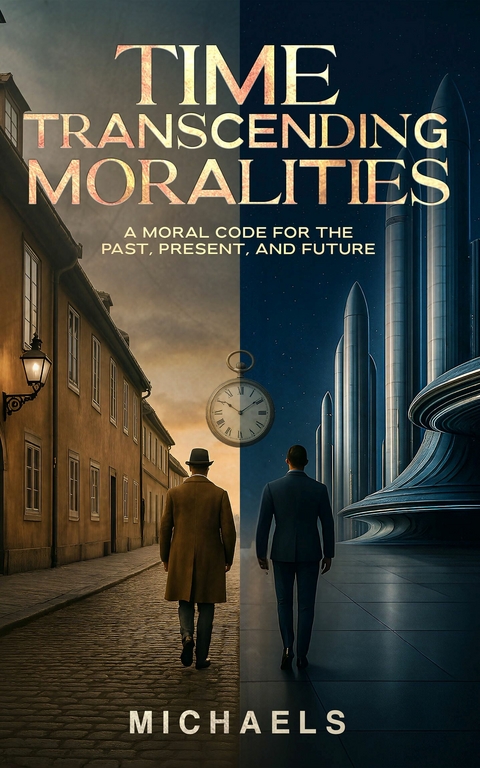
Time Transcending Moralities (eBook)
112 Seiten
Bookbaby (Verlag)
979-8-3178-1316-1 (ISBN)
Michaels is a systems thinker at heart; a mind shaped by both the circuitry of technology and the complexities of human behavior. Holding a degree in Applied Science in Information Technology, he has spent years navigating technical infrastructures. Yet, it is his curiosity about the human condition, not just human code, that fuels his deepest work. Michaels' worldview was not shaped solely by books, but by border crossings, language gaps, and eye-level conversations with people from dramatically different walks of life. These global experiences became the crucible for the reflections found in Time Transcending Moralities: A Moral Code for the Past, Present, and Future, a manuscript that began as a private journal and slowly evolved into a public inquiry: How do our moral systems hold up when stretched across time, culture, and consequence? His writing challenges readers to look backward with honesty, inward with courage, and forward with responsibility. Equal parts philosophical and practical, his work interrogates the assumptions we carry, the leaders we follow, and the legacy we leave behind.
Inside, you'll be guided through the challenges of moral judgment, including: Defending vs. Excusing: Understand the difference between protecting people, defending bad actions, and how misplaced loyalty can perpetuate harm Assessing Character: Learn the moral equation, a method for evaluating integrity and trustworthiness over time Leadership and Conscience: Explore the responsibilities of influence, the courage to step aside, and the ethical obligations of those in power Recognizing Corruption: Identify subtle forms of compromise, dehumanization, and moral inversion in society and self Wealth, Power, and Extremism: Examine how privilege, ideology, and social norms distort empathy, justice, and human judgmentThrough structured reflection, self-assessment exercises, and real-world case studies, this book challenges readers to act ethically even when it is uncomfortable, unpopular, or inconvenient. It is a call to cultivate moral foresight: to examine the patterns of our actions, not just isolated deeds; to question social comfort and inherited beliefs; and to place conscience above convenience. However, this is not a guidebook, a rulebook, or a sermon. It is a mirror. A challenge. When your values collide with loyalty, fear, or attachment, which will you defend? The one that feels safe, or the one that is right?Time-Transcending Moralities is a challenge to think beyond our moment, to live responsibly, and to become the kind of humans worthy of the future we are creating.
Laws? Ethics? . . . or Morals?
What guides your decisions? When you’re faced with a moral dilemma, do you look to the law, to ethical codes, or to your own moral sense of right and wrong?
The answer to this question might define your character more than any belief or affiliation ever could. Because while these three systems—laws, ethics, and morals—often overlap, they are not the same. And when they conflict, it reveals not just who we are as individuals, but what kind of society we are trying to build.
II. 1 Laws: The Will of Power
Laws are the rules a society enforces—written by institutions and backed by authority. They are designed to regulate behavior, maintain order, and protect the social contract. But laws are not infallible. They are shaped by those in power and influenced by money, politics, and fear. What is legal today may be condemned tomorrow.
Consider Prohibition in the United States. From 1920 to 1933, the production and sale of alcohol were outlawed. What began as a moral crusade quickly unraveled into a national contradiction. Lives were disrupted, livelihoods destroyed, and violence surged as black markets flourished to meet continued demand. After thirteen years, the Eighteenth Amendment was repealed. But the reversal of law did not reverse the damage—those incarcerated remained scarred, families remained broken, and the lives lost to Prohibition-era violence were not returned.
We see echoes of this today. Once-criminalized behaviors like gambling and marijuana use are now becoming legal in state after state. But the people who served prison time for those very actions—often disproportionately from marginalized communities—are still carrying the weight of their sentences. Legal forgiveness does not come with moral accountability. The law may change, but the human cost often does not.
This reality underscores a painful truth: Laws are not just words on paper—they are instruments of power that leave a permanent impact on people’s lives. And when laws are unjust or hastily reversed, they reveal how fragile and arbitrary the legal system can be—and how slow it is to acknowledge the harm it has caused.
Laws are reactive, not prophetic. They evolve with the times, often lagging behind social conscience and human need. Slavery was once legal. So was child labor. So was denying women the right to vote. Legality, then, is not a reliable measure of morality. It is a reflection of the values of those who hold the pen.
II. 2 Ethics: The Code of Collectives
Ethics are the unspoken (and sometimes written) contracts that govern how individuals should behave within specific fields, professions, or cultures. Unlike laws, ethics are not enforced by governments through penalties or incarceration, but by the weight of reputation, peer accountability, and institutional trust. They guide conduct within particular contexts, shaping what is considered “acceptable” rather than strictly “legal.”
Yet ethics are not universally fixed—they evolve with time, culture, and influence. What is ethical in one era or region may be condemned in another. This is because ethics often reflect not just morality, but also power structures, traditions, and collective comfort zones.
Medical ethics, for example, are built around the Hippocratic Oath and core principles like autonomy (respecting a patient’s right to choose), beneficence (doing good), non-maleficence (avoiding harm), and justice (ensuring fairness in care). These principles aim to place the well-being of the patient above all else. But even in medicine, ethical dilemmas persist. Should doctors breach confidentiality to report illegal behavior? Can life support be ethically withdrawn?
Legal ethics, similarly, are governed by principles like client confidentiality, avoiding conflicts of interest, upholding justice, and maintaining integrity. Lawyers are expected to represent clients zealously—even if those clients are unpopular or guilty. But the moral complexity deepens when lawyers are asked to defend actions that, while legal, may seem morally reprehensible. Legal ethics often draw a line between personal morality and professional duty.
These examples show how ethics strive to institutionalize morality, but they can also become outdated or misaligned with societal progress. Consider Reggie Bush, the college football star stripped of his Heisman Trophy for accepting money for his name and likeness, a violation of NCAA ethics at the time. Today, that same behavior is not only legal, it’s celebrated. Yet the stain on Bush’s legacy remains. This inconsistency shows how ethical codes can lag behind cultural evolution, punishing what society now views as just.
Workplace ethics, too, can be deeply flawed. In some countries, ethics prohibit men and women from working in the same spaces—not because it’s immoral, but because tradition deems it inappropriate. These ethical “standards” often serve to mask inequality and enforce systemic bias.
At their best, ethics codify fairness and integrity. At their worst, they shield prejudice under the guise of professionalism. Ethics must be questioned with the same intensity as laws: Who created them? Who benefits? And do they still serve humanity’s evolving sense of right and wrong?
II. 3 Morals: The Internal Compass
Morals are deeply personal, acting as a silent compass guiding our actions when no one is watching. Unlike laws, which are written and enforced, or ethics, which are agreed upon within professions or cultures, morals originate from within. They are shaped by upbringing, personal reflection, and emotional experience—and often live outside the bounds of any rulebook.
At their core, morals are internal convictions about what is right and wrong. They cannot be truly taught, only inspired. A person may be raised in a culture that justifies cruelty or discrimination, yet still feel, instinctively, that something is wrong. That resistance, that refusal to align with what is “normal” or “accepted,” is a moral signal.
Unlike laws or ethics, which shift with time, political power, or societal norms, morals are uniquely resilient. They persist even in silence and often cost something to uphold. That is their power and their burden.
But morals also have a sacred quality. They should remain private and untouchable, like a spiritual trust between the self and truth. No one who claims to love or value you—not a family member, not a friend, not a leader—should ever ask you to compromise your morals. Love should not demand obedience to injustice. Loyalty should not require you to mute your conscience.
Morals should be the forefront of every social injustice, political event, or breaking news incident. They are the lens through which all external chaos must be filtered. Whenever a headline strikes outrage or confusion, the first internal question must be: What is the moral issue here? What is the cost to human dignity, to truth, to justice? These moments are not just events to react to—they are moral tests for individuals and for society as a whole.
Whether it’s the abuse of power, inequality, systemic discrimination, or violence, the conversation must always come back to morality—either with others or within ourselves. Because if we remove morality from the equation, all that remains is emotion, politics, and tribalism. Morals keep us grounded. They demand consistency even when the world is chaotic.
This is why moral compromise is so dangerous: When you betray your moral compass to please someone else, you not only weaken your identity, but also risk permanently damaging your integrity. A compromised moral can easily become a silent pattern, growing more comfortable with each act of dismissal, until you wake up a stranger to your own values.
True morality requires solitude, honesty, and sometimes rebellion. It’s the quiet act of choosing what’s right over what’s convenient, even when it means losing something, whether status, relationships, or comfort.
A moral code doesn’t need to be publicly declared to be valid. In fact, the strongest moral convictions often live quietly, tested in private decisions: how you treat someone who can’t help you, how you speak about others when they’re not around, how you act when no reward is guaranteed.
In a world where performance is praised and visibility is currency, morality often becomes performative, like a curated persona. But real morals aren’t a showcase. They are what remain when the lights go out.
II. 4 When Systems Collide
What happens when the law tells you one thing, your profession tells you another, and your morality whispers something else entirely?
This is the crux of our modern dilemma—a collision between external authority and internal truth. Laws, ethics, and morals were each designed to guide human behavior, but they don’t always move in harmony. In fact, some of the most defining moments in history—and in personal lives—have emerged from the tension between these competing systems.
Consider a medical professional who is bound by the Hippocratic Oath—to do no harm—yet is legally...
| Erscheint lt. Verlag | 5.9.2025 |
|---|---|
| Sprache | englisch |
| Themenwelt | Geisteswissenschaften ► Philosophie ► Ethik |
| ISBN-13 | 979-8-3178-1316-1 / 9798317813161 |
| Informationen gemäß Produktsicherheitsverordnung (GPSR) | |
| Haben Sie eine Frage zum Produkt? |
 EPUB (Ohne DRM)
Größe: 825 KB
Digital Rights Management: ohne DRM
Dieses eBook enthält kein DRM oder Kopierschutz. Eine Weitergabe an Dritte ist jedoch rechtlich nicht zulässig, weil Sie beim Kauf nur die Rechte an der persönlichen Nutzung erwerben.
Dateiformat: EPUB (Electronic Publication)
EPUB ist ein offener Standard für eBooks und eignet sich besonders zur Darstellung von Belletristik und Sachbüchern. Der Fließtext wird dynamisch an die Display- und Schriftgröße angepasst. Auch für mobile Lesegeräte ist EPUB daher gut geeignet.
Systemvoraussetzungen:
PC/Mac: Mit einem PC oder Mac können Sie dieses eBook lesen. Sie benötigen dafür die kostenlose Software Adobe Digital Editions.
eReader: Dieses eBook kann mit (fast) allen eBook-Readern gelesen werden. Mit dem amazon-Kindle ist es aber nicht kompatibel.
Smartphone/Tablet: Egal ob Apple oder Android, dieses eBook können Sie lesen. Sie benötigen dafür eine kostenlose App.
Geräteliste und zusätzliche Hinweise
Buying eBooks from abroad
For tax law reasons we can sell eBooks just within Germany and Switzerland. Regrettably we cannot fulfill eBook-orders from other countries.
aus dem Bereich