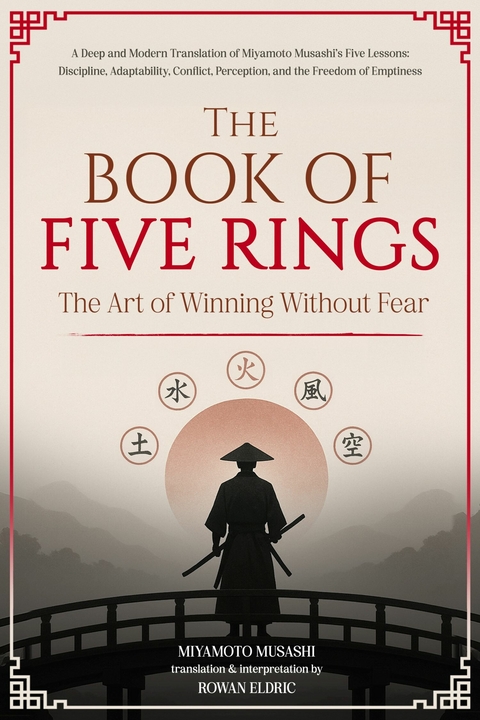
The Book of Five Rings (eBook)
118 Seiten
Publishdrive (Verlag)
978-0-00-104367-1 (ISBN)
⭐ What if you could turn confusion into clarity, chaos into calm, and fear into strength? The Book of Five Rings is more than ancient wisdom - it's a practical guide to face today's struggles with balance and inner power. ⭐
Do you ever feel overwhelmed by thoughts, obligations, and decisions that drain your energy?
Have you ever noticed yourself reacting out of anger or fear, only to regret it later?
Or wasting time on things that don't matter, while forgetting what truly does?
This book is not a historical treatise, nor a tale of swords. It is a timeless manual that teaches you how to regain clarity when you feel confused, calm when chaos takes over, and courage when fear holds you back.
'The Book of Five Rings', written by Miyamoto Musashi four centuries ago and here presented in a modern translation and interpretation curated by Rowan Eldric, still guides millions of people today. It speaks not only to warriors, but to anyone who faces invisible battles every day: anxiety, stress, difficult relationships, and uncertainty about the future. Its pages don't offer magical formulas - they show you how to move through life with greater clarity, balance, and inner strength.
Inside you will discover:
Musashi and His Legacy
Throughout history, few figures have captured as much reverence and intrigue as Miyamoto Musashi, the legendary samurai. Born in 1584, during a Japan torn apart by civil war and shifting political powers, his childhood was marked by loss and instability. Orphaned at a young age, he grew up in a society where the sword was not merely a weapon, but the very essence of survival and identity.
At only thirteen, Musashi stepped into his first duel, defeating a seasoned warrior in combat. This moment signaled the beginning of a career unmatched in the chronicles of the samurai, with more than sixty duels fought and not a single defeat to his name. Yet his greatness did not rest solely on his martial victories. He was a strategist who analyzed every encounter with precision, a philosopher who questioned the foundations of existence, and an artist whose brush strokes revealed as much discipline as his sword strikes. His entire life became a ceaseless pursuit of mastery—not only mastery of the blade, but of the self.
His legacy lives most vividly through The Book of Five Rings, written during the closing years of his life. This work goes beyond the mechanics of swordplay to explore universal principles of combat, perception, and personal transformation. It was not meant to glorify violence, but to transmit the lessons he had wrested from decades of conflict—a gift intended for generations far beyond his own time.
Although rooted in the turbulence of feudal Japan, his words transcend the confines of his age. They reveal truths about decision-making, resilience, and human nature that remain as relevant now as they were in the seventeenth century. His teachings were designed not only for warriors on the battlefield, but for anyone confronting obstacles, pursuing ambitions, or seeking personal growth.
Musashi’s life testifies to the power of discipline, clarity, and continuous learning. He embodied the paradox of mastery: a man unrivaled in skill, yet forever a student. He recognized that mastery is never a fixed destination but a path of constant refinement, demanding humility, patience, and self-awareness.
What makes his wisdom endure is its universality. He reminds us that victory—whether in combat, business, or personal struggle—depends less on raw talent and more on mindset, perspective, and strategy. His words urge us to see beneath appearances, to challenge our assumptions, and to sharpen our awareness until we perceive things as they truly are.
In the Book of Water, Musashi wrote: “The spirit of the thing is what is important. You must understand this.” With this insight, he emphasized adaptability. He knew the world is in perpetual motion, that circumstances shift suddenly and unpredictably. The wise warrior, therefore, does not cling rigidly to one way but flows like water, adjusting form and movement to seize advantage in any condition.
In the Book of Fire, he taught the value of decisive action—understanding timing, sensing momentum, and striking with initiative. These principles echo powerfully in our own era, where opportunities appear and vanish quickly, and success often belongs to those willing to act with clarity and boldness.
Musashi’s wisdom is not a relic of the past but a living philosophy, still guiding those navigating the challenges of the modern age. His writings challenge us to pursue excellence relentlessly, to discipline our minds, and to see life as a field of strategy where foresight and resilience determine the outcome. He shows us that success unfolds not as a straight path, but as a winding journey filled with hardship, discovery, and the chance to rise stronger from adversity.
In the chapters ahead, we will step further into the heart of Musashi’s teaching. We will follow the Five Rings—Earth, Water, Fire, Wind, and Emptiness—each representing a dimension of life and a principle of mastery. In doing so, we will find that his legacy is not only about the art of combat, but about the art of living with strength, clarity, and fearlessness.
Why the Five Rings Still Matter
The Five Rings, as conceived by Musashi, are far more than metaphors. They are living philosophies, each representing a vital dimension of existence and strategy. Earth signifies stability and discipline, forming the ground on which everything else stands. Water embodies adaptability, flowing easily to match any situation. Fire represents courage and decisive action, the energy that sparks movement at the right time. Wind stands for discernment, the clear vision that pierces illusion. Emptiness—sometimes called the Void—points to the state beyond fear and doubt, where clarity and freedom prevail.
In an age where life feels like an endless contest against uncertainty, these teachings remain profoundly relevant. They serve as a compass in the chaos of modern living, guiding us through professional challenges, personal struggles, and the unpredictability of our time. Each Ring speaks not only to warriors but to all who seek resilience, mastery, and balance.
The Book of Earth, the first Ring, stresses the necessity of strong foundations. In a culture obsessed with speed and constant motion, stability is often overlooked. Progress without grounding becomes fragile and unsustainable. His teaching urges us to develop discipline, to establish routine, and to embrace deliberate practice. In today’s world, this might mean nurturing healthy habits, committing to ongoing learning, or dedicating consistent effort to mastering our craft before facing greater trials.
The Book of Water, the second Ring, centers on adaptability and resilience. Change has become a constant force, shaping lives with sudden shifts in careers, economies, or personal circumstances. His insight reminds us to be like water—fluid, unyielding to rigidity, able to take any form required. Within such flexibility lies not just survival but the power to transform adversity into advantage.
The Book of Fire, the third Ring, reveals the importance of energy, courage, and timing. He understood that strategy without execution is empty, and that hesitation can be more dangerous than action. In our own lives, Fire teaches us to recognize the right moment—to seize opportunities, to face difficult truths, or to pause deliberately when action would cause harm. Timing transforms courage into precision, ensuring that decisions strike with impact rather than recklessness.
The Book of Wind, the fourth Ring, is devoted to discernment. False masters and shallow distractions existed in his era just as they do today. In a world overwhelmed by information, the ability to separate truth from noise is essential. His wisdom warns against chasing every trend or imitating empty appearances. Instead, we are called to refine judgment, to stay anchored in our own path, and to act from clarity rather than confusion.
The Book of Emptiness, the final Ring, guides us toward freedom from illusion and fear. Emptiness is not absence but a space of pure perception where anxiety and self-deception fall away. In a culture marked by stress and constant pressure, this teaching offers profound healing. It opens the possibility of detachment from what clouds the mind, creating space for calm, balance, and unshakable clarity.
The Five Rings, then, are not relics of the past but enduring principles for living. They were never confined to combat; they are strategies for the art of existence itself. His genius lay in transforming the chaos of war into insights that transcend centuries, guiding the human spirit through struggle and transformation.
As the world grows increasingly complex, these lessons remain a beacon. They show us that success depends not only on knowledge or ability but on perspective, mindset, and disciplined focus. They encourage us to face life’s storms with strength, to adapt fluidly, and to act decisively with wisdom and courage.
At their essence, the Five Rings matter because they illuminate what it means to live with fullness, to pursue mastery, and to embrace life without fear.
They offer a roadmap to resilience, clarity, and self-realization, proving that his legacy endures—not just for warriors of the past, but for every seeker striving for meaning and excellence today.
How to Apply Samurai Wisdom Today
In our modern world, the wisdom of the samurai may seem distant, even irrelevant. Yet, the principles that guided Musashi's life and strategy are as applicable today as they were in the tumultuous times of feudal Japan. They provide a framework for navigating the complexities and uncertainties of our contemporary lives, offering insights and strategies that can be applied in a variety of contexts.
Consider the realm of business. The corporate world is a battlefield of its own, marked by competition, innovation, and constant change. Here, the teachings of the Five Rings can serve as a strategic guide. The Book of Earth, with its emphasis on building solid foundations, reminds us of the importance of establishing a strong company culture, clear objectives, and robust systems. The Book of Water, with its lessons on adaptability, encourages businesses to be flexible and responsive to market changes. The Book of Fire, with its focus on decisive action, underscores the importance of timing in business decisions. The Book of Wind, advocating discernment, urges businesses to stay true to their core values and not...
| Erscheint lt. Verlag | 2.9.2025 |
|---|---|
| Übersetzer | Rowan Eldric |
| Sprache | englisch |
| Themenwelt | Geisteswissenschaften |
| ISBN-10 | 0-00-104367-6 / 0001043676 |
| ISBN-13 | 978-0-00-104367-1 / 9780001043671 |
| Informationen gemäß Produktsicherheitsverordnung (GPSR) | |
| Haben Sie eine Frage zum Produkt? |
 EPUB (Adobe DRM)
Größe: 3,0 MB
Kopierschutz: Adobe-DRM
Adobe-DRM ist ein Kopierschutz, der das eBook vor Mißbrauch schützen soll. Dabei wird das eBook bereits beim Download auf Ihre persönliche Adobe-ID autorisiert. Lesen können Sie das eBook dann nur auf den Geräten, welche ebenfalls auf Ihre Adobe-ID registriert sind.
Details zum Adobe-DRM
Dateiformat: EPUB (Electronic Publication)
EPUB ist ein offener Standard für eBooks und eignet sich besonders zur Darstellung von Belletristik und Sachbüchern. Der Fließtext wird dynamisch an die Display- und Schriftgröße angepasst. Auch für mobile Lesegeräte ist EPUB daher gut geeignet.
Systemvoraussetzungen:
PC/Mac: Mit einem PC oder Mac können Sie dieses eBook lesen. Sie benötigen eine
eReader: Dieses eBook kann mit (fast) allen eBook-Readern gelesen werden. Mit dem amazon-Kindle ist es aber nicht kompatibel.
Smartphone/Tablet: Egal ob Apple oder Android, dieses eBook können Sie lesen. Sie benötigen eine
Geräteliste und zusätzliche Hinweise
Buying eBooks from abroad
For tax law reasons we can sell eBooks just within Germany and Switzerland. Regrettably we cannot fulfill eBook-orders from other countries.
aus dem Bereich