


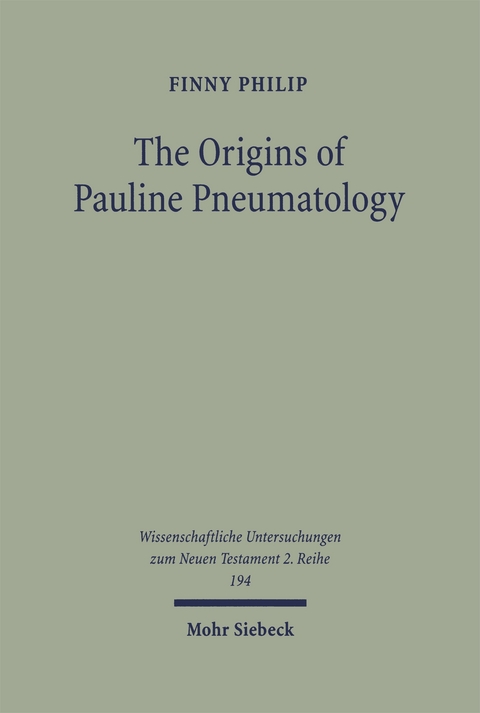
The Origins of Pauline Pneumatology
The Eschatological Bestowal of the Spirit upon Gentiles in Judaism and in the Early Development of Paul's Theology
2019
Mohr Siebeck (Hersteller)
978-3-16-157059-9 (ISBN)
Mohr Siebeck (Hersteller)
978-3-16-157059-9 (ISBN)
Finny Philip untersucht die Ursprünge der paulinischen Theologie des Geistes. Im Zentrum seiner Studie steht die Überzeugung des Apostels, daß er zur Bekehrung der Heiden berufen sei und daß Gott diesen Heiden seinen heiligen Geist auch ohne ein Befolgen der Thora verleiht. Paulus verdankt diese Überzeugung seinem eigenen Erweckungserlebnis und seinen Erfahrungen als Missionar in der hellenistischen Gemeinde Antiochia.
Finny Philip untersucht die Ursprünge der paulinischen Theologie des Geistes. Im Zentrum seiner Studie steht die Überzeugung des Apostels, daß er zur Bekehrung der Heiden berufen sei und daß Gott diesen Heiden seinen heiligen Geist auch ohne ein Befolgen der Thora verleiht. Paulus verdankt diese Überzeugung seinem eigenen Erweckungserlebnis und seinen Erfahrungen als Missionar in der hellenistischen Gemeinde Antiochia. Das Damaskuserlebnis war für Paulus eine Begegnung mit dem heiligen Geist, daß ihm den Glauben an eine neue Verbindung zu Gott gab, die nur durch den Geist ermöglicht wird. Auch der hellenistische Glaube an die Kirche als eschatologischen Tempel, in dem der Geist als Manifestation Gottes erfahrbar ist, hatte Einfluß auf die paulinische Theologie des Geistes. Finny Philip inquires into Paul's initial thoughts on the Holy Spirit. Paul's conviction that he was called to be an apostle to the Gentiles and that God bestowed the Spirit upon the Gentiles apart from Torah obedience is the basis for any inquiry on this subject. Central to Philip's argument is Paul's conviction that God graciously endowed his Gentile converts with the gift of the Spirit, an understanding that is rooted primarily in his conversion experience and secondarily in his experience with and as a missionary of the Hellenistic community in Antioch. In examining the range of expectations of the Spirit that were present in both Hebrew scripture and in the wider Jewish literature, the author comes to the conclusion that such a concept is rare, and that it is usually the covenant community to which the promise of the Spirit is given. Furthermore, Paul's own pre-Christian convictions about the Spirit, a result of his own self-perception as a Pharisee and persecutor of the church, display continuity between his thought patterns and those of Second Temple Judaism. Paul's Damascus experience was an experience of the Spirit. His experience of the "glory of God in the face of Jesus Christ" (2 Cor. 3:1-4:6) provided him with the belief that there was now a new relationship with God, which was possible through the sphere of the Spirit. In addition, Paul was influenced by the Hellenists, whose theological beliefs included the perception of the church as the eschatological temple in which the Spirit of God is the manifest presence of God. It is in these notions that one may trace the origins of Paul's thoughts on the Holy Spirit.
Finny Philip untersucht die Ursprünge der paulinischen Theologie des Geistes. Im Zentrum seiner Studie steht die Überzeugung des Apostels, daß er zur Bekehrung der Heiden berufen sei und daß Gott diesen Heiden seinen heiligen Geist auch ohne ein Befolgen der Thora verleiht. Paulus verdankt diese Überzeugung seinem eigenen Erweckungserlebnis und seinen Erfahrungen als Missionar in der hellenistischen Gemeinde Antiochia. Das Damaskuserlebnis war für Paulus eine Begegnung mit dem heiligen Geist, daß ihm den Glauben an eine neue Verbindung zu Gott gab, die nur durch den Geist ermöglicht wird. Auch der hellenistische Glaube an die Kirche als eschatologischen Tempel, in dem der Geist als Manifestation Gottes erfahrbar ist, hatte Einfluß auf die paulinische Theologie des Geistes. Finny Philip inquires into Paul's initial thoughts on the Holy Spirit. Paul's conviction that he was called to be an apostle to the Gentiles and that God bestowed the Spirit upon the Gentiles apart from Torah obedience is the basis for any inquiry on this subject. Central to Philip's argument is Paul's conviction that God graciously endowed his Gentile converts with the gift of the Spirit, an understanding that is rooted primarily in his conversion experience and secondarily in his experience with and as a missionary of the Hellenistic community in Antioch. In examining the range of expectations of the Spirit that were present in both Hebrew scripture and in the wider Jewish literature, the author comes to the conclusion that such a concept is rare, and that it is usually the covenant community to which the promise of the Spirit is given. Furthermore, Paul's own pre-Christian convictions about the Spirit, a result of his own self-perception as a Pharisee and persecutor of the church, display continuity between his thought patterns and those of Second Temple Judaism. Paul's Damascus experience was an experience of the Spirit. His experience of the "glory of God in the face of Jesus Christ" (2 Cor. 3:1-4:6) provided him with the belief that there was now a new relationship with God, which was possible through the sphere of the Spirit. In addition, Paul was influenced by the Hellenists, whose theological beliefs included the perception of the church as the eschatological temple in which the Spirit of God is the manifest presence of God. It is in these notions that one may trace the origins of Paul's thoughts on the Holy Spirit.
Born 1966; 1988 M.A. in English Literature University of Kerala; 1997 M.Th. in New Testament, Senate of Serampore University; 2003 Ph.D. in New Testament, University of Durham; currently working as the Academic Dean for Filadelfia Bible College, Udaipur, India and a visiting faculty to a Serampore affiliated college.
| Erscheint lt. Verlag | 10.12.2019 |
|---|---|
| Reihe/Serie | Wissenschaftliche Untersuchungen zum Neuen Testament 2. Reihe |
| Verlagsort | Tübingen |
| Sprache | englisch |
| Themenwelt | Religion / Theologie ► Christentum ► Bibelausgaben / Bibelkommentare |
| Geisteswissenschaften ► Religion / Theologie ► Judentum | |
| Schlagworte | Holy Spirit • Neues Testament • Paul's Theology |
| ISBN-10 | 3-16-157059-6 / 3161570596 |
| ISBN-13 | 978-3-16-157059-9 / 9783161570599 |
| Zustand | Neuware |
| Informationen gemäß Produktsicherheitsverordnung (GPSR) | |
| Haben Sie eine Frage zum Produkt? |
Mehr entdecken
aus dem Bereich

aus dem Bereich
Die Begründung von Lebensformen angesichts gesellschaftlicher …
Online Resource (2025)
Mohr Siebeck (Hersteller)
CHF 39,95


