


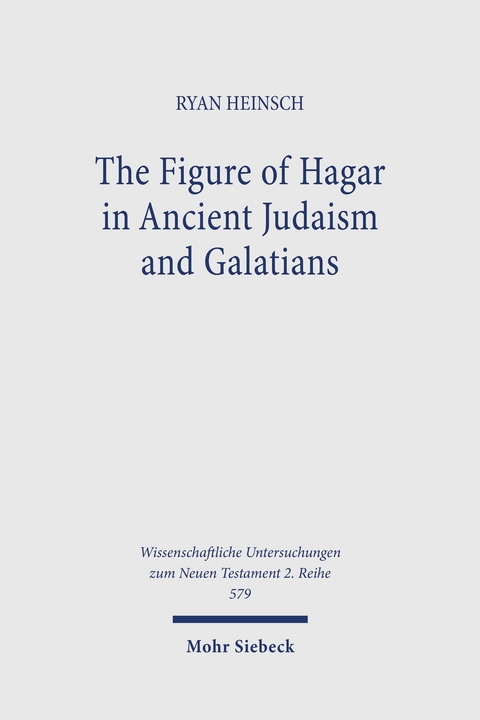
The Figure of Hagar in Ancient Judaism and Galatians
2022
Mohr Siebeck (Hersteller)
978-3-16-161855-0 (ISBN)
Mohr Siebeck (Hersteller)
978-3-16-161855-0 (ISBN)
Ryan Heinsch untersucht Paulus' Darstellung der Hagar in Gal 4,21-31 im Kontext des antiken Judentums.
Ryan Heinsch untersucht Paulus' Darstellung der Hagar in Gal 4,21-31 im Kontext des antiken Judentums. To date, scholarly study of the allegory of Hagar and Sarah in Galatians 4:21-31 has not paid adequate attention to the way Paul's use of the story - chiefly in relation to the figure of Hagar - can be located within streams of ancient Jewish tradition. In this study, Ryan Heinsch fills this scholarly gap by considering Paul's allegorical portrayal of the figure of Hagar in Galatians 4:21-31 within the context of ancient Judaism. The author argues that Paul stands in continuity with - rather than against - ancient Judaism in that he, like other Jews in antiquity, portrays Hagar and her descendants as non-Jews. As a result, the author demonstrates further that Galatians 4:21-31 is not to be read as a polemic against Jews, Jewish Christ-followers, or the continuing validity of the Jewish law (as is common among interpreters), but rather, that Galatians 4:21-31 is an allegory Paul develops about the experience of gentiles in general and the once pagan Galatian gentiles in particular.
Ryan Heinsch untersucht Paulus' Darstellung der Hagar in Gal 4,21-31 im Kontext des antiken Judentums. To date, scholarly study of the allegory of Hagar and Sarah in Galatians 4:21-31 has not paid adequate attention to the way Paul's use of the story - chiefly in relation to the figure of Hagar - can be located within streams of ancient Jewish tradition. In this study, Ryan Heinsch fills this scholarly gap by considering Paul's allegorical portrayal of the figure of Hagar in Galatians 4:21-31 within the context of ancient Judaism. The author argues that Paul stands in continuity with - rather than against - ancient Judaism in that he, like other Jews in antiquity, portrays Hagar and her descendants as non-Jews. As a result, the author demonstrates further that Galatians 4:21-31 is not to be read as a polemic against Jews, Jewish Christ-followers, or the continuing validity of the Jewish law (as is common among interpreters), but rather, that Galatians 4:21-31 is an allegory Paul develops about the experience of gentiles in general and the once pagan Galatian gentiles in particular.
Born 1985; 2008 BA, Moody Bible Institute; 2014 MDiv, Moody Theological Seminary, Michigan; 2019 PhD, University of Aberdeen; currently adjunct professor at Moody Theological Seminary, and Bible faculty at Southwest Christian High School (Chaska, MN).
| Erscheint lt. Verlag | 21.10.2022 |
|---|---|
| Reihe/Serie | Wissenschaftliche Untersuchungen zum Neuen Testament 2. Reihe |
| Verlagsort | Tübingen |
| Sprache | englisch |
| Themenwelt | Religion / Theologie ► Christentum ► Bibelausgaben / Bibelkommentare |
| Schlagworte | New Testament • Paul • Supersessionism |
| ISBN-10 | 3-16-161855-6 / 3161618556 |
| ISBN-13 | 978-3-16-161855-0 / 9783161618550 |
| Zustand | Neuware |
| Informationen gemäß Produktsicherheitsverordnung (GPSR) | |
| Haben Sie eine Frage zum Produkt? |
Mehr entdecken
aus dem Bereich

aus dem Bereich
Die Begründung von Lebensformen angesichts gesellschaftlicher …
Online Resource (2025)
Mohr Siebeck (Hersteller)
CHF 39,95


