


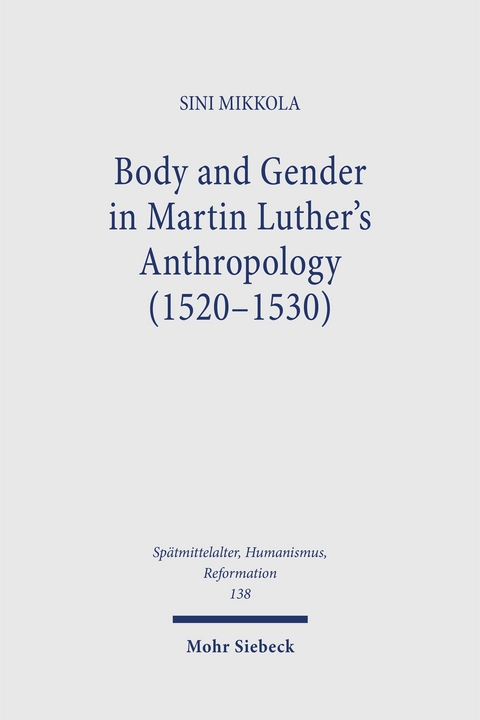
Body and Gender in Martin Luther's Anthropology (1520-1530)
2024
Mohr Siebeck (Hersteller)
978-3-16-163338-6 (ISBN)
Mohr Siebeck (Hersteller)
978-3-16-163338-6 (ISBN)
Sini Mikkola untersucht Martin Luthers Anthropologie während der 1520er Jahre aus der Perspektive von Leiblichkeit, genderspezifischer Daseinsform, Sexualität und Macht. Luthers Deutung von Weiblichkeit, Männlichkeit und dem Gendersystem werden in Anbetracht sowohl seiner theoretischen als auch seiner praktischen Sichtweisen erforscht.
Sini Mikkola untersucht Martin Luthers Anthropologie während der 1520er Jahre aus der Perspektive von Leiblichkeit, genderspezifischer Daseinsform, Sexualität und Macht. Luthers Deutung von Weiblichkeit, Männlichkeit und dem Gendersystem werden in Anbetracht sowohl seiner theoretischen als auch seiner praktischen Sichtweisen erforscht. Sini Mikkola examines Martin Luther's (1483-1546) view of the human being during a decade of ecclesiastical, social, and political turmoil, the 1520s, from the perspectives of bodiliness, gendered way of being, sexuality, and power. Luther's way to construct norms, ideals, and expectations vis-à-vis body, femininity, and masculinity are investigated in changing historical and different textual contexts, also via his self-narratives and interaction with contemporary women and men. The author demonstrates that Luther idealized and standardized the gender system, along with its hierarchies, in a very similar fashion throughout the 1520s. However, in addition to driving forward the gender system - based on his stance on the gendered body -, Luther's way to discuss and construct gender was also open to adaptations and developments.
Sini Mikkola untersucht Martin Luthers Anthropologie während der 1520er Jahre aus der Perspektive von Leiblichkeit, genderspezifischer Daseinsform, Sexualität und Macht. Luthers Deutung von Weiblichkeit, Männlichkeit und dem Gendersystem werden in Anbetracht sowohl seiner theoretischen als auch seiner praktischen Sichtweisen erforscht. Sini Mikkola examines Martin Luther's (1483-1546) view of the human being during a decade of ecclesiastical, social, and political turmoil, the 1520s, from the perspectives of bodiliness, gendered way of being, sexuality, and power. Luther's way to construct norms, ideals, and expectations vis-à-vis body, femininity, and masculinity are investigated in changing historical and different textual contexts, also via his self-narratives and interaction with contemporary women and men. The author demonstrates that Luther idealized and standardized the gender system, along with its hierarchies, in a very similar fashion throughout the 1520s. However, in addition to driving forward the gender system - based on his stance on the gendered body -, Luther's way to discuss and construct gender was also open to adaptations and developments.
Born 1982; University lecturer at the University of Eastern Finland; Associate Professor in church history at the University of Helsinki.
| Erscheint lt. Verlag | 23.5.2024 |
|---|---|
| Reihe/Serie | Spätmittelalter, Humanismus, Reformation / Studies in the Late Middle Ages, Humanism, and the Reformation |
| Verlagsort | Tübingen |
| Sprache | englisch |
| Themenwelt | Religion / Theologie ► Christentum ► Kirchengeschichte |
| Schlagworte | Femininity OR Womanhood • flesh • marriage • Masculinity OR Manhood • Sexuality |
| ISBN-10 | 3-16-163338-5 / 3161633385 |
| ISBN-13 | 978-3-16-163338-6 / 9783161633386 |
| Zustand | Neuware |
| Informationen gemäß Produktsicherheitsverordnung (GPSR) | |
| Haben Sie eine Frage zum Produkt? |


