


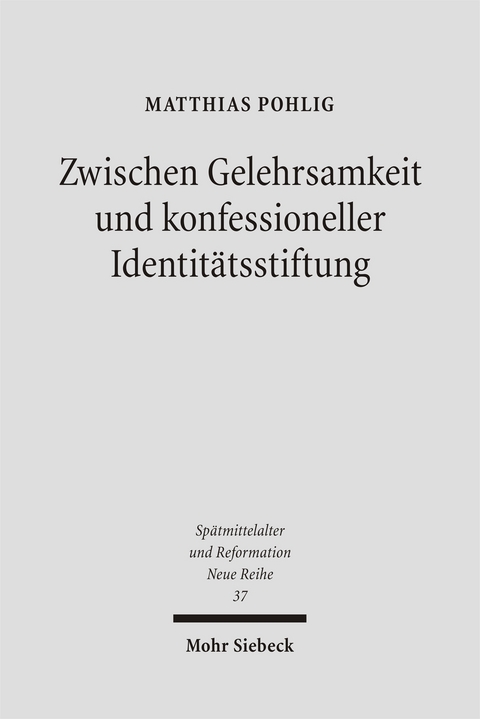
Zwischen Gelehrsamkeit und konfessioneller Identitätsstiftung
Lutherische Kirchen- und Universalgeschichtsschreibung 1546-1617
2020
Mohr Siebeck (Hersteller)
978-3-16-158574-6 (ISBN)
Mohr Siebeck (Hersteller)
978-3-16-158574-6 (ISBN)
Wie bestimmten Vertreter des frühen Luthertums den historischen Ort der Reformation? Wie hing die Geschichtsschreibung des Luthertums mit seiner "konfessionellen Identität" zusammen? Ausgehend von diesen Fragen untersucht Matthias Pohlig die lutherische Deutung der Geschichte zwischen 1546 und 1617.
How did advocates of early Lutheranism establish the historical location of the Reformation? What was the connection between the historiography of Lutheranism and its "denominational identity"? Matthias Pohlig studies the question of the patterns of argumentation of a Lutheran "memory" with the objective of constructing an identity and the question of the relationship between this memory and 16th century historiography and the theory of history. Lutheran historiography is based on basic assumptions, which are shared by many, regarding the significance of the Reformation for the history of salvation, the pontifical Antichrist, the esteem in which the German emperors were held as well as basic prophetic-biblical principles. The author shows how history has presented us with two types of Lutheran identity: the memory which is geared to the eschatological figure of Luther and the placing of the Reformation into a larger context.
How did advocates of early Lutheranism establish the historical location of the Reformation? What was the connection between the historiography of Lutheranism and its "denominational identity"? Matthias Pohlig studies the question of the patterns of argumentation of a Lutheran "memory" with the objective of constructing an identity and the question of the relationship between this memory and 16th century historiography and the theory of history. Lutheran historiography is based on basic assumptions, which are shared by many, regarding the significance of the Reformation for the history of salvation, the pontifical Antichrist, the esteem in which the German emperors were held as well as basic prophetic-biblical principles. The author shows how history has presented us with two types of Lutheran identity: the memory which is geared to the eschatological figure of Luther and the placing of the Reformation into a larger context.
Born 1973; Professor of Early Modern History at the Humboldt-Universität in Berlin.
| Erscheint lt. Verlag | 31.8.2020 |
|---|---|
| Reihe/Serie | Spätmittelalter, Humanismus, Reformation / Studies in the Late Middle Ages, Humanism, and the Reformation |
| Verlagsort | Tübingen |
| Sprache | deutsch |
| Themenwelt | Religion / Theologie ► Christentum ► Kirchengeschichte |
| Schlagworte | Geschichtsschreibung des Luthertu • Konfessionalisierung • Konfessionelle Klarheit |
| ISBN-10 | 3-16-158574-7 / 3161585747 |
| ISBN-13 | 978-3-16-158574-6 / 9783161585746 |
| Zustand | Neuware |
| Informationen gemäß Produktsicherheitsverordnung (GPSR) | |
| Haben Sie eine Frage zum Produkt? |


