


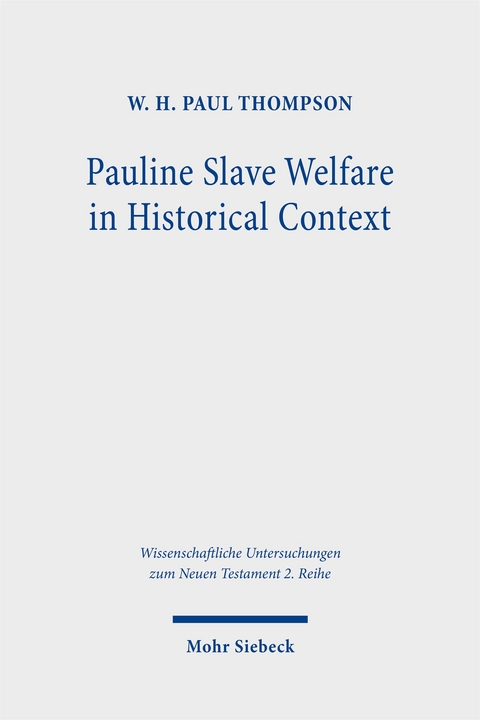
Pauline Slave Welfare in Historical Context
An Equality Analysis
2023
Mohr Siebeck (Hersteller)
978-3-16-161215-2 (ISBN)
Mohr Siebeck (Hersteller)
978-3-16-161215-2 (ISBN)
W.H. Paul Thompson befasst sich mit einer Gleichheitsanalyse der antiken Ethik zum Sklavenschutz - wie Sklaven im Verhältnis zu freien Personen behandelt werden sollten. Er rekonstruiert eine unverkennbare jüdische Ethik der Gleichbehandlung zwischen Sklaven und Freien, die Paulus in einen christozentrischen Rahmen umorientiert.
W.H. Paul Thompson befasst sich mit einer Gleichheitsanalyse der antiken Ethik zum Sklavenschutz - wie Sklaven im Verhältnis zu freien Personen behandelt werden sollten. Er rekonstruiert eine unverkennbare jüdische Ethik der Gleichbehandlung zwischen Sklaven und Freien, die Paulus in einen christozentrischen Rahmen umorientiert. W. H. Paul Thompson critiques modern scholarship on Pauline slavery for failing to define and reason consistently about equality. Instead, he engages in an equality analysis of Aristotle and Seneca in their Greco-Roman contexts, the Torah and its Jewish reception, and selected Pauline texts. Focusing on slave welfare − how slaves should be treated relative to free persons of the same historical context − rather than on abolitionism or reinforcement of slave submission, the author argues for a distinctive Jewish ethic of numerically equal treatment between slave and free that imitates Yahweh's impartiality. The Apostle reorients this ethic into a Christocentric framework to intensify both the quality of slave obedience and the degree of slave welfare required relative to the prevailing Roman ethos.
W.H. Paul Thompson befasst sich mit einer Gleichheitsanalyse der antiken Ethik zum Sklavenschutz - wie Sklaven im Verhältnis zu freien Personen behandelt werden sollten. Er rekonstruiert eine unverkennbare jüdische Ethik der Gleichbehandlung zwischen Sklaven und Freien, die Paulus in einen christozentrischen Rahmen umorientiert. W. H. Paul Thompson critiques modern scholarship on Pauline slavery for failing to define and reason consistently about equality. Instead, he engages in an equality analysis of Aristotle and Seneca in their Greco-Roman contexts, the Torah and its Jewish reception, and selected Pauline texts. Focusing on slave welfare − how slaves should be treated relative to free persons of the same historical context − rather than on abolitionism or reinforcement of slave submission, the author argues for a distinctive Jewish ethic of numerically equal treatment between slave and free that imitates Yahweh's impartiality. The Apostle reorients this ethic into a Christocentric framework to intensify both the quality of slave obedience and the degree of slave welfare required relative to the prevailing Roman ethos.
Born 1973; 2005 BA (Hons) from Middlesex University, through Oak Hill Theological College; 2014 MTh from University of Chester, through Wales Evangelical School of Theology; 2021 PhD from University of Chester, through Union School of Theology; Academic Dean and lecturer in New Testament and Theology for Equip Gospel Ministries in Malaysia, and adjunct lecturer for Seminari Theoloji Malaysia.
| Erscheint lt. Verlag | 20.3.2023 |
|---|---|
| Reihe/Serie | Wissenschaftliche Untersuchungen zum Neuen Testament 2. Reihe |
| Verlagsort | Tübingen |
| Sprache | englisch |
| Themenwelt | Religion / Theologie ► Christentum ► Bibelausgaben / Bibelkommentare |
| Schlagworte | Colossians 4:1 • Equality ethics • Galatians 3:28 • Haustafeln • Imitation ethics |
| ISBN-10 | 3-16-161215-9 / 3161612159 |
| ISBN-13 | 978-3-16-161215-2 / 9783161612152 |
| Zustand | Neuware |
| Informationen gemäß Produktsicherheitsverordnung (GPSR) | |
| Haben Sie eine Frage zum Produkt? |
Mehr entdecken
aus dem Bereich

aus dem Bereich
Die Begründung von Lebensformen angesichts gesellschaftlicher …
Online Resource (2025)
Mohr Siebeck (Hersteller)
CHF 39,95


