


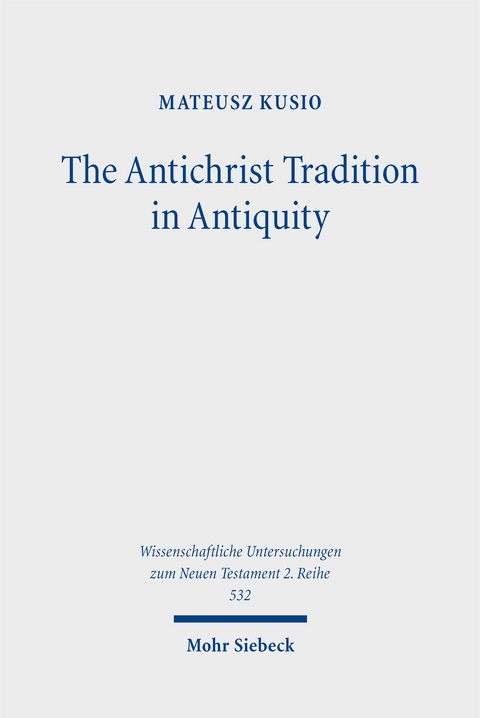
The Antichrist Tradition in Antiquity
Antimessianism in Second Temple and Early Christian Literature
2020
Mohr Siebeck (Hersteller)
978-3-16-159793-0 (ISBN)
Mohr Siebeck (Hersteller)
978-3-16-159793-0 (ISBN)
Gab es das Konzept der antiken Überlieferung, die den Antichristen umgibt, in ähnlicher Form auch bei Juden und Christen? Mateusz Kusio zeigt eine antimessianische Tradition auf, in der eine Vielzahl eschatologischer Antagonisten im Konflikt mit verschiedenen messianischen Akteuren zum Vorschein kommen. Diese Überlieferung erstreckt sich sowohl über jüdische als auch christliche Korpora und dreht sich um eine Reihe ähnlicher Motive, Ideen und biblischer Kerntexte.
Gab es das Konzept der antiken Überlieferung, die den Antichristen umgibt, in ähnlicher Form auch bei Juden und Christen? Mateusz Kusio zeigt eine antimessianische Tradition auf, in der eine Vielzahl eschatologischer Antagonisten im Konflikt mit verschiedenen messianischen Akteuren zum Vorschein kommen. Diese Überlieferung erstreckt sich sowohl über jüdische als auch christliche Korpora und dreht sich um eine Reihe ähnlicher Motive, Ideen und biblischer Kerntexte. Mateusz Kusio traces and investigates the references to the Antichrist across ancient Jewish and Christian literature. Beginning with a reception-historical study of a number of eschatological and oracular texts in the Hebrew Bible, he goes on to discuss texts from the Dead Sea Scrolls, the New Testament, biblical pseudepigrapha and Apocrypha, and Patristic writings. The study reveals an anti-messianic tradition involving a variety of eschatological antagonists in conflict with diverse messianic actors that stretches across both Jewish and Christian corpora and revolves around a set of similar motifs, ideas, and core Biblical texts.
Gab es das Konzept der antiken Überlieferung, die den Antichristen umgibt, in ähnlicher Form auch bei Juden und Christen? Mateusz Kusio zeigt eine antimessianische Tradition auf, in der eine Vielzahl eschatologischer Antagonisten im Konflikt mit verschiedenen messianischen Akteuren zum Vorschein kommen. Diese Überlieferung erstreckt sich sowohl über jüdische als auch christliche Korpora und dreht sich um eine Reihe ähnlicher Motive, Ideen und biblischer Kerntexte. Mateusz Kusio traces and investigates the references to the Antichrist across ancient Jewish and Christian literature. Beginning with a reception-historical study of a number of eschatological and oracular texts in the Hebrew Bible, he goes on to discuss texts from the Dead Sea Scrolls, the New Testament, biblical pseudepigrapha and Apocrypha, and Patristic writings. The study reveals an anti-messianic tradition involving a variety of eschatological antagonists in conflict with diverse messianic actors that stretches across both Jewish and Christian corpora and revolves around a set of similar motifs, ideas, and core Biblical texts.
Born 1993; 2015 BA Philosophy and Theology (Oxford); 2017 MPhil Theology (Oxford); 2019 DPhil Theology (Oxford); currently a postdoctoral research fellow at the Humboldt University in Berlin.
| Erscheint lt. Verlag | 12.11.2020 |
|---|---|
| Reihe/Serie | Wissenschaftliche Untersuchungen zum Neuen Testament 2. Reihe |
| Verlagsort | Tübingen |
| Sprache | englisch |
| Themenwelt | Religion / Theologie ► Christentum ► Bibelausgaben / Bibelkommentare |
| Schlagworte | Apocalypticism • Biblical Interpretation • messianism |
| ISBN-10 | 3-16-159793-1 / 3161597931 |
| ISBN-13 | 978-3-16-159793-0 / 9783161597930 |
| Zustand | Neuware |
| Informationen gemäß Produktsicherheitsverordnung (GPSR) | |
| Haben Sie eine Frage zum Produkt? |
Mehr entdecken
aus dem Bereich
aus dem Bereich
Die Begründung von Lebensformen angesichts gesellschaftlicher …
Online Resource (2025)
Mohr Siebeck (Hersteller)
CHF 39,95


