


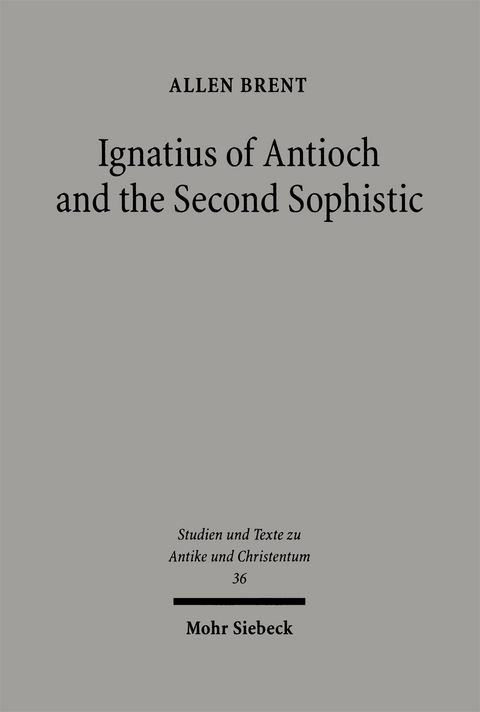
Ignatius of Antioch and the Second Sophistic
A Study of an Early Christian Transformation of Pagan Culture
2020
Mohr Siebeck (Hersteller)
978-3-16-158642-2 (ISBN)
Mohr Siebeck (Hersteller)
978-3-16-158642-2 (ISBN)
Allen Brent analysiert die Sprache der Briefe des Ignatius von Antiochien und weist nach, daß sie argumentativ und vom Aufbau her zum Umfeld der heidnischen griechischen Städte Kleinasiens während der zweiten Sophistik gehören.
Die Briefe des Ignatius von Antiochien werden bisher dahingehend interpretiert, daß sie Belange innerhalb der Kirche untersuchen. Ihre Sprache wird als Ausdruck des Juden-Christentums des zweiten Jahrhunderts bzw. als eine Antwort auf den Valentianismus gelesen, ohne direkten Bezug zur den Autor umgebenden heidnischen Kultur. Allen Brent analysiert die Sprache der Briefe und weist nach, daß sie argumentativ und vom Aufbau her zum Umfeld der heidnischen griechischen Städte Kleinasiens während der zweiten Sophistik gehören. Ignatius' Hintergrund findet sich sowohl im Diskurs der hellenischen Autonomie gegen Rom als auch in den bilderreichen Mysterienkulten der Städte, an die er sich wendet. Ignatius ist beeinflußt vom Ideal einer Einheit der gemeinsamen Kultur, die sich in Verfassungen und Kulten ausdrückt. Allen Brent zeigt dies anhand von literarischen, epigraphischen und ikonographischen Belegen. The letters of Ignatius of Antioch, whether considered genuine or pseudonymous, have been generally understood as addressing concerns and issues within the Church. Consequently, his language has been read as an expression of second century Judaeo Christianity or as a reply to Valentinianism, with little direct contact or concern with the surrounding pagan culture. Allen Brent submits Ignatius' language to a comprehensive analysis and seeks to show that both conceptually, and in terms of the form of his arguments, his language game is clearly that of the pagan, Greek city-states of Asia Minor in the Second Sophistic. The author shows from a variety of evidence, both literary, epigraphic and iconographic, that Ignatius' cultural background is in the world of the discourse of Hellenic autonomy against Roman imperial power, in the image-bearing mystery cults of the cities to whom he writes, in their embassies and Homonia treaties, and in their ideal of unity in a common culture expressed by their constitutions and cultural practices. Ignatius emerges as a brilliant missionary strategist, able to reshape ecclesial order in terms of secular social order and its conventions, whose work was scarcely comprehended by his more conservative Christian contemporaries and only later canonized by means of a gross distortion that obscured his original meaning.
Die Briefe des Ignatius von Antiochien werden bisher dahingehend interpretiert, daß sie Belange innerhalb der Kirche untersuchen. Ihre Sprache wird als Ausdruck des Juden-Christentums des zweiten Jahrhunderts bzw. als eine Antwort auf den Valentianismus gelesen, ohne direkten Bezug zur den Autor umgebenden heidnischen Kultur. Allen Brent analysiert die Sprache der Briefe und weist nach, daß sie argumentativ und vom Aufbau her zum Umfeld der heidnischen griechischen Städte Kleinasiens während der zweiten Sophistik gehören. Ignatius' Hintergrund findet sich sowohl im Diskurs der hellenischen Autonomie gegen Rom als auch in den bilderreichen Mysterienkulten der Städte, an die er sich wendet. Ignatius ist beeinflußt vom Ideal einer Einheit der gemeinsamen Kultur, die sich in Verfassungen und Kulten ausdrückt. Allen Brent zeigt dies anhand von literarischen, epigraphischen und ikonographischen Belegen. The letters of Ignatius of Antioch, whether considered genuine or pseudonymous, have been generally understood as addressing concerns and issues within the Church. Consequently, his language has been read as an expression of second century Judaeo Christianity or as a reply to Valentinianism, with little direct contact or concern with the surrounding pagan culture. Allen Brent submits Ignatius' language to a comprehensive analysis and seeks to show that both conceptually, and in terms of the form of his arguments, his language game is clearly that of the pagan, Greek city-states of Asia Minor in the Second Sophistic. The author shows from a variety of evidence, both literary, epigraphic and iconographic, that Ignatius' cultural background is in the world of the discourse of Hellenic autonomy against Roman imperial power, in the image-bearing mystery cults of the cities to whom he writes, in their embassies and Homonia treaties, and in their ideal of unity in a common culture expressed by their constitutions and cultural practices. Ignatius emerges as a brilliant missionary strategist, able to reshape ecclesial order in terms of secular social order and its conventions, whose work was scarcely comprehended by his more conservative Christian contemporaries and only later canonized by means of a gross distortion that obscured his original meaning.
Born 1940; supernumary member of the Faculty of Divinity in the University of Cambridge.
| Erscheint lt. Verlag | 31.8.2020 |
|---|---|
| Reihe/Serie | Studien und Texte zu Antike und Christentum / Studies and Texts in Antiquity and Christianity |
| Verlagsort | Tübingen |
| Sprache | englisch |
| Themenwelt | Religion / Theologie ► Christentum ► Kirchengeschichte |
| Schlagworte | Early Christianity • Ignatius von Antiochien • Kirchenordnung |
| ISBN-10 | 3-16-158642-5 / 3161586425 |
| ISBN-13 | 978-3-16-158642-2 / 9783161586422 |
| Zustand | Neuware |
| Informationen gemäß Produktsicherheitsverordnung (GPSR) | |
| Haben Sie eine Frage zum Produkt? |


