


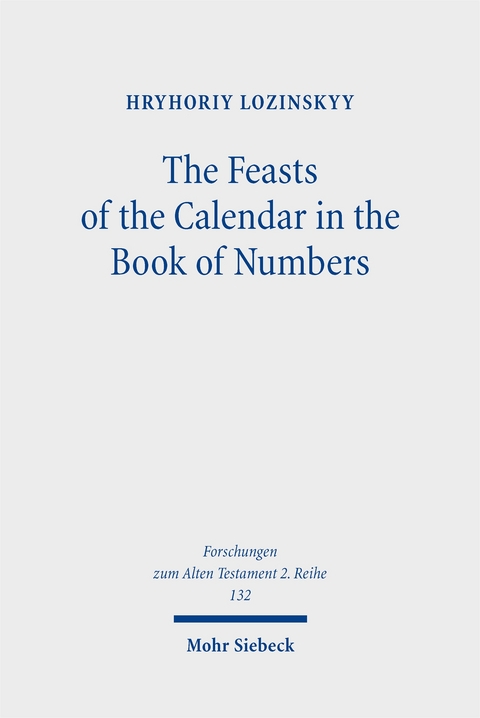
The Feasts of the Calendar in the Book of Numbers
Num 28:16-30:1 in the Light of Related Biblical Texts and Some Ancient Sources of 200 BCE-100 CE
2021
Mohr Siebeck (Hersteller)
978-3-16-160783-7 (ISBN)
Mohr Siebeck (Hersteller)
978-3-16-160783-7 (ISBN)
Hryhoriy Lozinskyy beschäftigt sich mit fünf jüdischen Festen, die im Kalender des Buches Numeri enthalten sind. In der bisher einzigen Monographie über die Feste im Buch Numeri berücksichtigt der Autor drei Themen: Opfer, Feste und Kalender.
Hryhoriy Lozinskyy beschäftigt sich mit fünf jüdischen Festen, die im Kalender des Buches Numeri enthalten sind. In der bisher einzigen Monographie über die Feste im Buch Numeri berücksichtigt der Autor drei Themen: Opfer, Feste und Kalender. In this monograph, Hryhoriy Lozinskyy studies five feasts contained in Num 28:16-30:1. Each of them is first treated in the light of biblical calendars and other related texts. The calendar in Numbers is later than an earlier version of Leviticus 23; yet the final form of Lev 23:1-44 is also a result of some later additions that took place after Num 28:1-30:1 had been composed. The author also focuses on the history of interpretation: he examines several pseudepigrapha, the Dead Sea Scrolls, and ancient Jewish writers from 200 BCE to 100 CE. He shows how these ancient sources reworked the biblical texts by expansions, clarifications, and omissions. In sum, the calendar in Numbers employs several previous traditions that dealt with the feasts, sacrifices, and calendars in order to compose the detailed list of the offerings for the appointed times. Moreover, it is a text that has been used by many ancient sources, especially in the matter of the sacrifices.
Hryhoriy Lozinskyy beschäftigt sich mit fünf jüdischen Festen, die im Kalender des Buches Numeri enthalten sind. In der bisher einzigen Monographie über die Feste im Buch Numeri berücksichtigt der Autor drei Themen: Opfer, Feste und Kalender. In this monograph, Hryhoriy Lozinskyy studies five feasts contained in Num 28:16-30:1. Each of them is first treated in the light of biblical calendars and other related texts. The calendar in Numbers is later than an earlier version of Leviticus 23; yet the final form of Lev 23:1-44 is also a result of some later additions that took place after Num 28:1-30:1 had been composed. The author also focuses on the history of interpretation: he examines several pseudepigrapha, the Dead Sea Scrolls, and ancient Jewish writers from 200 BCE to 100 CE. He shows how these ancient sources reworked the biblical texts by expansions, clarifications, and omissions. In sum, the calendar in Numbers employs several previous traditions that dealt with the feasts, sacrifices, and calendars in order to compose the detailed list of the offerings for the appointed times. Moreover, it is a text that has been used by many ancient sources, especially in the matter of the sacrifices.
Born 1986; 2020 SSD Pontifical Biblical Institute, Rome; currently Adjunct Professor at the Byzantine Catholic Seminary, Pittsburgh, PA and Administrator at St John the Baptist Byzantine Catholic Church, Trumbull, CT.
| Erscheint lt. Verlag | 20.12.2021 |
|---|---|
| Reihe/Serie | Forschungen zum Alten Testament 2. Reihe |
| Verlagsort | Tübingen |
| Sprache | englisch |
| Themenwelt | Religion / Theologie ► Christentum ► Bibelausgaben / Bibelkommentare |
| Schlagworte | Pentateuch • Priestly Literature • sacrifices |
| ISBN-10 | 3-16-160783-X / 316160783X |
| ISBN-13 | 978-3-16-160783-7 / 9783161607837 |
| Zustand | Neuware |
| Informationen gemäß Produktsicherheitsverordnung (GPSR) | |
| Haben Sie eine Frage zum Produkt? |
Mehr entdecken
aus dem Bereich
aus dem Bereich
Die Begründung von Lebensformen angesichts gesellschaftlicher …
Online Resource (2025)
Mohr Siebeck (Hersteller)
CHF 39,95


