


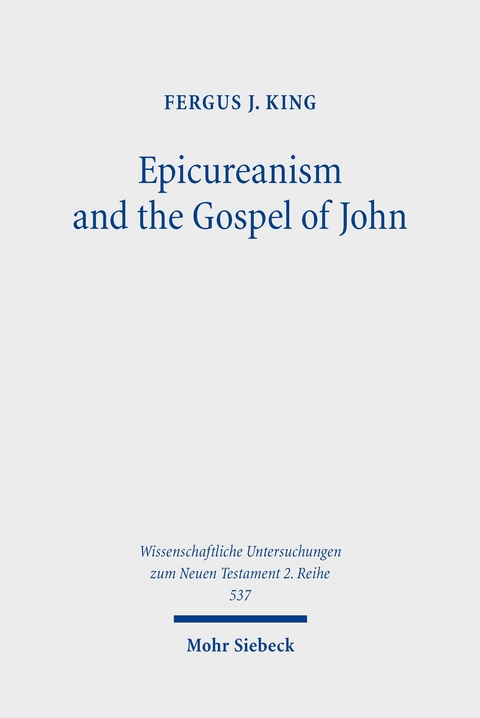
Epicureanism and the Gospel of John
A Study of their Compatibility
2020
Mohr Siebeck (Hersteller)
978-3-16-159546-2 (ISBN)
Mohr Siebeck (Hersteller)
978-3-16-159546-2 (ISBN)
Neuere Studien zum Epikureismus und zum aufkommenden Christentum beschäftigen sich eher mit Paulus. Fergus J. King befasst sich mit der möglichen Vereinbarkeit des Johannesevangeliums mit der epikureischen Theorie und Praxis und ergänzt frühere und neuere Studien über die Beziehung des Evangeliums zum Platonismus und Stoizismus.
Neuere Studien zum Epikureismus und zum aufkommenden Christentum beschäftigen sich eher mit Paulus. Fergus J. King befasst sich mit der möglichen Vereinbarkeit des Johannesevangeliums mit der epikureischen Theorie und Praxis und ergänzt frühere und neuere Studien über die Beziehung des Evangeliums zum Platonismus und Stoizismus. The Gospel of John and Epicureanism share vocabulary and reject the conventions of Graeco-Roman theology. Would it then have been easy for an Epicurean to become a Christian or vice-versa? Fergus J. King suggests that such claims become unlikely when detailed analyses of the two traditions are set out and compared. The first step in his examination looks at evidence for potential engagement between the two traditions historically and geographically. Both traditions address concerns about the good life, death, and the divine. However, this correspondence soon unravels as their worldviews are far from identical. Shared terms (like Saviour), their respective rituals, and teaching about community life reveal substantial differences in ethos and behaviour.
Neuere Studien zum Epikureismus und zum aufkommenden Christentum beschäftigen sich eher mit Paulus. Fergus J. King befasst sich mit der möglichen Vereinbarkeit des Johannesevangeliums mit der epikureischen Theorie und Praxis und ergänzt frühere und neuere Studien über die Beziehung des Evangeliums zum Platonismus und Stoizismus. The Gospel of John and Epicureanism share vocabulary and reject the conventions of Graeco-Roman theology. Would it then have been easy for an Epicurean to become a Christian or vice-versa? Fergus J. King suggests that such claims become unlikely when detailed analyses of the two traditions are set out and compared. The first step in his examination looks at evidence for potential engagement between the two traditions historically and geographically. Both traditions address concerns about the good life, death, and the divine. However, this correspondence soon unravels as their worldviews are far from identical. Shared terms (like Saviour), their respective rituals, and teaching about community life reveal substantial differences in ethos and behaviour.
Born 1962; holds a doctorate in Theology from the University of South Africa; has taught at St Mark's College, Dar es Salaam and The University of Newcastle, NSW; Farnham Maynard Associate Professor in Ministry and Director of the Ministry Education Centre at Trinity College Theological School, within the University of Divinity, Melbourne.
| Erscheint lt. Verlag | 27.11.2020 |
|---|---|
| Reihe/Serie | Wissenschaftliche Untersuchungen zum Neuen Testament 2. Reihe |
| Verlagsort | Tübingen |
| Sprache | englisch |
| Themenwelt | Religion / Theologie ► Christentum ► Bibelausgaben / Bibelkommentare |
| Schlagworte | Johannine Studies • Post-Aristotelian Philosophy • Sociocultural Interpretation |
| ISBN-10 | 3-16-159546-7 / 3161595467 |
| ISBN-13 | 978-3-16-159546-2 / 9783161595462 |
| Zustand | Neuware |
| Informationen gemäß Produktsicherheitsverordnung (GPSR) | |
| Haben Sie eine Frage zum Produkt? |
Mehr entdecken
aus dem Bereich

aus dem Bereich
Die Begründung von Lebensformen angesichts gesellschaftlicher …
Online Resource (2025)
Mohr Siebeck (Hersteller)
CHF 39,95


