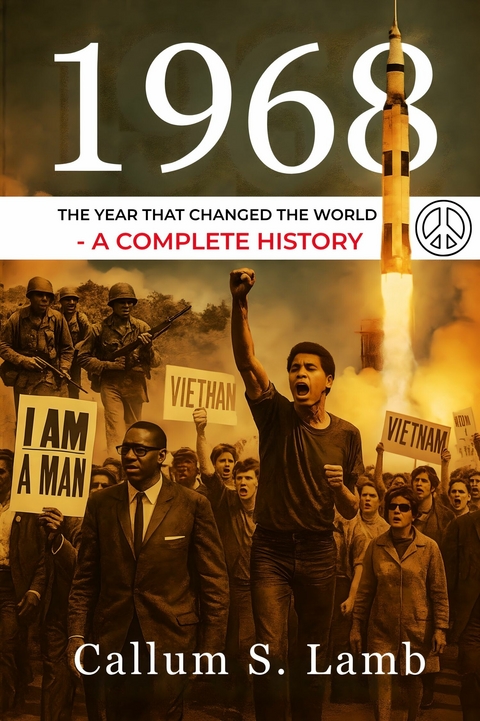
1968 (eBook)
326 Seiten
Seahorse Pub (Verlag)
978-0-00-101801-3 (ISBN)
The year that changed everything. The story America needs to remember.
In twelve explosive months, the United States was torn apart and rebuilt. From the jungles of Vietnam to the streets of Chicago, from the hallowed halls of Columbia University to the Olympic podium in Mexico City, 1968 witnessed a nation convulsing with unprecedented upheaval that would reshape American society forever.
1968: The Year That Changed the World takes you inside the most turbulent year in modern American history, when assassins' bullets claimed two of the nation's most beloved leaders, student revolutionaries occupied university campuses, and television cameras captured police beating protesters in the streets of Chicago. This meticulously researched narrative reveals how Martin Luther King Jr.'s murder ignited cities across America, how Robert Kennedy's assassination shattered liberal dreams, and how Richard Nixon's stunning political comeback changed the course of American politics.
From the Tet Offensive that exposed the lies about Vietnam to the Prague Spring crushed by Soviet tanks, from the Democratic National Convention that devolved into chaos to the raised fists at the Olympics that defined a generation's defiance, every pivotal moment comes alive through intimate character portraits and gripping storytelling.
Drawing on declassified documents, personal interviews, and eyewitness accounts, this powerful chronicle reveals how ordinary Americans-students, soldiers, activists, and politicians-navigated twelve months that tested the very foundations of democracy. Discover the untold stories behind the headlines: the secret machinations in the White House, the courage of civil rights workers facing deadly violence, and the determination of young people who refused to accept the status quo.
More than just history, this is the story of how America transformed from the confident nation of the early 1960s into the divided country we recognize today. 1968: The Year That Rocked the World is essential reading for anyone seeking to understand how we became who we are-and where we might be heading.
A masterpiece of historical narrative that reads like a thriller and resonates like prophecy.
Introduction
The giant Waterford crystal ball suspended above Times Square caught the glare of television floodlights as it prepared for its annual descent into history. Five minutes before midnight on December 31, 1967, nearly a million revelers packed into the concrete canyon of Broadway, their breath forming white clouds in the bitter New York winter air. The temperature hovered at twenty-eight degrees, but the crowd's energy generated its own heat as bodies pressed together in anticipation of 1968's arrival.
Television cameras from all three networks captured the scene for a national audience estimated at seventy-five million Americans, while radio broadcasts carried the countdown to troops in Vietnam, civil rights workers in the South, and college students on campuses from Berkeley to Columbia. The crowd represented America's demographic kaleidoscope: suburban families who had driven in from New Jersey, young couples on dates, groups of college students home for winter break, and solitary individuals seeking connection in the anonymous crush of humanity.
ABC's Dick Clark stood on his elevated platform, microphone in hand, surveying the sea of faces below. Many in the crowd held handmade signs reading "Peace in '68" and "Bring Our Boys Home," while others waved small American flags or wore buttons supporting various presidential candidates. The visual contrast was striking: traditional patriotic displays mixed with emerging symbols of dissent, a microcosm of a nation increasingly divided against itself.
As the massive crowd began chanting the countdown—"Ten! Nine! Eight!"—few could imagine the upheavals that awaited them in the coming year. The collective voice rose above the honking taxis and police sirens, above the distant rumble of subway trains carrying late revelers into Manhattan. "Seven! Six! Five!" The sound echoed off the towering billboards advertising Coca-Cola, Camel cigarettes, and the latest Hollywood films, while steam rose from manholes like incense in some urban cathedral.
"Four! Three! Two!" The ball began its descent, a perfect sphere of light dropping through the darkness as cameras flashed throughout the crowd. Couples prepared for midnight kisses, strangers grabbed hands, and somewhere in the distance, church bells began their own countdown to the new year. "One!" The roar that erupted as 1968 officially began shook windows twenty stories above the street, a primal scream of hope, fear, anticipation, and dread that seemed to capture everything America was feeling as it crossed the threshold into the most tumultuous year of the twentieth century.
…
As confetti rained down on Times Square and champagne corks popped in apartments across America, the new year arrived amid gathering storm clouds of unprecedented social and political upheaval. In Vietnam, American troop levels had reached 525,000, with casualties mounting at an alarming rate—over 16,000 dead in 1967 alone, more than all previous years combined. The Tet holiday ceasefire, scheduled for late January, would prove to be the calm before a devastating storm that would shatter American confidence in military victory and expose the credibility gap between official optimism and battlefield reality.
The war's expansion had catalyzed the largest antiwar movement in American history, transforming from isolated campus protests into a broad coalition spanning college students, clergy, intellectuals, and increasingly, working-class families who watched their sons return in body bags. Draft card burnings, teach-ins, and massive demonstrations had become weekly occurrences, while underground newspapers and radical organizations proliferated across college campuses. The movement's rhetoric was becoming more militant, influenced by Third World liberation movements and domestic Black Power advocates who viewed Vietnam as part of America's broader imperial project.
Meanwhile, the Civil Rights Movement was entering its most complex and dangerous phase. The legislative victories of 1964 and 1965—the Civil Rights Act and Voting Rights Act—had addressed legal segregation but left untouched the deeper structural inequalities of American society. Martin Luther King Jr. had expanded his focus beyond the South to address poverty, unemployment, and housing discrimination in Northern cities, but his Chicago campaign had exposed the fierce resistance of white working-class communities to integration. The rise of Black Power ideology, exemplified by leaders like Stokely Carmichael and H. Rap Brown, challenged King's commitment to nonviolence and integration, advocating instead for black separatism and armed self-defense.
Urban riots had become an annual summer ritual, with major uprisings in Watts, Newark, and Detroit revealing the depth of black rage in America's ghettos. The Kerner Commission, appointed by President Johnson to investigate the causes of urban violence, was preparing to release its explosive report documenting systematic white racism as the root cause of civil disorder. The commission's findings would shatter white America's comfortable assumptions about racial progress and equal opportunity.
Student activism was spreading beyond American campuses to universities worldwide, creating an international network of revolutionary ferment. At Columbia University, Students for a Democratic Society were planning major confrontations with the administration over the university's ties to the Pentagon and its expansion into Harlem. In Paris, student radicals led by Daniel Cohn-Bendit were organizing protests against the rigid French educational system and the authoritarianism of the de Gaulle government. German students were demonstrating against American imperialism and their own country's Nazi past, while Japanese students battled police over their government's support for the Vietnam War.
The global youth culture was creating new forms of consciousness that transcended national boundaries. Rock music, psychedelic drugs, Eastern philosophy, and radical politics were fusing into a counterculture that rejected conventional values of materialism, conformity, and deference to authority. The Beatles' "Sergeant Pepper's Lonely Hearts Club Band" had defined the "Summer of Love" in 1967, but the optimistic psychedelia was giving way to harder sounds and angrier messages as musicians like Jimi Hendrix and Jim Morrison explored themes of rebellion and social chaos.
In Eastern Europe, tentative moves toward liberalization were challenging Soviet control and raising hopes for democratic reform. Alexander Dubček's rise to power in Czechoslovakia promised "socialism with a human face," while Polish and Hungarian intellectuals pushed for greater cultural and political freedom. These developments created new possibilities for ending the Cold War but also raised the specter of Soviet military intervention to preserve communist orthodoxy.
…
As 1968 dawned, the major figures who would shape the year's dramatic events were positioning themselves for confrontations that would define their legacies and transform American society. At the center of the political maelstrom stood Lyndon Baines Johnson, the towering Texan whose Great Society programs had achieved unprecedented domestic reforms while his escalation of the Vietnam War threatened to destroy his presidency. Johnson began the year as a deeply embattled leader, his approval ratings plummeting as the war's costs mounted and social unrest spread across American cities. Private conversations recorded in the White House revealed a president increasingly isolated and tormented, torn between his determination to achieve victory in Vietnam and his recognition that the war was consuming his domestic agenda and his political future.
Martin Luther King Jr. entered 1968 at the most challenging moment of his career, struggling to maintain his leadership of a civil rights movement increasingly fractured between militant black nationalists and moderate integrationists. His opposition to the Vietnam War had alienated him from the Johnson administration and mainstream civil rights organizations, while his commitment to nonviolence seemed increasingly irrelevant to young blacks inspired by Black Power rhetoric. Yet King was preparing his most ambitious campaign yet—the Poor People's Campaign—designed to bring thousands of America's dispossessed to Washington to demand economic justice. His acceptance of an invitation to support striking sanitation workers in Memphis would prove to be a fateful decision that would place him in the crosshairs of history.
Robert F. Kennedy stood at his own crossroads, torn between family loyalty to the Johnson administration and his growing conviction that the Vietnam War was both morally wrong and politically disastrous. The senator from New York had emerged as the most charismatic spokesman for the liberal wing of the Democratic Party, combining his brother's political legacy with a passionate commitment to civil rights and social justice. His visits to Mississippi Delta poverty and California migrant worker camps had radicalized his understanding of American inequality, while his criticism of the war had made him the focus of antiwar hopes. His decision whether to challenge Johnson for the Democratic nomination would reshape American politics.
Richard Nixon was methodically planning his political resurrection after his devastating defeats in 1960 and 1962. The former vice president had spent the intervening years rebuilding his reputation through foreign travel, legal practice, and tireless campaigning for Republican candidates. Nixon sensed that American society's upheavals were creating an opportunity for conservative politics, appealing to what he would call the "silent majority" of Americans who felt threatened by...
| Erscheint lt. Verlag | 15.8.2025 |
|---|---|
| Sprache | englisch |
| Themenwelt | Geisteswissenschaften ► Geschichte ► Regional- / Ländergeschichte |
| ISBN-10 | 0-00-101801-9 / 0001018019 |
| ISBN-13 | 978-0-00-101801-3 / 9780001018013 |
| Informationen gemäß Produktsicherheitsverordnung (GPSR) | |
| Haben Sie eine Frage zum Produkt? |
 EPUB (Adobe DRM)
Größe: 3,5 MB
Kopierschutz: Adobe-DRM
Adobe-DRM ist ein Kopierschutz, der das eBook vor Mißbrauch schützen soll. Dabei wird das eBook bereits beim Download auf Ihre persönliche Adobe-ID autorisiert. Lesen können Sie das eBook dann nur auf den Geräten, welche ebenfalls auf Ihre Adobe-ID registriert sind.
Details zum Adobe-DRM
Dateiformat: EPUB (Electronic Publication)
EPUB ist ein offener Standard für eBooks und eignet sich besonders zur Darstellung von Belletristik und Sachbüchern. Der Fließtext wird dynamisch an die Display- und Schriftgröße angepasst. Auch für mobile Lesegeräte ist EPUB daher gut geeignet.
Systemvoraussetzungen:
PC/Mac: Mit einem PC oder Mac können Sie dieses eBook lesen. Sie benötigen eine
eReader: Dieses eBook kann mit (fast) allen eBook-Readern gelesen werden. Mit dem amazon-Kindle ist es aber nicht kompatibel.
Smartphone/Tablet: Egal ob Apple oder Android, dieses eBook können Sie lesen. Sie benötigen eine
Geräteliste und zusätzliche Hinweise
Buying eBooks from abroad
For tax law reasons we can sell eBooks just within Germany and Switzerland. Regrettably we cannot fulfill eBook-orders from other countries.
aus dem Bereich