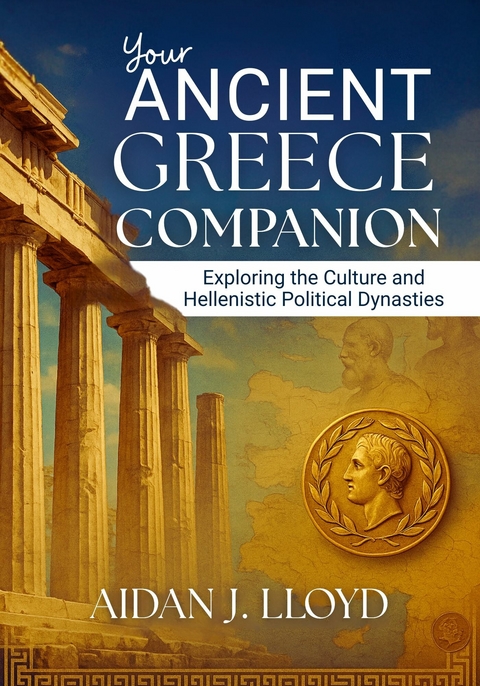
Your Ancient Greece Companion (eBook)
391 Seiten
Seahorse Pub (Verlag)
978-0-00-101800-6 (ISBN)
Discover the fascinating world of Ancient Greece through this comprehensive companion guide that explores the rich culture and complex political dynasties of the Hellenistic period.
Your Ancient Greece Companion takes you on an engaging journey through one of history's most influential civilizations. This authoritative yet accessible guide reveals how Greek culture evolved after Alexander the Great's conquests, shaping the ancient Mediterranean world for centuries.
Understand the Hellenistic era, where Greek traditions merged with Eastern customs, creating a vibrant cultural mosaic that influenced art, philosophy, science, and politics. From the bustling streets of Alexandria to the royal courts of Ptolemaic Egypt and Seleucid Persia, explore how Greek ideals adapted and thrived in diverse societies.
Uncover the intricate web of Hellenistic political dynasties that ruled vast territories after Alexander's death. Learn about the Ptolemies in Egypt, the Seleucids in Asia, and the Antigonids in Macedonia-powerful families whose rivalries and alliances shaped the ancient world. Understand how these rulers balanced Greek governance traditions with local customs, creating unique hybrid kingdoms.
This companion explores key cultural developments including the spread of Greek language and literature, revolutionary scientific discoveries, and the emergence of new philosophical schools. Discover how Hellenistic culture influenced Roman civilization and laid foundations for Western thought.
Perfect for history enthusiasts, students, and anyone curious about ancient civilizations, Your Ancient Greece Companion combines scholarly research with engaging storytelling. Whether you're new to ancient history or seeking to deepen your knowledge, this guide provides essential insights into Greece's most dynamic period.
Chapter 1: The Death That Shook the World
The Final Hours in Babylon
The thick Mesopotamian air hung motionless in the royal chambers of Nebuchadnezzar's ancient palace, now transformed into the nerve center of the world's largest empire. June heat pressed against the limestone walls like a physical weight, broken only by the rhythmic waving of ostrich-feather fans wielded by silent Persian attendants. Frankincense smoke drifted upward from bronze braziers, its sweet pungency unable to mask the sharper scent of fevered sweat and approaching death.
Alexander lay propped against silk cushions on his elevated bed, the famous golden locks now matted against his skull, his legendary violet eyes dulled by days of raging fever. Around him stood the men who had conquered half the known world at his side—veterans scarred by a dozen campaigns, their weathered faces now etched with something they had rarely known: uncertainty.
The marble floor beneath their sandaled feet had witnessed the deliberations of Babylonian kings for centuries, but never a moment quite like this. These Macedonian generals, men who had charged war elephants and scaled impossible fortress walls, shifted nervously as their king struggled for each breath. Outside, the great city of Babylon continued its daily rhythm—merchants haggling in the markets, priests conducting sacred rituals, farmers working the irrigation channels—unaware that the fate of three continents hung in the balance within these walls.
"The ring," Perdiccas whispered, his voice barely audible above the soft rustle of silk hangings. His dark eyes fixed on Alexander's right hand, where the royal signet still gleamed on a finger now grown thin. The bodyguard-turned-regent had positioned himself closest to the bed, his powerful frame tense with barely contained ambition.
Alexander's lips moved, forming words that seemed to dissolve in the heavy air before reaching his generals' ears. Ptolemy leaned forward from his position near the eastern window, sunlight catching the premature silver in his beard. Unlike the others, he appeared almost calm, his intelligent features betraying none of the desperation that flickered across younger faces.
"He speaks of the strongest," Ptolemy said quietly, though whether interpreting Alexander's words or offering his own remained unclear.
"Nonsense," growled Antipater's weathered voice from the shadows near the doorway. The old regent of Macedonia had arrived from the west only days earlier, his loyalty to Alexander's memory already competing with his practical concerns for the homeland. "The strongest will tear the empire apart like wolves."
The silence that followed carried weight beyond words. Each man present understood that Alexander's death would unleash forces none of them could fully control. The empire stretched from the Adriatic Sea to the Indus River, encompassing dozens of peoples, languages, and customs held together by little more than their shared submission to one extraordinary individual. Without that unifying presence, what would prevent the vast territories from fragmenting into chaos?
Seleucus stood apart from the inner circle, his calculating gaze moving between the dying king and his assembled companions. At thirty-nine, he possessed the patience that came with surviving years of Alexander's impulsive brilliance. His scarred hands rested calmly at his sides, but those who knew him well recognized the subtle tension in his shoulders—the readiness of a man preparing for whatever might come.
Near the chamber's northern wall, Antigonus the One-Eyed dominated the space despite his silence. His massive frame cast shadows across the geometric patterns of the floor mosaics, while his single good eye surveyed the scene with the intensity of a general studying a battlefield. He alone among them still harbored dreams of holding the empire together, though he kept such thoughts carefully hidden behind his gruff exterior.
A soft moan from the bed drew every gaze back to Alexander. His breathing had grown more labored, each inhalation requiring visible effort. The fever that had consumed him for days showed no signs of breaking, and even the Egyptian physicians summoned from Memphis had admitted their helplessness. Whatever ailment had struck down the seemingly invincible conqueror, it cared nothing for his divine pretensions or earthly achievements.
"The arrangements," Perdiccas said more urgently now, his voice cutting through the chamber's oppressive atmosphere. "We must know his wishes regarding succession."
But Alexander's response, if any came, remained locked behind fevered lips that moved soundlessly. The greatest military mind of the age, the king who had revolutionized warfare and reshaped the world's political landscape, seemed unable or unwilling to provide the one guidance his empire needed most—a clear path forward.
As afternoon shadows lengthened across the palace courtyard, the assembled generals faced a truth none wished to acknowledge. The death approaching this bed would not merely end a life; it would shatter the largest continuous empire in human history and plunge the known world into decades of warfare, transformation, and cultural revolution that would echo through the centuries.
The empire Alexander had built through genius and force of will now stood poised to become something entirely different—not one kingdom, but many, each shaped by the ambitions and capabilities of the men who would claim pieces of his legacy.
The Empire's Unprecedented Scale and Diversity
When Alexander breathed his last in Babylon, he left behind a political creation unlike anything the ancient world had ever witnessed. The empire stretched approximately 3,000 miles from east to west and 2,000 miles from north to south, encompassing territories that today would include Greece, Turkey, Syria, Lebanon, Israel, Egypt, Iraq, Iran, Afghanistan, Pakistan, and parts of India and Central Asia. This vast domain contained an estimated 50 million people speaking dozens of languages and following hundreds of local customs and religious practices.
The sheer logistics of governing such an expanse challenged every conventional assumption about ancient statecraft. Messages from Babylon to Macedonia required weeks to arrive, while communications with the eastern satrapies could take months. Local governors, or satraps, necessarily wielded enormous autonomy simply due to the impossibility of real-time oversight from the center. This decentralization, originally born of practical necessity, would prove crucial in determining how the empire fragmented after Alexander's death.
The conquered territories themselves represented a patchwork of civilizations at vastly different stages of development. Egypt brought three millennia of pharaonic tradition, sophisticated administration, and immense agricultural wealth derived from the Nile's annual floods. The river valley produced enough grain to feed much of the eastern Mediterranean while generating enormous tax revenues through its efficient bureaucratic systems inherited from the Ptolemaic period.
Mesopotamia, centered on Babylon, offered different advantages. Its ancient cities controlled crucial trade routes between east and west, while its agricultural systems, dependent on complex irrigation networks along the Tigris and Euphrates rivers, had supported dense populations for thousands of years. The region's commercial expertise and central location made it a natural administrative hub, explaining Alexander's decision to establish his final capital there rather than in his Macedonian homeland.
The eastern territories presented their own complexities. Bactria, in modern Afghanistan, sat astride the crucial trade routes connecting the Mediterranean world with India and Central Asia. Its Greek-influenced cities would later become centers of remarkable cultural synthesis, producing art and literature that blended Hellenic and Indian traditions in unprecedented ways. The region's strategic importance far outweighed its relatively small population, making it a prize that Alexander's successors would fight over repeatedly.
Persia itself, the former imperial heartland, brought both opportunities and challenges. Its sophisticated administrative systems, refined through centuries of governing a multi-ethnic empire, offered valuable organizational models. Persian nobles, many of whom had accepted Alexander's rule and intermarried with Macedonian families, possessed governing experience essential for managing the eastern provinces. However, their loyalty remained questionable, and their cultural differences with the Macedonian elite created ongoing tensions.
The Greek cities of Asia Minor occupied a unique position within this imperial mosaic. These coastal communities had maintained their Hellenic character through centuries of Persian rule, and Alexander's conquest had restored their theoretical independence while placing them under Macedonian protection. Their commercial networks, maritime expertise, and cultural connections to mainland Greece made them valuable allies, but their traditional independence made them unreliable subjects.
Perhaps most challenging of all were the regions that remained incompletely conquered or barely integrated into the imperial system. The mountainous areas of modern Pakistan and Afghanistan harbored tribes that had submitted to Alexander's overwhelming military superiority but maintained their own leaders, customs, and military organizations. Their allegiance depended entirely on the continued presence of Macedonian forces and the promise of continued victories and plunder.
This diversity created both the empire's greatest strength and its fundamental weakness....
| Erscheint lt. Verlag | 15.8.2025 |
|---|---|
| Sprache | englisch |
| Themenwelt | Geisteswissenschaften ► Geschichte ► Regional- / Ländergeschichte |
| ISBN-10 | 0-00-101800-0 / 0001018000 |
| ISBN-13 | 978-0-00-101800-6 / 9780001018006 |
| Informationen gemäß Produktsicherheitsverordnung (GPSR) | |
| Haben Sie eine Frage zum Produkt? |
 EPUB (Adobe DRM)
Größe: 2,8 MB
Kopierschutz: Adobe-DRM
Adobe-DRM ist ein Kopierschutz, der das eBook vor Mißbrauch schützen soll. Dabei wird das eBook bereits beim Download auf Ihre persönliche Adobe-ID autorisiert. Lesen können Sie das eBook dann nur auf den Geräten, welche ebenfalls auf Ihre Adobe-ID registriert sind.
Details zum Adobe-DRM
Dateiformat: EPUB (Electronic Publication)
EPUB ist ein offener Standard für eBooks und eignet sich besonders zur Darstellung von Belletristik und Sachbüchern. Der Fließtext wird dynamisch an die Display- und Schriftgröße angepasst. Auch für mobile Lesegeräte ist EPUB daher gut geeignet.
Systemvoraussetzungen:
PC/Mac: Mit einem PC oder Mac können Sie dieses eBook lesen. Sie benötigen eine
eReader: Dieses eBook kann mit (fast) allen eBook-Readern gelesen werden. Mit dem amazon-Kindle ist es aber nicht kompatibel.
Smartphone/Tablet: Egal ob Apple oder Android, dieses eBook können Sie lesen. Sie benötigen eine
Geräteliste und zusätzliche Hinweise
Buying eBooks from abroad
For tax law reasons we can sell eBooks just within Germany and Switzerland. Regrettably we cannot fulfill eBook-orders from other countries.
aus dem Bereich