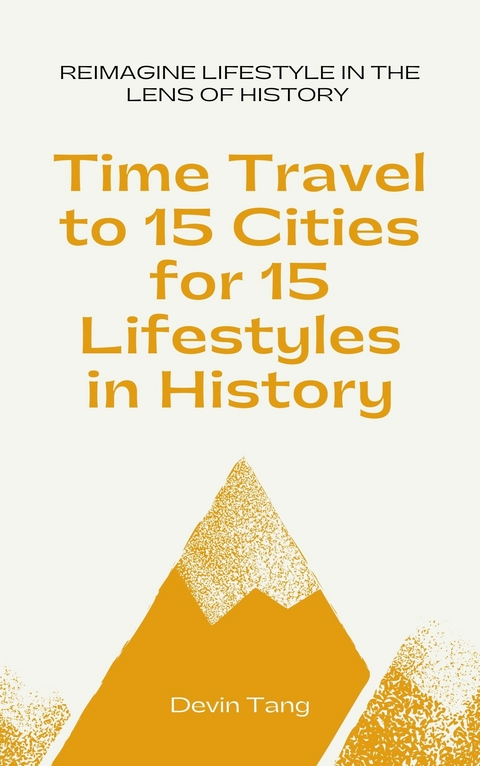
Time Travel to 15 Cities for 15 Lifestyles in History (eBook)
160 Seiten
YiKai Books (Verlag)
978-0-00-101792-4 (ISBN)
Have you ever wondered what it feels like to travel back in time for a different lifestyle? This book is your invitation to escape the routines of modern life and step directly into lives of the past.
'Time Travel to 15 Cities for 15 Lifestyles in History' offers an immersive journey across fifteen remarkablecities in the olden days. Each chapter brings to life the must-go through aspects of everyday living, guiding you through how people navigated family, work, festivals, fashion, and food-with immediate, firsthand detail - from sharing bread and beer in ancient Ur, relaxing in the public baths of Imperial Rome, hanging out in night markets of Song Dynasty Kaifeng, celebrating carnival in Renaissance Venice, to dancing at jazz clubs in the sex-liberated 1920s New York.
The best part is that you follow a full day in each city through the eyes of someone who lived decades or centuries ago. Whether you are a history lover, a curious traveler, or someone who simply enjoys exploring new ways of life, each city offers a fresh perspective and a chance for self-discovery.
Are you ready to find which city and lifestyle speak to you? Purchase your copy and begin your unforgettable adventure!
Ur (Sumer) – Hospitality of the Fertile Crescent in Human’s First City

Ur (Sumer, c. 2100–2000 BCE)
Ur stood as a gleaming center of Sumerian civilization, rising from the southern Mesopotamian plain near the banks of the Euphrates. Its towering ziggurat dominated the skyline, serving as both religious and social hub. The city’s bustling streets were lined with mud-brick homes, bazaars, and workshops, where merchants and craftsmen traded goods from distant lands. Priests and scribes kept records and led rituals in grand temples, while canal networks brought water and life to the city. In Ur, daily existence blended devotion, commerce, and innovation, making it a jewel of the ancient world and a cradle of early urban life.
Home and Family Among the Mudbricks
Slip off your sandals and step inside a home in Ur (around 2100–2000 BCE). The walls are built from sun-dried mudbricks, warm during the day and cool at night, and the air inside carries the comforting scents of barley stew and dust. These houses are not grand, but they are sturdy—simple rectangles with flat roofs, packed close together along narrow streets, each one bustling with life.
Family is at the center of everything here. More than just parents and children live under one roof—grandparents, aunts and uncles, cousins, and sometimes even a neighbor in need. In the corner, a grandmother stirs a pot over a clay hearth, telling stories to a little one who watches her every move. An older child sits nearby, trying to copy his father as he weaves a basket from reeds, fingers poking and fumbling, earning a gentle laugh.
Light comes through a small window high in the wall, casting patterns across clay shelves lined with bowls and little statues of household gods. These figures are meant to keep everyone safe, and sometimes, before meals, someone will touch one for luck. The floors are swept with palm branches, and beds are nothing more than reed mats laid out at night and rolled away each morning.
Most of daily life unfolds in the open-air courtyard at the center of the house. Here, women knead dough in wide bowls, children chase each other around jars of water, and chickens peck at the ground. Laundry hangs from lines, swaying in the breeze. Neighbors’ voices drift over the walls, mixing with the bray of donkeys and the clatter of pots. The courtyard is the heart of the home—everyone comes here to work, talk, or simply rest in the shade.
Meals are simple but filling—flat bread, beans, perhaps a few dates if the day has been good. At dusk, everyone gathers around the hearth. News and gossip are shared, small gifts exchanged, and old stories retold. There is no clock, but everyone senses when it is time to settle in for the night.
Outside these walls, the tall ziggurat towers over the city, but inside, life feels smaller and closer. As darkness falls, lamps are lit and the family settles down together. The youngest children curl up next to their elders, safe in the warmth of many bodies and familiar voices. The mudbrick walls may seem humble, but they hold a world of love, routine, and quiet resilience—a place where every day begins and ends with family.
Bread, Beer, and the Daily Meal
As the sun climbs over the rooftops of Ur, the city’s alleys fill with the earthy aroma of baking bread. The day’s first meal begins in the home’s open courtyard, where a mother kneads dough with practiced hands, her fingers dusted in flour ground from barley harvested in the fields beyond the city. The small round loaves she shapes will feed the family from morning until night, their golden crusts a simple but constant comfort.
Barley is at the heart of nearly every meal in Ur. The grain, soaked and pounded, becomes porridge for breakfast or is pressed into flat cakes, sometimes sweetened with dates picked from groves near the river. For special occasions, a handful of honey might be added, turning an everyday staple into a rare treat. Next to the hearth, a jar of bubbling mash hints at another tradition—beer. Unlike the clear, fizzy drink familiar today, Sumerian beer is thick and hearty, more like a nourishing soup. It is poured into clay cups or large communal jars, and families use long reed straws to sip together, sharing both the drink and the moment.
The midday meal offers a chance to pause the day’s labor, whether in the fields, workshops, or markets. On a mat in the shade, the family gathers to eat lentil stew, seasoned with leeks, garlic, or wild herbs from the city’s outskirts. Fish, freshly caught from the Euphrates, sometimes appear at the table, roasted or dried for flavor and preservation. Meat is rare and precious, reserved for feasts, sacrifices, or visits from distant relatives. Most days, sustenance comes from what the land provides—onions, beans, cucumbers, and the ever-present bread.
As afternoon light spills across the courtyard, children snack on dried fruits or roasted chickpeas while elders rest and share stories. Water is drawn from the city’s wells and carried home in clay jars, sometimes flavored with a sprig of mint or a dash of date syrup, a small luxury in the heat. The city’s markets offer a handful of imported delicacies—perhaps a pinch of cinnamon or a piece of cheese for those who can afford them—but for most, the daily meal is shaped by what grows along the river and what families can make with their own hands.
Evening brings everyone together once more. Bread is broken, beer is poured, and the air hums with quiet conversation as lamps flicker on the walls. The taste of the day’s work lingers in each bite, from the smoky crust of the bread to the tang of pickled vegetables on a clay plate. In Ur, meals are more than food—they are a thread that ties the family to the land, to the seasons, and to each other, carrying the warmth of the hearth long after the meal has ended.
Dressing the Part: Adornment and Status
Step from the sun-baked courtyards of Ur into the gentle shade of an early morning, and you will find the city stirring with quiet rituals of self-presentation. In these winding alleys, clothing is much more than simple protection from desert winds or the summer sun—it is a daily language, woven with meaning, status, and a touch of pride.
A family prepares for the day, their garments laid out on reed mats. Linen is the favored cloth, spun smooth from flax and soft against the skin. Men wrap themselves in long, draped skirts called kaunakes, their edges tufted like a fringe of wool or decorated with intricate patterns. Women choose dresses of linen or wool, belted at the waist, their hems brushing the ground. These clothes are practical, but also beautiful, dyed in gentle earth tones or brightened with a precious streak of indigo or madder when the household can afford it.
Jewelry is as much a part of daily life as the morning meal. Girls and boys delight in stringing together necklaces from clay beads, shells, or bits of colored stone found at the edge of the river. For adults, adornment speaks to a family’s good fortune or a craftsman’s careful hand. Bronze pins fasten cloaks in place, and bracelets made of copper or lapis lazuli glint in the sunlight. Lapis, brought from far-off lands, is a treasure—a deep blue stone prized by kings and temple priests alike, such as those serving under the reign of our great king Ur-Nammu (c. 2112–2095 BCE).
A mother braids her daughter’s hair in the courtyard, nimble fingers working through thick strands, weaving in a ribbon or a bead for luck. Men smooth scented oil onto their beards, shaping them with care, for a well-tended beard is a quiet sign of dignity and adulthood. Children mimic the actions of their parents, eager to try on an anklet or a headband, turning daily routine into playful ritual.
Footwear is simple—soft leather sandals for those who can afford them, or bare feet that know every pebble and patch of warm earth. The city’s wealthier residents, perhaps merchants or scribes, may own cloaks embroidered with geometric designs, signaling their success to neighbors and strangers alike as they make their way toward the ziggurat or the bustling marketplace.
As the day unfolds, Ur’s streets become a living tapestry of fabric, color, and sparkle. No two citizens are dressed quite the same, yet each carries a piece of the city’s spirit—practical, inventive, and proud. In these small acts of choosing a cloak, braiding a strand of hair, or pinning on a necklace, the people of Ur express their hopes, their standing, and their connection to a world that stretches from the muddy banks of the Euphrates to the farthest reaches of the ancient world.
Temples, Work, and Community Life
The city of Ur begins to stir in the cool, early hours, as sunlight touches the tops of its walls and rooftops. From every doorway, people step out to start their daily routines, each contributing to the steady flow of community life. At the city’s heart towers the ziggurat, its massive form built under Ur-Nammu (c. 2112–2095 BCE). With its mudbrick terraces rising skyward, the ziggurat glows in the morning light, serving as both a spiritual beacon and a gathering place for all. For the people of Ur, this monumental temple is much more than a striking landmark—it is the spiritual heart and social center of their city.
Daily life draws many toward the ziggurat and the temples nestled around it. Here, priests and priestesses...
| Erscheint lt. Verlag | 9.8.2025 |
|---|---|
| Sprache | englisch |
| Themenwelt | Geisteswissenschaften ► Geschichte |
| ISBN-10 | 0-00-101792-6 / 0001017926 |
| ISBN-13 | 978-0-00-101792-4 / 9780001017924 |
| Informationen gemäß Produktsicherheitsverordnung (GPSR) | |
| Haben Sie eine Frage zum Produkt? |
 EPUB (Adobe DRM)
Größe: 3,2 MB
Kopierschutz: Adobe-DRM
Adobe-DRM ist ein Kopierschutz, der das eBook vor Mißbrauch schützen soll. Dabei wird das eBook bereits beim Download auf Ihre persönliche Adobe-ID autorisiert. Lesen können Sie das eBook dann nur auf den Geräten, welche ebenfalls auf Ihre Adobe-ID registriert sind.
Details zum Adobe-DRM
Dateiformat: EPUB (Electronic Publication)
EPUB ist ein offener Standard für eBooks und eignet sich besonders zur Darstellung von Belletristik und Sachbüchern. Der Fließtext wird dynamisch an die Display- und Schriftgröße angepasst. Auch für mobile Lesegeräte ist EPUB daher gut geeignet.
Systemvoraussetzungen:
PC/Mac: Mit einem PC oder Mac können Sie dieses eBook lesen. Sie benötigen eine
eReader: Dieses eBook kann mit (fast) allen eBook-Readern gelesen werden. Mit dem amazon-Kindle ist es aber nicht kompatibel.
Smartphone/Tablet: Egal ob Apple oder Android, dieses eBook können Sie lesen. Sie benötigen eine
Geräteliste und zusätzliche Hinweise
Buying eBooks from abroad
For tax law reasons we can sell eBooks just within Germany and Switzerland. Regrettably we cannot fulfill eBook-orders from other countries.
aus dem Bereich