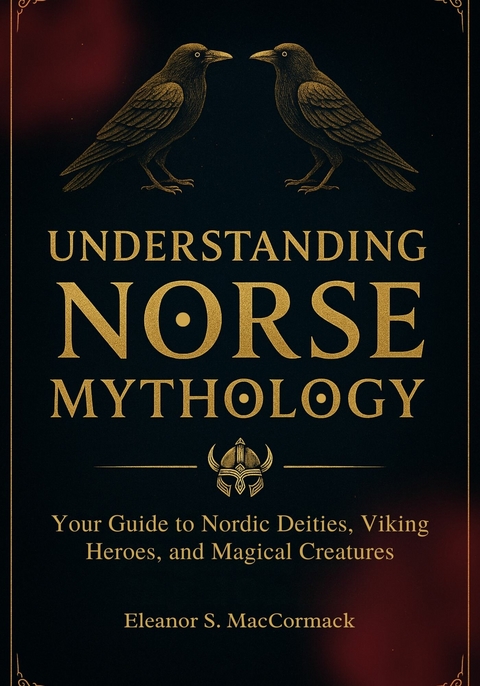
Understanding Norse Mythology (eBook)
342 Seiten
Seahorse Pub (Verlag)
978-0-00-097779-3 (ISBN)
Unlock the Mysteries of Norse Mythology: A Journey Into Nordic Deities, Viking Heroes, and Magical Creatures
Understand the enchanting world of Norse mythology, where ancient legends come alive through tales of powerful gods, fearless warriors, and mystical beings. In 'Understanding Norse Mythology: Your Guide to Nordic Deities, Viking Heroes, and Magical Creatures,' you'll embark on an unforgettable exploration of one of history's most captivating mythologies. Whether you're a curious beginner or a seasoned enthusiast, this comprehensive guide offers fresh insights and timeless wisdom that will deepen your understanding of these legendary stories.
Discover the awe-inspiring pantheon of Nordic deities, from Odin, the Allfather of wisdom and war, to Thor, the thunder-wielding protector, and Freyja, the goddess of love and magic. Uncover their intricate relationships, heroic feats, and tragic flaws that shaped the cosmos of Asgard, Midgard, and beyond. Alongside these divine figures, journey with the indomitable Viking heroes-brave seafarers and warriors whose courage and cunning continue to inspire modern sagas.
But the realm of Norse myths extends far beyond gods and mortals. Encounter magical creatures like trolls, dragons, elves, and dwarves, whose otherworldly presence adds layers of mystery and wonder to these age-old tales. Each story reveals profound truths about human nature, destiny, and the eternal struggle between chaos and order.
This meticulously crafted book combines scholarly research with vivid storytelling, making it accessible for readers of all backgrounds. Packed with keywords like Norse mythology, Nordic gods, Viking warriors, and mythical creatures, it's designed to satisfy both your curiosity and search engines alike. Perfect for fans of history, fantasy, and cultural studies, this guide is your key to unlocking the secrets of a timeless tradition.
Are you ready to explore the untold depths of Norse mythology? Let this book be your gateway to a world where legends never die.
Introduction
Realms of Gods and Giants
The old farmer stood at the edge of the field, his weathered face turned skyward. Dark clouds loomed overhead, and the air crackled with the promise of lightning. He muttered a prayer to Thor, the thunder god, asking for protection for his homestead and family. In that moment, at the threshold between his cultivated land and the wild forest beyond, the boundary between the mundane world and the realm of myth grew thin. The farmer lived in a cosmos alive with meaning, where the thunder might be the sound of Thor's chariot wheels across the sky, where the changing seasons reflected divine dramas, and where the wild places beyond the farm might harbor beings both helpful and dangerous.
This scene, imagined from the fragments of knowledge we have about pre-Christian Norse society, captures something essential about the worldview we will explore in this book. Norse mythology was not merely a collection of entertaining stories but a framework through which people understood their place in a complex, often dangerous universe. It was a living system of beliefs that permeated daily life, seasonal celebrations, and community identity.
Entering the Norse Mythic World
Norse mythology encompasses the pre-Christian religious beliefs and practices of the Germanic peoples of Scandinavia, primarily those living in what are now Norway, Sweden, Denmark, Iceland, and the Faroe Islands, from roughly the 8th to the 14th centuries CE. However, these myths have roots that stretch back much further, to the Migration Period (approximately 300-700 CE) and beyond. The tales of gods, giants, dwarves, elves, and heroes reflect a worldview shaped by the harsh northern environment, a social structure based on honor and kinship, and complex cultural exchanges with neighboring peoples.
When we speak of "Norse mythology," we refer to a rich tapestry of narratives, beliefs, and practices that were not static but evolved over centuries. The myths were not codified in a single sacred text during their period of active belief but were transmitted orally through generations, taking different forms in different regions and periods. This dynamic quality makes Norse mythology both fascinating and challenging to study.
As the 13th-century Icelandic scholar Snorri Sturluson wrote in his Prose Edda, one of our most important sources:
"These things have now been told to you so that intelligent men may know from what beginnings of deception their error developed, when all peoples counted their ancestors as gods, and later those same ancestors dedicated temples and made sacrifices to their chieftains."
Though Snorri wrote from a Christian perspective and was attempting to rationalize the pagan beliefs of his ancestors, his words point to the complex relationship between myth, history, and cultural identity that we will explore throughout this book.
The Norse mythological world was shaped by the geography of Northern Europe. Rugged mountains, dense forests, fjords cutting deep into the coastline, and long, dark winters all influenced the Norse worldview. The sea was not just a boundary but a highway, connecting communities and facilitating trade, warfare, and cultural exchange.
The peoples who shared these myths were not united under a single political structure but were organized into smaller kingdoms, chieftaincies, and regional groupings. Society was stratified, with jarls (nobles), karls (free farmers), and thralls (slaves) forming the main social classes. The family unit and broader kinship networks were fundamental to social organization, and concepts of honor, loyalty, and fate were central to the value system.
The period we associate most strongly with Norse mythology—the Viking Age (approximately 793-1066 CE)—was a time of significant change and expansion. Norse seafarers established trade networks across Europe, colonized new lands, and engaged in raiding and warfare. These activities brought them into contact with diverse cultures and religions, including Christianity, which would eventually replace the old beliefs.
Major Figures and Pantheons
Norse mythology features a rich cast of characters, which we will explore in depth throughout this book. Here, we provide a brief overview of the most significant figures and groups:
The Æsir are the main pantheon of gods, associated with power, warfare, and governance. Key figures include:
- Odin, the complex and enigmatic chief of the Æsir, associated with wisdom, poetry, death, and magic. He sacrificed an eye at Mimir's well to gain wisdom and hung himself on Yggdrasil for nine days to obtain knowledge of the runes.
- Thor, the mighty thunder god, defender of Asgard and Midgard. Armed with his hammer Mjölnir, he is the implacable enemy of the giants.
- Tyr, the god of war and justice, who sacrificed his hand to bind the wolf Fenrir.
- Frigg, Odin's wife and the goddess of foresight and wisdom.
The Vanir are a secondary divine group associated with fertility, prosperity, and natural cycles. They include:
- Freyr, the god of fertility, sunshine, and rain.
- Freyja, goddess of love, beauty, and fertility, but also of war and death.
- Njord, god of the sea, winds, and fishing.
The mythology also features a range of other beings, including:
- Giants (jötnar), the primordial beings who are often in conflict with the gods but also intermarry with them.
- Dwarves, master craftsmen who live beneath the earth and create magical objects.
- Elves, mysterious beings associated with fertility and ancestral worship.
- Humans, who inhabit Midgard and are connected to the gods through worship and, in some cases, lineage.
Textual Sources and Their Limitations
Our knowledge of Norse mythology comes from a variety of sources, each with its own limitations and biases:
The Poetic Edda is a collection of mythological and heroic poems preserved in an Icelandic manuscript from the 13th century known as the Codex Regius. These poems, with their archaic language and complex imagery, are believed to preserve older oral traditions. However, they were written down centuries after the conversion to Christianity, and the extent to which they accurately reflect pre-Christian beliefs is debated.
The Prose Edda, written by Snorri Sturluson around 1220 CE, is a handbook for poets that explains mythological references and provides a systematic account of Norse cosmology. While invaluable, it was composed by a Christian author with his own agendas and perspectives.
The Icelandic Sagas, written between the 12th and 14th centuries, contain references to myths and legends amid their historical narratives. They provide insight into how mythological concepts were integrated into cultural memory and identity.
Archaeological evidence including rune stones, burial sites, and cult objects provides material context for textual sources but requires careful interpretation.
Comparative mythology allows us to examine parallels with other Indo-European mythological systems, potentially illuminating aspects of Norse belief that are sparsely documented.
The limitations of these sources are significant. Most were recorded after the conversion to Christianity and may reflect deliberate or unconscious modification of older beliefs. Our understanding is further complicated by regional variations in belief and practice, the evolution of myths over time, and the likelihood that many aspects of Norse religion were never recorded at all.
The Christian Lens
It is crucial to acknowledge that our primary textual sources for Norse mythology were recorded by Christian writers, often centuries after the conversion. This Christian lens affects our understanding in several ways:
- Euhemerization: Christian writers often interpreted gods as deified human kings or heroes, a process seen clearly in Snorri's prologue to the Prose Edda.
- Moralization: Pre-Christian myths may have been recast to align more closely with Christian moral frameworks.
- Systematization: The messy, contradictory nature of living mythology was often streamlined into more coherent narratives.
- Demonization: Certain figures, particularly giants and Loki, may have been portrayed more negatively than in pre-Christian conceptions.
Rather than seeing these Christian influences as mere contamination, we can view them as part of the ongoing evolution of Norse mythology. The recorded myths represent a particular stage in a dynamic tradition, one in which Christian and pagan elements were in dialogue and sometimes conflict.
Why study these ancient myths in the modern world? Norse mythology continues to resonate with contemporary audiences for several reasons:
First, these stories address universal human concerns about origin, identity, mortality, and meaning. The Norse vision of a cosmos that emerges from chaos, is maintained through struggle, and ultimately returns to chaos before renewal speaks to existential questions that remain relevant today.
Second, Norse mythology offers a distinctive perspective on human agency and cosmic order. Unlike some religious traditions that emphasize divine omnipotence, Norse myths present a world where even the gods are subject to fate, where wisdom often comes through sacrifice, and where ethical choices matter even in the face of inevitable doom.
Third, these myths have profoundly influenced Western culture, from literature...
| Erscheint lt. Verlag | 25.7.2025 |
|---|---|
| Sprache | englisch |
| Themenwelt | Geisteswissenschaften ► Geschichte ► Regional- / Ländergeschichte |
| ISBN-10 | 0-00-097779-9 / 0000977799 |
| ISBN-13 | 978-0-00-097779-3 / 9780000977793 |
| Informationen gemäß Produktsicherheitsverordnung (GPSR) | |
| Haben Sie eine Frage zum Produkt? |
 EPUB (Adobe DRM)
Größe: 2,4 MB
Kopierschutz: Adobe-DRM
Adobe-DRM ist ein Kopierschutz, der das eBook vor Mißbrauch schützen soll. Dabei wird das eBook bereits beim Download auf Ihre persönliche Adobe-ID autorisiert. Lesen können Sie das eBook dann nur auf den Geräten, welche ebenfalls auf Ihre Adobe-ID registriert sind.
Details zum Adobe-DRM
Dateiformat: EPUB (Electronic Publication)
EPUB ist ein offener Standard für eBooks und eignet sich besonders zur Darstellung von Belletristik und Sachbüchern. Der Fließtext wird dynamisch an die Display- und Schriftgröße angepasst. Auch für mobile Lesegeräte ist EPUB daher gut geeignet.
Systemvoraussetzungen:
PC/Mac: Mit einem PC oder Mac können Sie dieses eBook lesen. Sie benötigen eine
eReader: Dieses eBook kann mit (fast) allen eBook-Readern gelesen werden. Mit dem amazon-Kindle ist es aber nicht kompatibel.
Smartphone/Tablet: Egal ob Apple oder Android, dieses eBook können Sie lesen. Sie benötigen eine
Geräteliste und zusätzliche Hinweise
Buying eBooks from abroad
For tax law reasons we can sell eBooks just within Germany and Switzerland. Regrettably we cannot fulfill eBook-orders from other countries.
aus dem Bereich