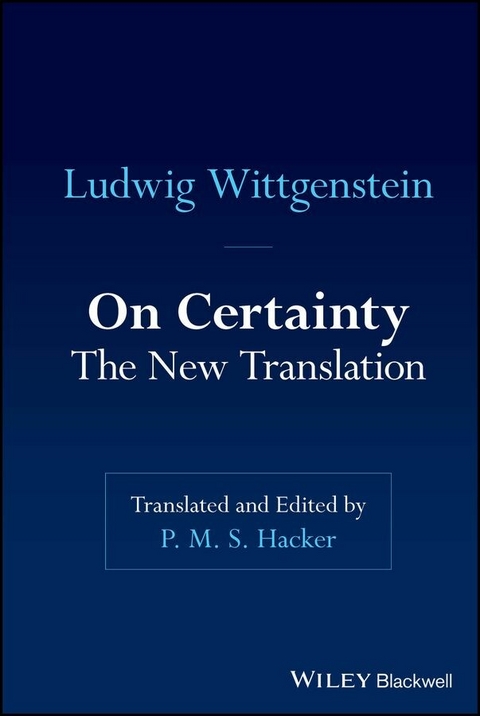
On Certainty (eBook)
339 Seiten
Wiley-Blackwell (Verlag)
978-1-394-32464-4 (ISBN)
The German text, with a facing English translation by P. M. S. Hacker
Ludwig Wittgenstein's On Certainty collects the final notes of one of the twentieth century's most influential thinkers, written during the last eighteen months of his life. These posthumously published fragments reflect on questions of knowledge, doubt, and belief. They offer a distinctive perspective on Wittgenstein's late philosophy, and contain many remarks which have greatly influenced epistemological debate in the ensuing decades.
This new translation by P. M. S. Hacker offers a clear and improved rendering of the original German, restoring features of the manuscripts that are essential for understanding the text. Presented in a facing-page German-English format, the edition is clear and readable for both students and scholars, includes a detailed introductory essay on the genesis of the text, and benefits from extensive textual notes that support deeper engagement with Wittgenstein's arguments. The text also includes several appendices with new translations of select excerpts from other late Wittgenstein manuscripts with reflections on knowledge, belief, doubt, and certainty.
This definitive translation and edition of On Certainty enables readers to engage thoughtfully with Wittgenstein's final thoughts on the limits of doubt and the grounding of belief. Enhanced by Hacker's expertise, it is an invaluable resource for those studying epistemology, philosophy of language, or Wittgenstein's later work
P. M. S. HACKER is an Emeritus Fellow at St John's College, Oxford, and one of the world's leading authorities on the philosophy of Wittgenstein. He has authored 25 books and over 175 papers, with significant contributions to the philosophy of language, mind, and neuroscience. His works include Philosophical Foundations of Neuroscience (co-authored with M. R. Bennett) and the four-volume Human Nature series.
The German text, with a facing English translation by P. M. S. Hacker Ludwig Wittgenstein's On Certainty collects the final notes of one of the twentieth century s most influential thinkers, written during the last eighteen months of his life. These posthumously published fragments reflect on questions of knowledge, doubt, and belief. They offer a distinctive perspective on Wittgenstein's late philosophy, and contain many remarks which have greatly influenced epistemological debate in the ensuing decades. This new translation by P. M. S. Hacker offers a clear and improved rendering of the original German, restoring features of the manuscripts that are essential for understanding the text. Presented in a facing-page German English format, the edition is clear and readable for both students and scholars, includes a detailed introductory essay on the genesis of the text, and benefits from extensive textual notes that support deeper engagement with Wittgenstein s arguments. The text also includes several appendices with new translations of select excerpts from other late Wittgenstein manuscripts with reflections on knowledge, belief, doubt, and certainty. This definitive translation and edition of On Certainty enables readers to engage thoughtfully with Wittgenstein's final thoughts on the limits of doubt and the grounding of belief. Enhanced by Hacker's expertise, it is an invaluable resource for those studying epistemology, philosophy of language, or Wittgenstein's later work
Editorial Preface to the New Edition and Translation of On Certainty
1. The previous editions and the New Edition
On Certainty was published in 1969 by Basil Blackwell, edited by G. E. M. Anscombe and G. H. von Wright. The text was extracted selectively from Wittgenstein’s last notebooks, written between late 1949, after his return from his visit to the USA, and 27 April 1951, two days before his death. The English preface was written by Anscombe, with small corrections made by von Wright. The first edition was published without an index. The second edition was published in 1974, with corrections and an index.
The translation of these previous editions was made by Denis Paul1 with corrections by Anscombe. How extensive Anscombe’s corrections were is unclear. The translation contains numerous infelicities. Half a century later, it is evident that a new translation and edition are desirable. The first two editions tampered with the text of the manuscripts in various ways. Wittgenstein inserted forty‐four horizontal lines of four different kinds in his text. Most (twenty‐six) are crossed by a small vertical stroke in the centre, some are plain horizontals, one is a horizontal with a double small vertical, and one is a double horizontal. Whether these differences are of any moment is wholly unclear. The function of these horizontals is not clear either. Sometimes they appear to indicate a separation of different themes. More often, it is unclear what function they were meant to fulfil. They may simply indicate ‘enough for today’. Anscombe removed many of these lines from the text, and added separating lines of her own to indicate new MSS. This has been avoided in the present edition. All separating lines in this edition are in the original MSS, but I have not preserved their differentiation into four types. The commencement of a new MS source in the current edition is indicated by the MS number and pages printed in bold.
Because Anscombe was convinced that Wittgenstein’s last manuscripts included a self‐contained monograph on certainty, she omitted any passages that did not meet her criteria for inclusion. Since Wittgenstein’s concurrent preoccupation during this period with the Inner and the Outer (the mental and its behavioural manifestation) did not fit her vision of a treatise on certainty, she screened out all discussions of knowledge, belief, certainty and doubt regarding the mental attributes of others, even when they were continuous with more general reflections on certainty. This seems most distorting in the elimination of the remarks in MS 176, 46v–51v, which are, in origin, continuous with MS 176, 22r–46r (= OC §426–§523), although, to be fair to Anscombe, they were separated by horizontal lines from §523 and §524. Nevertheless, it seemed to me appropriate to restore them to the text in the new edition and they have been numbered §523(a)–§523(s). They were written concurrently with the remarks that preceded them and with those that succeeded them in the manuscript, and restoring them to their original locus and order seemed to me more illuminating than excising them. The numerous other remarks on knowledge, belief, certainty and doubt that were screened out by Anscombe have been allocated to Appendices 1–5. The rationale for their presentation is twofold. First, it is important for scholars to be able to trace the evolution of Wittgenstein’s thoughts during the last phase of his life on these important matters. Secondly, if On Certainty is used as a teaching text on Wittgenstein’s later views on epistemological and logico‐epistemological themes, it is desirable that teachers be able to refer students to his remarks on these topics in his contemporaneous writings on the Inner and the Outer. Appendix 6 consists of Norman Malcolm’s brief notes on his conversations with Wittgenstein in Ithaca in the autumn of 1949 on Moore’s ‘Proof of an External World’ and his ‘Defence of Common Sense’. This too, is relevant for the understanding of Wittgenstein’s text in as much as the conversations with Malcolm stimulated Wittgenstein’s final reflections on these and related themes after his return from the USA (see ‘The Genesis of On Certainty’ below).
It was Wittgenstein’s custom to inscribe general cultural, and sometimes personal, reflections in his MSS, marking them out by flanking them with short vertical lines. Anscombe removed most of these remarks. They have all been restored, leaving it to readers to reflect on whether their occurrence at any particular point is purely coincidental or whether the remark is associatively linked with its antecedent. They have been given the number of their antecedent together with a lower‐case bracketed letter. (For the most part, they have been extracted and printed in Vermischte Bemerkungen, edited by G. H. von Wright (Frankfurt am Main: Suhrkamp Verlag, 2nd edn 1994).)
One form of editorial interference has been allowed in this edition. Wittgenstein, often scribbling hastily and engaged in intense dialogue with himself, frequently did not bother to complete lines, leaving instead either an ‘etc.’ or a sequence of dots (viz… .). It seemed warranted to insert the missing words or sentence in these cases in order to clarify and disambiguate. This editorial intervention is always placed between curly brackets (viz. { and }). Another use of the same notational device is to bracket the insertion of the word ‘kind of’ in phrases such as ‘That is: If I make certain false statements, …’ (gewisse falsche Aussagen mache) (§81) and ‘The truth of certain empirical propositions …’ (gewisser Erfahrungssätze) (§83) to read ‘That is: if I make certain {kinds of} false statements’, and ‘The truth of certain {kinds of} empirical propositions’ in order to make it clear that in such contexts the word ‘certain’ signifies a particular sort or kind of item, not something that is certain as opposed to doubtful.
Wittgenstein often scribbled two or three variants of a given word, phrase or sentence. Where these are philosophically relevant, they have been incorporated in the translated text, using one of Wittgenstein’s devices, namely double slashes (// … //). So, for example, one variant on the idea that he is certain that he had never been to the moon is that he had never been to the north pole. The decision as to relevance is an editorial judgement. Since this is not a critical edition, no attempt has been made to incorporate all variants (which can be seen in the Bergen electronic edition of the Nachlass).
Wittgenstein’s German punctuation and underlining is erratic and often eccentric. After several failed attempts to emulate it in English, it seemed preferable to abandon such futile efforts and to opt for perspicuous contemporary English punctuation and more circumspect italicization.
2. The translation
Wittgenstein was not particularly interested in exploring the differences between Gewißheit and Sicherheit, between gewiß and sicher, but used them as an Austrian native speaker of German would find natural. The two earlier editions did not attempt to cleave to his usage. The New Edition endeavours to mirror his usage, since the two expressions are not equivalent, and the differences are often important.2
As always in the translation of German texts, the expression ‘Satz’ is problematic and choices have to be made between ‘sentence’ and ‘proposition’ according to the exigencies of the argument. The expressions ‘Grund’ and ‘Gründe’ have been translated by ‘reason’ and ‘reasons’, rather than the more laboured ‘ground’ and ‘grounds’ (e.g. §18, 78, 90–92). This translation also maintains the nexus with reasoning and rationality. The German practice of referring to or listing concepts by inserting words in quotation marks, for example ‘den Begriffen “glauben”, “vermuten”, “zweifeln”, “überzeugt sein”’ (§21) is inappropriate in English and wherever possible such phrases are translated by disquotation, namely ‘the concepts of believing, surmising, doubting and being convinced’. The German definite article is not always to be translated by the corresponding English one. For example, Wittgenstein often speaks of ‘der Andre’ (e.g. §18). This has been translated as ‘some other person’ rather than ‘the other person’.
Wittgenstein is liberal with his use of ‘ z. B.’, ‘D. h.’, ‘u. s. w.’ and ‘etc.’. This is ugly in print, and an effort has been made to reduce the number of these abbreviations in the English text by more frequent use of ‘for example’, ‘that is’, and ‘and so forth’.
Double quotation marks have been used for quoted sentences, and single quotation marks for quotations within quotations. Single quotation marks have also been employed to mention as opposed to using an expression, and for scare quotes. When in doubt, clarity has overridden consistency.
The passages to which the notes relate are indicated by an asterisk in the German text and...
| Erscheint lt. Verlag | 21.7.2025 |
|---|---|
| Sprache | englisch |
| Themenwelt | Geisteswissenschaften ► Philosophie ► Erkenntnistheorie / Wissenschaftstheorie |
| Schlagworte | Analytic philosophy • Epistemology • On Certainty • Peter Hacker • Philosophy of Language • Philosophy of mind • skepticism • Wittgenstein • Wittgenstein certainty and belief • Wittgenstein English translation • Wittgenstein German language translation |
| ISBN-10 | 1-394-32464-2 / 1394324642 |
| ISBN-13 | 978-1-394-32464-4 / 9781394324644 |
| Informationen gemäß Produktsicherheitsverordnung (GPSR) | |
| Haben Sie eine Frage zum Produkt? |
 EPUB (Adobe DRM)
Kopierschutz: Adobe-DRM
Adobe-DRM ist ein Kopierschutz, der das eBook vor Mißbrauch schützen soll. Dabei wird das eBook bereits beim Download auf Ihre persönliche Adobe-ID autorisiert. Lesen können Sie das eBook dann nur auf den Geräten, welche ebenfalls auf Ihre Adobe-ID registriert sind.
Details zum Adobe-DRM
Dateiformat: EPUB (Electronic Publication)
EPUB ist ein offener Standard für eBooks und eignet sich besonders zur Darstellung von Belletristik und Sachbüchern. Der Fließtext wird dynamisch an die Display- und Schriftgröße angepasst. Auch für mobile Lesegeräte ist EPUB daher gut geeignet.
Systemvoraussetzungen:
PC/Mac: Mit einem PC oder Mac können Sie dieses eBook lesen. Sie benötigen eine
eReader: Dieses eBook kann mit (fast) allen eBook-Readern gelesen werden. Mit dem amazon-Kindle ist es aber nicht kompatibel.
Smartphone/Tablet: Egal ob Apple oder Android, dieses eBook können Sie lesen. Sie benötigen eine
Geräteliste und zusätzliche Hinweise
Buying eBooks from abroad
For tax law reasons we can sell eBooks just within Germany and Switzerland. Regrettably we cannot fulfill eBook-orders from other countries.
aus dem Bereich