


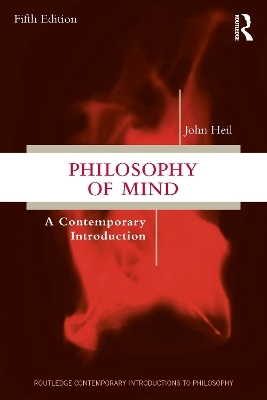
Philosophy of Mind
A Contemporary Introduction
Seiten
2026
|
5th edition
Routledge (Verlag)
978-1-041-05363-7 (ISBN)
Routledge (Verlag)
978-1-041-05363-7 (ISBN)
- Lieferbar (Termin unbekannt)
- Versandkostenfrei
- Auch auf Rechnung
- Artikel merken
This coursebook offers an accessible introduction to issues in the philosophy of mind, including the mind-body problem, causal interactions between the mental and the physical, computational models of thought, including: behaviorism, dualism, eliminativism, emergentism, functionalism, materialism, neutral monism, and panpsychism.
This popular coursebook offers an accessible introduction to issues in the philosophy of mind, including the mind–body problem, causal interactions between the mental and the physical, computational models of thought, and assorted -isms, including: behaviorism, dualism, eliminativism, emergentism, functionalism, materialism, neutral monism, and panpsychism.
Updates to the Fifth Edition include a new chapter on artificial intelligence (AI) and a revised chapter on eliminativism, externalism, and extended mind. In addition, Chapter Summaries and five Discussion Questions now appear at the end of each chapter to highlight key concepts and facilitate meaningful classroom dialogues.
The aim of the Fifth Edition, however, remains the same as the previous four: to offer a clear and engaging, relevant, and metaphysically grounded introduction to philosophy of mind. Philosophy majors and other advanced undergraduate students will, after finishing this book, have a solid grasp of problems central to this field and know where to turn next for the most promising avenues of further inquiry.
Key Updates to the Fifth Edition
A chapter on Davidson’s ‘radical interpretation’ has been replaced by a chapter on artificial intelligence, reflecting a growing interest in this area
New sections on ‘content externalism’ and the ‘extended mind’ have been added to the chapter on eliminativism
Revisions to all existing chapters, with the addition or expansion of important topics and the elimination of some less relevant material, make the book more reader-friendly without sacrificing rigor and accuracy
New Chapter Summaries and Discussion Questions appear after each chapter to cultivate productive student dialogue in the classroom
Updates to Suggested Reading lists at the end of each chapter and the Reference list at the back of the book
This popular coursebook offers an accessible introduction to issues in the philosophy of mind, including the mind–body problem, causal interactions between the mental and the physical, computational models of thought, and assorted -isms, including: behaviorism, dualism, eliminativism, emergentism, functionalism, materialism, neutral monism, and panpsychism.
Updates to the Fifth Edition include a new chapter on artificial intelligence (AI) and a revised chapter on eliminativism, externalism, and extended mind. In addition, Chapter Summaries and five Discussion Questions now appear at the end of each chapter to highlight key concepts and facilitate meaningful classroom dialogues.
The aim of the Fifth Edition, however, remains the same as the previous four: to offer a clear and engaging, relevant, and metaphysically grounded introduction to philosophy of mind. Philosophy majors and other advanced undergraduate students will, after finishing this book, have a solid grasp of problems central to this field and know where to turn next for the most promising avenues of further inquiry.
Key Updates to the Fifth Edition
A chapter on Davidson’s ‘radical interpretation’ has been replaced by a chapter on artificial intelligence, reflecting a growing interest in this area
New sections on ‘content externalism’ and the ‘extended mind’ have been added to the chapter on eliminativism
Revisions to all existing chapters, with the addition or expansion of important topics and the elimination of some less relevant material, make the book more reader-friendly without sacrificing rigor and accuracy
New Chapter Summaries and Discussion Questions appear after each chapter to cultivate productive student dialogue in the classroom
Updates to Suggested Reading lists at the end of each chapter and the Reference list at the back of the book
John Heil is a Professor of Philosophy Emeritus at Durham University and Washington University, an Honorary Research Associate at Monash University, and a Corresponding Fellow of the Australian Academy of Humanities. His most recent books include Appearance in Reality (2021), Relations (2021), and What Is Metaphysics? (2021).
1 Introduction 2 Cartesian Dualism 3 Descartes’s Legacy 4 Mind and Behavior 5 The Identity Theory 6 Functionalism 7 The Representational Theory of Mind 8 Artificial Intelligence 9 The Intentional Stance 10 Eliminativism, Externalism, and Extended Minds 11 Non-Reductive Physicalism 12 Conscsiousness 13 Emergence and Panpsychism 14 The Mind’s Place in Nature.
| Erscheinungsdatum | 03.12.2025 |
|---|---|
| Reihe/Serie | Routledge Contemporary Introductions to Philosophy |
| Zusatzinfo | 36 Line drawings, black and white; 36 Illustrations, black and white |
| Verlagsort | London |
| Sprache | englisch |
| Maße | 152 x 229 mm |
| Themenwelt | Geisteswissenschaften ► Philosophie ► Metaphysik / Ontologie |
| ISBN-10 | 1-041-05363-0 / 1041053630 |
| ISBN-13 | 978-1-041-05363-7 / 9781041053637 |
| Zustand | Neuware |
| Informationen gemäß Produktsicherheitsverordnung (GPSR) | |
| Haben Sie eine Frage zum Produkt? |
Mehr entdecken
aus dem Bereich



aus dem Bereich
eine philosophische Reise
Buch | Softcover (2024)
Goldmann (Verlag)
CHF 21,90


