


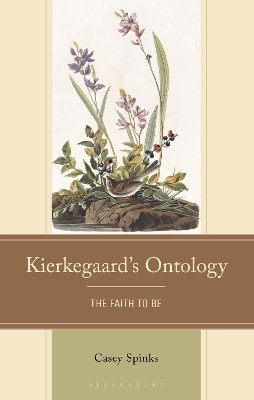
Kierkegaard's Ontology
The Faith to Be
Seiten
2026
Rowman & Littlefield (Verlag)
978-1-6669-8192-6 (ISBN)
Rowman & Littlefield (Verlag)
978-1-6669-8192-6 (ISBN)
- Noch nicht erschienen (ca. April 2026)
- Versandkostenfrei
- Auch auf Rechnung
- Artikel merken
For Kierkegaard, to be is to be in relationship to God. Bringing this understanding to Kierkegaard’s authorship helps uncover his fundamental ontology.
What is it to be? And what is it to be a Christian? Casey Spinks suggests these two questions belong together when readers attend to Kierkegaard’s authorship, and such attention calls for the task of uncovering Kierkegaard’s fundamental ontology.
This book argues that the heart of that ontology is to be found in the religious discourses of his Second Authorship. Using the devotional discourse The Lily of the Field and the Bird of the Air as his guide, Spinks argues that Kierkegaard offers a distinct Christian sense of being: faith. In particular, in his Second Authorship, he moves from irony to earnestness, and identifies silence, obedience, and joy as ontologically significant categories. This Christian ontology fundamentally opposes the rationalist ontology of G.W.F. Hegel—as well as any other philosophical ontology based on autonomous reason or human subjectivity. As a result, Kierkegaard proves to be a unique Christian figure in the history of Western metaphysics, one with forceful relevance to contemporary questions of first philosophy and first theology.
What is it to be? And what is it to be a Christian? Casey Spinks suggests these two questions belong together when readers attend to Kierkegaard’s authorship, and such attention calls for the task of uncovering Kierkegaard’s fundamental ontology.
This book argues that the heart of that ontology is to be found in the religious discourses of his Second Authorship. Using the devotional discourse The Lily of the Field and the Bird of the Air as his guide, Spinks argues that Kierkegaard offers a distinct Christian sense of being: faith. In particular, in his Second Authorship, he moves from irony to earnestness, and identifies silence, obedience, and joy as ontologically significant categories. This Christian ontology fundamentally opposes the rationalist ontology of G.W.F. Hegel—as well as any other philosophical ontology based on autonomous reason or human subjectivity. As a result, Kierkegaard proves to be a unique Christian figure in the history of Western metaphysics, one with forceful relevance to contemporary questions of first philosophy and first theology.
Casey Spinksis teaching postdoctoral fellow of religion at Baylor University, USA.
Preface
Acknowledgments
A Note on Abbreviations
Part One: Introduction
Being and the Essentially Christian
Part Two: Being an Ontological Writer
Chapter Two: (Not) Being a Knower
Chapter Three: Being Edified
Part Three: Being-In-Itself: Silence
Chapter Four: Being Silent
Chapter Five: Against Being Bound to Human Speech
Part Four: Being-For-Itself: Obedience
Chapter Six: Being Obedient
Chapter Seven: Against Being a Master
Part Five: Being-In-And-For-Itself: Joy
Chapter Eight: Being Joy
Chapter Nine: Against Being in Despair
Part Six: Conclusion
The End of the Path of Thinking
Bibliography
Index
| Erscheint lt. Verlag | 30.4.2026 |
|---|---|
| Reihe/Serie | New Kierkegaard Research |
| Sprache | englisch |
| Maße | 152 x 229 mm |
| Themenwelt | Geisteswissenschaften ► Philosophie ► Metaphysik / Ontologie |
| Geisteswissenschaften ► Philosophie ► Philosophie der Neuzeit | |
| Geisteswissenschaften ► Religion / Theologie | |
| ISBN-10 | 1-6669-8192-3 / 1666981923 |
| ISBN-13 | 978-1-6669-8192-6 / 9781666981926 |
| Zustand | Neuware |
| Informationen gemäß Produktsicherheitsverordnung (GPSR) | |
| Haben Sie eine Frage zum Produkt? |
Mehr entdecken
aus dem Bereich


aus dem Bereich
eine philosophische Reise
Buch | Softcover (2024)
Goldmann (Verlag)
CHF 21,90


