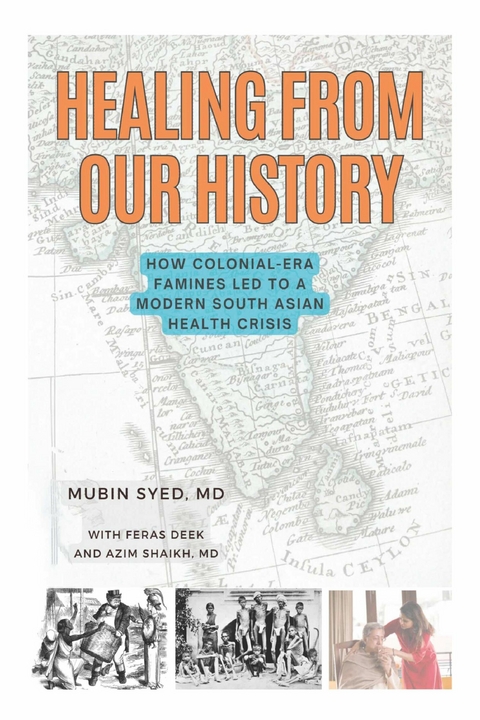
Healing From Our History (eBook)
340 Seiten
Bookbaby (Verlag)
979-8-3509-6478-3 (ISBN)
Azim Shaikh, MD, MBA, is an Internal and Obesity Medicine specialist, and CEO of a surgical hospital. With over 20 years of collaboration, he and Dr. Mubin Syed have achieved remarkable success, including numerous publications, patents, and medical device innovations. Of South Asian heritage, Dr. Shaikh's own experience with a cardiac event at 51 deepened his commitment to exploring why South Asians are more susceptible to early-onset cardiometabolic diseases, driving his desire to research this critical health concern.
Healing From Our History presents a clear, often shocking case of how man-made famines and systemic depopulation of South Asia during the British colonial era led to a modern health crisis among South Asians today. How with knowledge of this hidden history, South Asians can be proactive about living healthier lives. Dr. Mubin Syed, a practicing physician with six board certifications and a published health historian, details how South Asians, who make up 25% of the world population, have alarmingly high rates of heart disease, diabetes, and other life-threatening illnesses. This is partly due to lifestyle choices like poor diet and lack of exercise, but there's also a growing body of evidence, some previously hidden or whitewashed, that it was the numerous and tragic colonial-era famines all over South Asia that led to modern genetic predispositions for disease. Over the 190 years that the British controlled South Asia, there were more than 25 famines that led to the death of an estimated 165 million people. South Asia was seen as an abundant territory to exploit, the population considered an obstacle to remove or disregard. Studies of children and grandchildren of famine-surviving populations show that genetic differences make them more susceptible to disease and early death. Healing From Our History shares details of the man-made famines and systematic and destructive policies and practices. It presents commentary from contemporaries who implemented the policies that taxed, subjugated, starved, imprisoned millions of people. There were people who tried to help by shedding light on the tragedies like Florence Nightingale, and Willoughby Wallace Hooper, a British photographer who took pictures of South Asians famine victims hours before they died. It was a small but vital attempt to document the tragedies being ignored or hidden under the British colonial-era zeal for wealth at all costs. This book is a reckoning with the past to help people and leaders acknowledge these historical truths that affect South Asian health today. It is for individuals, doctors, and leaders to help current generations pay closer attention to the unique healthcare needs of South Asians, and pave a healthier path for future generations.
Timeline of South Asian History
| Year | Event |
| Precolonial South Asia |
| 1526-1857 | Mughal Empire rule |
| 1600 | Formation of the East India Company (EIC). |
| 1615 | The EIC acquires its first territory on the Indian subcontinent, Surat (Gujarat). |
| 1628-1658 | Shah Jahan serves as the 5th Mughal emperor. |
| 1630-1632 | The Deccan Famine, an estimated 7.4 million excess deaths were reported. |
| 1658-1707 | Aurangzeb (Muhi-ud-Din Muhammad) serves as the 6th Mughal emperor. |
| 1645-1818 | Maratha Empire rule |
| Colonial British Rule |
| 1757 | Battle of Plassey, resulted in the EIC gaining full control over the Bengal territories. |
| 1769-1773 | Great Bengal Famine: 10 million estimated deaths (33% of the population). |
| 1772-1785 | Warren Hastings serves as the Governor General of Bengal. |
| 1782-1784 | Madras and Chalisa Famines, upwards of 11 million deaths. |
| 1782-1799 | Kingdom of Mysore, Tipu Sultan serves as a ruler. |
| 1791-1792 | Doji Bara “Skull” Famine: 11 million deaths from starvation occurred 1789-1792. |
| 1802-1803 | Bombay Presidency Famine |
| 1805-1807 | Madras Presidency Famine |
| 1812-1813 | Rajputana Famine: 1.5-2 million deaths. |
| 1812-1813 | Kathiawar Region Famine: western Indian peninsula, Gujarat. |
| 1813 | Passing of the Charter Act, ending ended the EIC trade monopoly in India. |
| 1818 | Third Anglo-Maratha war |
| 1819-1820 | Broach Famine: Bharuch, Gujarat, western India |
| 1820-1822 | Sind Famine (southeastern Pakistan) |
| 1823 | Madras Presidency Famine |
| 1825 | Dadabhai Naoroji (“The Grand Old Man of India) is born. |
| 1837-1838 | Agra Famine: 800,000-1 million deaths. |
| 1839-1842 | First Anglo-Afghan war |
| 1845-1852 | Irish Potato Famine: Over 1 million deaths.2 |
| 1848-1856 | Lord Dalhousie (aka James Broun-Ramsay) serves as the Viceroy of India. |
| 1849 | The Great Indian Peninsular Railways begins operating for purposes of exporting cotton, silk, opium, sugar and spices. |
| 1853 | Berar territory is taken under EIC administration |
| 1853 | Thane and Colaba Famine: western India, Maharashthra. |
| 1854 | Madras Presidency Famine |
| 1854 | Bellary Famine, associated with other local famines resultant of food price spikes. |
| 1857 | First Indian War of independence (Sepoy Mutiny/Rebellion) |
| 1858 | 1858 Government of India Act: ends of Mughal rule in India, and of direct British Crown rule (British Raj). |
| 1861-1865 | American Civil War |
| 1860-1861 | Upper Doab Famine: at least 2 million deaths. |
| 1865 | First Indian Forest Act is passed. |
| 1866 | Orissa Famine: 1.5 million deaths. |
| 1869 | Mahatma Gandhi is born. |
| 1869 | Rajputana Famine, 1.5 million official deaths. |
| 1873-1874 | Bihar Famine, with an estimated death toll of 23, demonstrates the capabilities of British interventions to reduce death tolls during famine. |
| 1873-1876 | The Cotton Depression.3 |
| 1876-1878 | The Great Famine (Madras Famine): an estimated 5.5-11 million deaths. |
| 1876-1880 | Lord Robert Lytton serves as the Viceroy of India. |
| 1877 | Queen Victoria serves as Empress. |
| 1877-1880 | Sir Richard Temple serves as Governor of Bombay. |
| 1878 | The Second Indian Forest Act is passed. |
| 1878-1880 | Second Anglo-Afghan... |
| Erscheint lt. Verlag | 8.4.2025 |
|---|---|
| Sprache | englisch |
| Themenwelt | Geisteswissenschaften ► Geschichte ► Regional- / Ländergeschichte |
| ISBN-13 | 979-8-3509-6478-3 / 9798350964783 |
| Informationen gemäß Produktsicherheitsverordnung (GPSR) | |
| Haben Sie eine Frage zum Produkt? |
 EPUB (Ohne DRM)
Größe: 4,6 MB
Digital Rights Management: ohne DRM
Dieses eBook enthält kein DRM oder Kopierschutz. Eine Weitergabe an Dritte ist jedoch rechtlich nicht zulässig, weil Sie beim Kauf nur die Rechte an der persönlichen Nutzung erwerben.
Dateiformat: EPUB (Electronic Publication)
EPUB ist ein offener Standard für eBooks und eignet sich besonders zur Darstellung von Belletristik und Sachbüchern. Der Fließtext wird dynamisch an die Display- und Schriftgröße angepasst. Auch für mobile Lesegeräte ist EPUB daher gut geeignet.
Systemvoraussetzungen:
PC/Mac: Mit einem PC oder Mac können Sie dieses eBook lesen. Sie benötigen dafür die kostenlose Software Adobe Digital Editions.
eReader: Dieses eBook kann mit (fast) allen eBook-Readern gelesen werden. Mit dem amazon-Kindle ist es aber nicht kompatibel.
Smartphone/Tablet: Egal ob Apple oder Android, dieses eBook können Sie lesen. Sie benötigen dafür eine kostenlose App.
Geräteliste und zusätzliche Hinweise
Buying eBooks from abroad
For tax law reasons we can sell eBooks just within Germany and Switzerland. Regrettably we cannot fulfill eBook-orders from other countries.
aus dem Bereich