


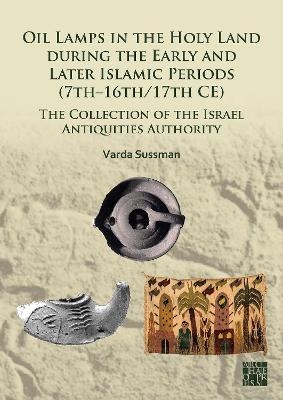
Oil Lamps in the Holy Land during the Early and Later Islamic Periods (7th–16th/17th CE)
Archaeopress Archaeology (Verlag)
978-1-80327-911-4 (ISBN)
This volume is the last in a comprehensive catalogue of oil lamps in the collection of the Israel Antiquities Authority. It considers the final stage of development in the shaping and decoration of pottery lamps, drawing from earlier forms to gradually become distinct lamps in their own right while retaining characteristics of their forerunners. The change of shape from a saucer to a small closed lamp was subject to both western and eastern influences and guided the local workshops for the next thousand years. The lamps of the Islamic period clearly demonstrate this continuity, incorporating the ethnic and cultural changes among Jews, Samaritans, Christians, and Muslims in the Holy Land.
This is readily discernible in the Islamic period, when lamp production throughout the country became 'culturally' unified, as expressed by the general avoidance of depicting ethnic symbols. The lamps from the Islamic period are easily recognizable by their linear style of decoration (no relief, the avoidance of figural art). The acceptance of the shape of these lamps and their division into sections with a central pattern (the decorated 'channel') – suggested here as a Christian means of perceiving the lamp and its light as a divine vessel – was now further adapted through the pattern along the center of the 'nozzle' under the wick hole, rendering the torch from which the flame/light emanated (or the shrine and hanging lamp (the wick hole) beneath the lamp’s vault) as an integral part of the pattern resting on the filling hole.
Varda Sussman graduated from the Hebrew University in Jerusalem in 1956, earning her BA and MA degrees. She studied for a year at the Oriental School of Archaeology in Chicago toward her Ph.D., but decided to return to Israel and work at the Israel Department of Antiquities in Jerusalem. She participated in various excavations and became the Curator responsible for cataloguing and storing archaeological artifacts, establishing a system of registration and retrieval that enabled their availability to the academic world as a source of research. After retiring, Varda taught at Bar Ilan University, imparting her broad knowledge about the development of pottery oil lamps. In addition to publishing many articles on oil lamps, she has focused on publishing catalogues, by historical period, of the present-day Israel Antiquities Authority’s collection of oil lamps.
Introduction. The Islamic period (The late Byzantine to Medieval periods)
Part I. Mold-Made Oil Lamps
I. Blister- and cone-shaped handles (Map 1)
ISM1: Lamps with a torque surrounding the filling hole (including a subtype) (#3287–#3321): 7th–8th centuries CE
ISM2: Lamps decorated with radial strokes (#3327–#3335): late 6th–9th centuries CE
ISM3: Lamps decorated in bold linear relief (#3336–#3341): late 7th(?)–8th centuries CE
ISM4: Lamps with conical or lump-shaped handles: products of northern workshops in the Early Islamic period (Umayyad [7th–8th centuries CE] to Abbasid) (#3344–#3446)
Discussion: Types ISM1–ISM4
Decorations
Part II. Tongue-shaped handles
ISM5–ISM11: Lamps with erect tongue-shaped handles
ISM5: Samaritan lamps with a horseshoe-shaped filling hole and a tongue-shaped handle (#3447–#3454): #3447, #3448, #3449, #3450, and #3451 from Kh. al-Lajjun; #3452, #3453, and #3454 from a pit at Ramla—7th–9th centuries CE (Abbasid period)
ISM6: Crudely fashioned lamps with a narrow semicircular horseshoe filling hole (lamps 40.380 from Jordan and #3455 and #3456 are of unknown provenance, but are included in the catalogue because of parallels at excavated sites)—probably 8th century CE and later (Map 2)
ISM7: Coarse lamps with a circular filling hole (#3457 from Ashqelon, #3458 from Apollonia, #3459 from Jerusalem [Bethany], and #3460 from Kokhav Hayarden)—Early/Late Islamic period (Map 2)
ISM8: Coarsely decorated northern (Jordan Valley) lamps #3461 from Bet She’an; #3462 and #3463 from Kh. el-Minyeh; #3464, #3465, #3466, #3467, #3468, and #3469 from Kokhav Hayarden—the date is unclear 9th–11th/12th or 13th–14th centuries CE
ISM9: Almond-shaped lamps with an almond-shaped center and base (#3471–#3495) from a workshop in Tiberias—8th–12th centuries CE
ISM10: Lamps probably produced in two workshops: central (Caesarea) and northern (Tiberias and Bet She’an) (#3496–#3531)—8th–9th centuries CE or later
ISM11: Lamps of the Kh. el-Mafjar type, 8th/ 9th–11th centuries CE (with a “straight-sided channel”) (#3533–#3837)
ISM12: Jerash lamps of the late 6th/7th–8th/9th centuries CE (#3838–#3844)
ISM13: Sandal-shaped (slipper- or duck-shaped) lamps, 13th–15th centuries CE (#3845–#3868.1): #3855 from Kh. el-Minyeh; #3849.1 from Susiya; #3859 from Hammat Gader; #3849, #3865, and #3868.1 from Atlit; #3848 from Apollonia; #3850 purchased in Hebron; #3851 and #3858 from Qaqun; 3846; #3854, #3860, #3866, and #3867 from Bet She’an; #3845, #3862, #3863, #3864, and #3868 from Jerusalem; #3857 from Kh. Shema‘ (Meron); #3853 from Kokhav Hayarden; #3852 from Tell el-Ajjul; #3856 from Kh. el-Mafjar
Part III. Wheel-Made Oil Lamps: Introduction
ISW14: Circular/tire-shaped lamps with a pointed “nozzle” (#3869–#3875): Late Byzantine–Umayyad periods or later (fig. 113)
ISW15: lamps with no handle and with a carinated bowl covered with a wide, slightly convex lid (10th–11th centuries CE)
ISW16: Beehive- or dome-shaped lamps (#3876–#3992): 9th/10th–13th up to the 15th centuries CE
ISW17: Conch-shaped saucer lamps (#3998–#4006; 13th—20th centuries CE)
ISW18: Boot-shaped teapot lamps with gutter-shaped “nozzles” (#4037–#4048): 11th–14th centuries CE
Bibliography
Concordance table of sites
Catalogue
| Erscheinungsdatum | 02.08.2025 |
|---|---|
| Zusatzinfo | 146 figures, 142 tables, 93 plates (some colour) |
| Verlagsort | Oxford |
| Sprache | englisch |
| Maße | 205 x 290 mm |
| Gewicht | 1644 g |
| Themenwelt | Geisteswissenschaften ► Archäologie |
| ISBN-10 | 1-80327-911-7 / 1803279117 |
| ISBN-13 | 978-1-80327-911-4 / 9781803279114 |
| Zustand | Neuware |
| Informationen gemäß Produktsicherheitsverordnung (GPSR) | |
| Haben Sie eine Frage zum Produkt? |
aus dem Bereich


