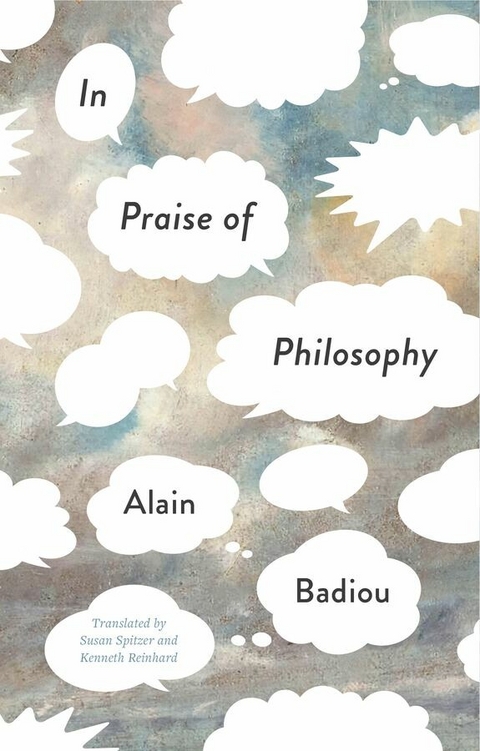
In Praise of Philosophy (eBook)
190 Seiten
Polity (Verlag)
978-1-5095-6565-8 (ISBN)
At the same time, philosophy is presented not as a system or doctrine but as movement and dialogue. The philosopher is not a solitary figure; he is inseparable from his pupils, his disciples and his adversaries. It is only at the end of the journey that he arrives at the written, stable forms of his work. So we are dealing more with a play than a treatise, more with dialogues than monologues, more with a course than a book. The obvious model is Plato's Socrates, who, in founding philosophy as a discipline, ensured that it could be established anywhere in the world. In praise, yes, of philosophy as the public creation of a thought that, inventing itself and transporting itself anywhere, speaking to anyone about anything, invents the theatricalization of being.
Alain Badiou is a philosopher, mathematician and novelist who lives in Paris.
What kind of philosophy do we need for the 21st century? To answer to this question, Alain Badiou imagines a dialogue between Toc ras, an earnest and engaging professor, and various interlocutors from different countries and philosophical cultures John After from Britain, Amantha from Greece, B adj Akil from Senegal, Xi La Pong from China and several others. Their conversation takes readers on a playful journey through the history of philosophy framed by the five great questions that have preoccupied Alain Badiou: democracy, freedom, universality, language and being. At the same time, philosophy is presented not as a system or doctrine but as movement and dialogue. The philosopher is not a solitary figure; he is inseparable from his pupils, his disciples and his adversaries. It is only at the end of the journey that he arrives at the written, stable forms of his work. So we are dealing more with a play than a treatise, more with dialogues than monologues, more with a course than a book. The obvious model is Plato's Socrates, who, in founding philosophy as a discipline, ensured that it could be established anywhere in the world. In praise, yes, of philosophy as the public creation of a thought that, inventing itself and transporting itself anywhere, speaking to anyone about anything, invents the theatricalization of being.
Day 1
As he was walking beside a gentle little stream, “Professor” Tocéras, who, before being hired by the Institution Instituted as Instituting—the famous I. I. I.—had never “professed” anything, wondered wistfully why, in our world, English is spoken everywhere, or at any rate approximations of that beautiful language, which he, despite being a professional speaker (at the I. I. I. they said “speaker,” never “professor”), had never been able to speak. Tocéras was thinking/speaking aloud, amid the gentle babbling of the water: “Of course, you could say that in a certain sense there’s only one world, that of global commerce and its capitalist substructure. And, if there really is only one world, it’s no wonder that there’s only one language of that world. And for reasons of history and imperial power, that language is English or a dialect derived from it, like American English …”
Tocéras had a habit of contradicting himself, especially when he was alone by the stream, all the more so because he was a fanatical admirer of Socrates’ dictum “The only thing I know is that I know nothing.” In “his deep-down insides,” as Sapeur Camember1 used to say, he continued his linguistic meditation, all the while stepping over stinging nettles. “It’s a problem, a real problem! Because philosophy is supposed to take all differences into consideration and especially to ponder the multiplicity of peoples and cultures. So, are we going to speak only this one language, simply because we’re part of contemporary capitalist globalization? Wouldn’t that be a capitulation?”
Tocéras then did a little jump for joy. “We’re back to our same old problem: we have to speak English, but why? That’s it! Philosophy means always asking ‘why?’ Well, first and foremost because today we need to address philosophy to other people, to everyone, and because, basically, ‘everyone’ speaks English today. Of course, this doesn’t apply to everyday life, where we speak French, German, Spanish, Bambara, Persian, or Japanese, or any other of the hundreds of existing languages, all of which can be said, in this respect, to have the same intrinsic relevance to the course of existence as English. But to address philosophy to people who don’t speak your language, you have to speak English nowadays, you have to be translated into English.”
He was approaching the old mill. A little waterfall was endlessly turning the remnants of a waterwheel that was once responsible for providing the village of Foos-en-Sus with a fitful supply of electricity. It was in this mill that the speaker’s listeners met (at the I. I. I. they never said “pupil” or even “student” but always “listener”). And, when it came to speaking, Speaker Tocéras was ready to roll: he would continue with his meditation on English for his little group of listeners. As a speaker, he’d already mulled over, while walking beside the stream, the main consideration of his little speech as he intended to speak it in the speaking-mill.
And he launched into it in this way:
— The problem of the contemporary hegemony of the English language is very specific but also very far-reaching because it concerns the relationship—today, in “our” world—between philosophy and universality. Why is this so? Well, because we must first ask ourselves whether philosophy’s universality can be explained by its inclusion in the world as it is or whether it is universal precisely because it does not lie completely within the world as it is, because it lies in a world that, in a way, doesn’t exist, a world—according to conflicting opinions—that is either imaginary and illusory or more real than all the worlds that can be found within reality.
An Italian listener named Clesacalli, who was already known for his insolence, responded to this opening attack with a short but forceful counterattack, directly connected to the question of existence:
— There’s lotsa people who say that philosophy isn’t worth squat anyhow, since, as you yourself say, the world of philosophy’s an abstraction that doesn’t exist.
But Tocéras, unruffled, applied the electric current of his thought to the objection itself:
— Good point, Mr. Clesacalli. You’re giving me another argument! We could in fact respond by saying that, on the contrary, philosophy is useful precisely because the world of philosophy is not exactly the world as it is: the philosophical will and the language in which that will is expressed actually lie between the world as it is and the world as we would like it to be. As I see it, philosophy moves between two approaches. The first considers the world as it is, a world that we need to know and of which we need to provide a clear vision. The second, which considers the world from the standpoint of what could be called philosophical desire, speaks to us about what the world could be.
At that point, one of the listeners, the most faithful among the faithful, a young Greek woman named Amantha, felt that she could not only support the speaker but at the same time steer his argument back to its starting point, namely the question of English.
— On that basis, we can return to the truly crucial question posed at the outset by Mr. Tocéras: in what language should philosophy be spoken and written? This is not just a question of grammar and logic, concerning the structure of languages; it’s a question that more precisely concerns the problem of knowing in what language philosophy exists, so to speak, most effectively. The answer is that philosophy exists today in the dominant language of capitalist globalization and that if it accepts to be within the world as it is, then it has to speak this contemporary universal language, that is, a kind of bastardized English, an international and commercial language derived from the English language.
Tocéras was always delighted when the astute, beautiful Amantha came to his assistance, and he wouldn’t have minded if she’d gone even farther in that direction, if, for example, she’d transformed “assistance” into the ambiguous concept of “active sympathy.” But he was also adept at showing nothing of his feelings, except on rare occasions, through the slightest nuances in the inflections of his voice. This time, though, he began his reply with a somewhat suspicious degree of enthusiasm:
— You’re remarkable, Amantha. You’re like a shepherdess who always knows how to bring her lost sheep back to the fold. The common expression “Let’s get back to our sheep”2 implies a genuine discipline of thought where you’re concerned. Yet I don’t think we can be satisfied with that obligation, however realistic it may seem. It’s actually not a truly creative possibility. The true creative logic to which philosophy should be subjected would consist, on the contrary, in inscribing the real of philosophy not in the dominant language but in the total multiplicity of languages. What does this mean? First and foremost, that philosophy can’t be reduced to a single language, because if it could, if it were expressed in only one particular language, it could certainly not be universal …
Just then, Clesacalli saw a chance to jam the machine and shut the speaker up:
— Everyone speaks in their own language, that’s all there is to it, and the philosopher does the same. Later, you translate if you like …
— Oh, come on, Clesacalli! Don’t play dumb! Tocéras shot back. I assume you’re familiar with the example of Heidegger. He didn’t just write in German! He had the audacity to say that, today, German was, after Ancient Greek, the true language of philosophy and that it was possible to say something along the lines of “Being speaks German.” That’s a purely nationalistic position, in the fascistic sense of the term. I think Heidegger is a great philosopher, but this specific position regarding the language of philosophy is in total contradiction with the universality of philosophy, with the recognition that there is a Subject to which philosophy is addressed, a Subject that is humanity as such, not humanity in one language, in one specific culture, in the frenzy of intellectual nationalism. Philosophy, as I understand it—and, for me, this is a condition of its existence—is impossible if we don’t accept that there is something like humanity as such. Naturally, there are all sorts of cultures and differences, because humanity is a complex multiplicity, but this multiplicity must first be recognized in its fundamental unity, otherwise sub-humans, or sub-nations, or a “weaker sex,” or accursed “races” would be singled out, which would immediately bring disgrace upon philosophy. To use a more technical term, there’s something like a generic humanity, a humanity that’s not reducible, at least not right away, to its immanent differences, nor to any of its particularities. And so, whatever the idiom in which it’s expressed, philosophy, speaking about humanity to humanity, cuts across all existing languages, even those...
| Erscheint lt. Verlag | 8.4.2025 |
|---|---|
| Übersetzer | Susan Spitzer, Kenneth Reinhard |
| Sprache | englisch |
| Themenwelt | Geisteswissenschaften ► Philosophie ► Allgemeines / Lexika |
| Schlagworte | agreement • Alain Badiou • Alain Badiou new book • Badiou • Being • Capitalism • Colonization • communism • Democracy • everyday philosophy • freedom • Globalization • History of Philosophy • imperialism • in praise of philosophy • instituting • irreducible humanity • language • Multiculturalism • Objection • philosophy as academic discipline • philosophy as movement and dialogue • Plato • Politics • Scientific Method • Socratic dialogue • the culture of philosophy • Traditional Wisdom • universality • what are Alain Badiou’s key concepts • who is a philosopher • why philosophize |
| ISBN-10 | 1-5095-6565-5 / 1509565655 |
| ISBN-13 | 978-1-5095-6565-8 / 9781509565658 |
| Informationen gemäß Produktsicherheitsverordnung (GPSR) | |
| Haben Sie eine Frage zum Produkt? |
 EPUB (Adobe DRM)
Kopierschutz: Adobe-DRM
Adobe-DRM ist ein Kopierschutz, der das eBook vor Mißbrauch schützen soll. Dabei wird das eBook bereits beim Download auf Ihre persönliche Adobe-ID autorisiert. Lesen können Sie das eBook dann nur auf den Geräten, welche ebenfalls auf Ihre Adobe-ID registriert sind.
Details zum Adobe-DRM
Dateiformat: EPUB (Electronic Publication)
EPUB ist ein offener Standard für eBooks und eignet sich besonders zur Darstellung von Belletristik und Sachbüchern. Der Fließtext wird dynamisch an die Display- und Schriftgröße angepasst. Auch für mobile Lesegeräte ist EPUB daher gut geeignet.
Systemvoraussetzungen:
PC/Mac: Mit einem PC oder Mac können Sie dieses eBook lesen. Sie benötigen eine
eReader: Dieses eBook kann mit (fast) allen eBook-Readern gelesen werden. Mit dem amazon-Kindle ist es aber nicht kompatibel.
Smartphone/Tablet: Egal ob Apple oder Android, dieses eBook können Sie lesen. Sie benötigen eine
Geräteliste und zusätzliche Hinweise
Buying eBooks from abroad
For tax law reasons we can sell eBooks just within Germany and Switzerland. Regrettably we cannot fulfill eBook-orders from other countries.
aus dem Bereich