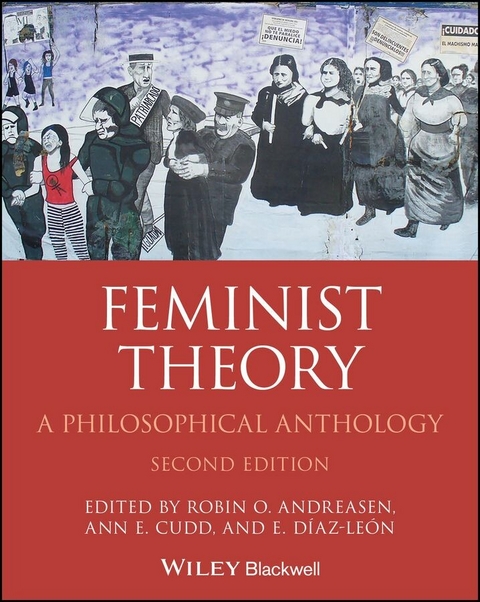
Feminist Theory (eBook)
1817 Seiten
Wiley-Blackwell (Verlag)
978-1-394-17267-2 (ISBN)

Bringing together influential voices and groundbreaking new essays, Feminist Theory: A Philosophical Anthology examines the key questions at the heart of feminist philosophy through a clear structure and accessible yet rigorous content. This carefully curated selection of classic and contemporary essays emphasizes the flourishing growth of feminist thought over time, ranging from foundational texts by Simone de Beauvoir, Judith Butler, and Kimberlé Crenshaw, to new essays by contemporary scholars like Kate Manne, Talia Mae Bettcher, and Robin Dembroff.
This edition expands on the original with fresh scholarship and a broader range of perspectives on gender, identity, knowledge, production and justice. New essays address intersectionality, gender identity, the critique of ideal theory, feminist critiques of traditional ethics, the impact of social norms on autonomy and epistemic injustice, and much more. Including critiques of traditional philosophical frameworks and self-reflection of feminism itself, this essential collection highlights how feminist theory shapes and challenges our current understanding of society.
Designed for students and scholars in philosophy, gender studies, and social theory, Feminist Theory: A Philosophical Anthology is ideal for students taking courses in feminist philosophy and feminist theory, educators in social sciences and humanities, and activists and professionals seeking a nuanced understanding of feminist philosophy.
ROBIN O. ANDREASEN is Chair and Professor in the Department of Linguistics & Cognitive Science at the Department of Philosophy at the University of Delaware. Her research interests lie at the intersection of philosophy of science and the philosophy of race and gender. Her work has been featured in many journals, including The British Journal of Philosophy of Science, Philosophy of Science, and Biology and Philosophy.
ANN E. CUDD is Professor of Philosophy at the University of Pittsburgh, where she also serves as Provost and Senior Vice Chancellor. Previously, she was Dean of the College of Arts and Sciences at Boston University and University Distinguished Professor of Philosophy at the University of Kansas. She is co-editor of Theorizing Backlash: Philosophical Reflections on the Resistance to Feminism.
E. DÍAZ-LEÓN is Associate Professor in the Department of Philosophy at the University of Barcelona. She specializes in the philosophy of mind and language, and the philosophy of gender, race, and sexuality. Her main interests include the metaphysics of sexual orientation, the nature of social construction, and methodological issues surrounding conceptual ethics.
Bringing together influential voices and groundbreaking new essays, Feminist Theory: A Philosophical Anthology examines the key questions at the heart of feminist philosophy through a clear structure and accessible yet rigorous content. This carefully curated selection of classic and contemporary essays emphasizes the flourishing growth of feminist thought over time, ranging from foundational texts by Simone de Beauvoir, Judith Butler, and Kimberl Crenshaw, to new essays by contemporary scholars like Kate Manne, Talia Mae Bettcher, and Robin Dembroff. This edition expands on the original with fresh scholarship and a broader range of perspectives on gender, identity, knowledge, production and justice. New essays address intersectionality, gender identity, the critique of ideal theory, feminist critiques of traditional ethics, the impact of social norms on autonomy and epistemic injustice, and much more. Including critiques of traditional philosophical frameworks and self-reflection of feminism itself, this essential collection highlights how feminist theory shapes and challenges our current understanding of society. Designed for students and scholars in philosophy, gender studies, and social theory, Feminist Theory: A Philosophical Anthology is ideal for students taking courses in feminist philosophy and feminist theory, educators in social sciences and humanities, and activists and professionals seeking a nuanced understanding of feminist philosophy.
Feminist Theory: An Introduction to the Second Edition
What Is Feminist Theory?
Feminist theory is a diverse field that defies a simple or singular characterization. Feminist theorists come from a variety of disciplines across the humanities, social, and natural sciences and often vary in their theoretical and methodological approaches to inquiry. Theorists do not always agree on the primary goal(s) of feminism (whether it be to end or mitigate against patriarchy, women’s oppression, sexism, or something else) nor in their characterizations of key concepts (patriarchy, oppression, gender, etc.). There are also a variety of viewpoints about the types of remedies that ought to be pursued and over whether a society free of patriarchy, sexism, or oppression is possible or what it should look like.
These differences in perspective ought to be embraced. Not only are they important for advancing the field; they are a reflection of the flourishing of the feminist theory over time. The editors of this volume see no reason to insist on a strict definition of feminism or universally agreed upon answers to concerns of interest to feminists. For the purposes of this volume, we suggest the following working definition – or broad characterization – of feminist theory: Feminist theory is an intellectually driven effort to mitigate against women’s oppression and its intersections with other forms of oppression. Our goal with this characterization is to allow for conceptual latitude while at the same time highlighting some points of general, though perhaps not universal, agreement.
For example, most if not all feminists hold that patriarchy exists and that it harms women. The exact nature of the harm is under discussion but there is no doubt about its existence. We can think of patriarchy as a hierarchical social system that is underwritten by deeply embedded social norms and institutional structures that concentrate power and privilege in the hands of men and oppresses women. Patriarchal social systems are, and have been, prevalent across cultures and throughout much of history. Women around the world and historically have experienced reduced educational, professional, and leadership opportunities, often take on a larger proportion of family labor, are more likely than men to experience gender‐based violence, and are less politically, economically, epistemically, and socially empowered (UNESCO 2024; World Economic Forum 2024; United Nations 2020). Such disparities are neither accidental nor occasional; they are a consequence of patriarchy.
The concept of women’s oppression has received significant theoretical development and critical scrutiny over the years. Oppression, broadly construed, is a moral or social justice concept used to describe a broad network of systemic inequities, harms, limitations, injustices, and so on, which most feminists claim all women experience as a consequence of patriarchy. First‐ and second‐wave characterizations of women’s oppression tended to assume that there is a universal form of oppression experienced by all women regardless of their position in other stratified social groups. Such characterizations typically relied almost exclusively on the experiences of advantaged white women in their theoretical development of the concept. Black feminists as early as the mid‐nineteenth century, however, objected that such characterizations neglect the experiences of women of color. Sojourner Truth (1851), for example, argued that social justice movements have been biased in theory and in action by failing to take into account the obvious differences in experiences and concerns between nineteenth‐century black and upper‐class white women. Feminists from the 1970s and 1980s built on this theme by making explicit, and eventually naming (Crenshaw 1989), the phenomenon of intersectionality and integrating it into their theoretical work. This is the idea that people take on or are attributed multiple social identities – based on race/ethnicity, gender, sexual orientation, economic status, ability status, global status, and so on – that interact and produce compounded experiences of oppression for individuals belonging to multiple marginalized social groups. This body of work has led to general agreement among feminists that there is no one way in which women are oppressed and no singular concept of women’s oppression. It has also brought to the fore the generally held view that effective resistance to patriarchy should not be based on an analysis of gender alone.
In addition to agreeing that patriarchy exists and that it plays a role in interlocking networks of oppression, feminists tend to be united in a commitment to bring about change. What this looks like and how it might be accomplished depends on one's methodological and theoretical approach, but there is broad agreement that systems of oppression are wrong, unjust, and ought to be resisted. Feminist theory contributes to resistance in a multitude of ways – for example, by exposing the systemic power imbalances produced by patriarchy and other hierarchical social systems, by identifying and working to dismantle the social structures and norms that uphold such systems, by examining the moral and ethical implications of patriarchy, by offering visions of liberation, and using their theory to motivate and shape feminist activism.
The Aims and Organization of the Volume
This volume brings together works in feminist theory written from a philosophical perspective. Articles have been chosen to represent theoretically important philosophical contributions to feminism as well as feminist contributions to the advancement of philosophical theorizing. Because of the theoretical location in which the editors are situated, the focus is largely on Anglo‐centric philosophy. This type of theoretical approach has its roots in the analytic and pragmatic traditions that have been embraced in the United Kingdom, the United States, Canada, and Australia and is sometimes contrasted with continental approaches to philosophy as practiced in many parts of Europe. That said, the editors would caution against thinking of these traditions as dichotomous or non‐complimentary. While each has its own methodological and theoretical style, there are also many examples of creative and synergistic philosophical works that draw from the methods and theories of both traditions.
Philosophy has played an historically important role in feminist theory since at least the days of the Enlightenment. Many of the early works in feminist theory were written by philosophers – such as Mary Astell, Mary Wollstonecraft, Poullain de le Barre, Harriet Taylor Mill, and John Stuart Mill. There are good reasons for philosophy’s early influence on feminism. Both philosophy and feminism are inherently critical disciplines. Philosophers are trained to question basic assumptions, conceptual practices, theories and their justifications, and so on, across a diversity of areas (e.g., metaphysics, epistemology, science, language, politics, ethics). Feminist philosophers are, therefore, well‐poised to examine and critique the multitude of ways in which women are oppressed – politically, economically, physically, intellectually, and more – and to evaluate and resist the wrongs and injustices that occur in the name of patriarchy. They also aim to uncover the ways that patriarchy and sexism have infiltrated philosophical thinking, producing biased theories about gender, knowledge, science, justice, and more.
Despite philosophy’s early influence on feminism, philosophy as a discipline has resisted feminism. Relative to other disciplines – such as political science, history, sociology – philosophers have been slower to address areas of feminist concern (Pearse et al. 2019). Indeed, feminist philosophy did not become a relatively autonomous area of academic inquiry until quite recently (McAfee et al. 2024). For example, the first journal of feminist philosophy was not founded until the mid‐1980s and it was not until the 1990s that one could go to graduate school to study feminist philosophy. Though feminist philosophy is now a flourishing area in its own right, it is still marginalized as a philosophical subdiscipline. While this outsider status is problematic in many ways, it may also support theoretical advancement. Feminist philosophers are situated in a critical space that can facilitate new ways of thinking about old theories – making visible problematic assumptions in areas of concern to feminism and working to make those areas more inclusive. Perhaps as a consequence, feminist philosophers have used their academic skills to examine areas that have been previously ignored or under‐theorized in philosophy including (but not limited to) disability, the body, gender‐based violence, epistemic injustice, and the ethical aspects of misgendering.
This volume is in its second edition. Since the publication of the first edition (2005), feminist philosophy has grown in scope and influence. Not only has there been an increase in the number of feminist philosophy publication outlets and in the number of feminist articles in traditional philosophy journals, the field has also seen an increased breadth and diversity of topics, authors, and approaches to theorizing (McAfee et al. 2024). Like the first edition, the volume introduces the reader to classical works in feminist theory by Simone de Beauvoir, bell hooks, Judith Butler, and more. It also includes updated and contemporary works that highlight important theoretical advancements...
| Erscheint lt. Verlag | 3.4.2025 |
|---|---|
| Reihe/Serie | Blackwell Philosophy Anthologies |
| Sprache | englisch |
| Themenwelt | Geisteswissenschaften ► Philosophie |
| Schlagworte | feminist epistemology • feminist essays • feminist ethics • feminist philosophy anthology • feminist theory anthology • feminist thinkers • gender studies philosophy • gender studies theory • intersectionality feminist theory • Philosophy of Gender |
| ISBN-10 | 1-394-17267-2 / 1394172672 |
| ISBN-13 | 978-1-394-17267-2 / 9781394172672 |
| Informationen gemäß Produktsicherheitsverordnung (GPSR) | |
| Haben Sie eine Frage zum Produkt? |
 EPUB (Adobe DRM)
Kopierschutz: Adobe-DRM
Adobe-DRM ist ein Kopierschutz, der das eBook vor Mißbrauch schützen soll. Dabei wird das eBook bereits beim Download auf Ihre persönliche Adobe-ID autorisiert. Lesen können Sie das eBook dann nur auf den Geräten, welche ebenfalls auf Ihre Adobe-ID registriert sind.
Details zum Adobe-DRM
Dateiformat: EPUB (Electronic Publication)
EPUB ist ein offener Standard für eBooks und eignet sich besonders zur Darstellung von Belletristik und Sachbüchern. Der Fließtext wird dynamisch an die Display- und Schriftgröße angepasst. Auch für mobile Lesegeräte ist EPUB daher gut geeignet.
Systemvoraussetzungen:
PC/Mac: Mit einem PC oder Mac können Sie dieses eBook lesen. Sie benötigen eine
eReader: Dieses eBook kann mit (fast) allen eBook-Readern gelesen werden. Mit dem amazon-Kindle ist es aber nicht kompatibel.
Smartphone/Tablet: Egal ob Apple oder Android, dieses eBook können Sie lesen. Sie benötigen eine
Geräteliste und zusätzliche Hinweise
Buying eBooks from abroad
For tax law reasons we can sell eBooks just within Germany and Switzerland. Regrettably we cannot fulfill eBook-orders from other countries.
aus dem Bereich