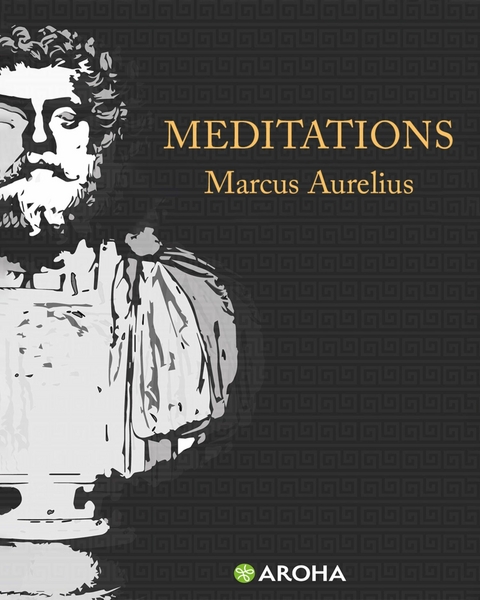
Meditations (eBook)
250 Seiten
Aroha (Verlag)
979-8-3072-6823-0 (ISBN)
Marcus Aurelius (121-180 CE) was a Roman emperor and Stoic philosopher, renowned for his work Meditations, a series of personal writings on virtue, wisdom, and self-discipline. His reign was marked by military challenges and philosophical reflection, emphasizing duty, resilience, and moral integrity, influencing both ancient and modern philosophical thought.
Marcus Aurelius (121–180 CE) was a Roman emperor and Stoic philosopher, renowned for his work Meditations, a series of personal writings on virtue, wisdom, and self-discipline. His reign was marked by military challenges and philosophical reflection, emphasizing duty, resilience, and moral integrity, influencing both ancient and modern philosophical thought.
HIS FIRST BOOK
concerning HIMSELF:
Wherein Antoninus recordeth, What and of whom, whether Parents, Friends, or Masters; by their good examples, or good advice and counsel, he had learned:
Divided into Numbers or Sections.
ANTONINUS Book vi. Num. xlviii. Whensoever thou wilt rejoice thyself, think and meditate upon those good parts and especial gifts, which thou hast observed in any of them that live with thee:
as industry in one, in another modesty, in another bountifulness, in another some other thing. For nothing can so much rejoice thee, as the resemblances and parallels of several virtues, eminent in the dispositions of them that live with thee, especially when all at once, as it were, they represent themselves unto thee. See therefore, that thou have them always in a readiness.
THE FIRST BOOK
I. Of my grandfather Verus I have learned to be gentle and meek, and to refrain from all anger and passion. From the fame and memory of him that begot me I have learned both shamefastness and manlike behaviour. Of my mother I have learned to be religious, and bountiful; and to forbear, not only to do, but to intend any evil; to content myself with a spare diet, and to fly all such excess as is incidental to great wealth. Of my great-grandfather, both to frequent public schools and auditories, and to get me good and able teachers at home; and that I ought not to think much, if upon such occasions, I were at excessive charges.
II. Of him that brought me up, not to be fondly addicted to either of the two great factions of the coursers in the circus, called Prasini, and Veneti: nor in the amphitheatre partially to favour any of the gladiators, or fencers, as either the Parmularii, or the Secutores. Moreover, to endure labour; nor to need many things; when I have anything to do, to do it myself rather than by others; not to meddle with many businesses; and not easily to admit of any slander.
III. Of Diognetus, not to busy myself about vain things, and not easily to believe those things, which are commonly spoken, by such as take upon them to work wonders, and by sorcerers, or prestidigitators, and impostors; concerning the power of charms, and their driving out of demons, or evil spirits; and the like. Not to keep quails for the game; nor to be mad after such things. Not to be offended with other men's liberty of speech, and to apply myself unto philosophy. Him also I must thank, that ever I heard first Bacchius, then Tandasis and Marcianus, and that I did write dialogues in my youth; and that I took liking to the philosophers' little couch and skins, and such other things, which by the Grecian discipline are proper to those who profess philosophy.
IV. To Rusticus I am beholding, that I first entered into the conceit that my life wanted some redress and cure. And then, that I did not fall into the ambition of ordinary sophists, either to write tracts concerning the common theorems, or to exhort men unto virtue and the study of philosophy by public orations; as also that I never by way of ostentation did affect to show myself an active able man, for any kind of bodily exercises. And that I gave over the study of rhetoric and poetry, and of elegant neat language. That I did not use to walk about the house in my long robe, nor to do any such things. Moreover I learned of him to write letters without any affectation, or curiosity; such as that was, which by him was written to my mother from Sinuessa: and to be easy and ready to be reconciled, and well pleased again with them that had offended me, as soon as any of them would be content to seek unto me again. To read with diligence; not to rest satisfied with a light and superficial knowledge, nor quickly to assent to things commonly spoken of: whom also I must thank that ever I lighted upon Epictetus his Hypomnemata, or moral commentaries and common-factions: which also he gave me of his own.
V. From Apollonius, true liberty, and unvariable steadfastness, and not to regard anything at all, though never so little, but right and reason: and always, whether in the sharpest pains, or after the loss of a child, or in long diseases, to be still the same man; who also was a present and visible example unto me, that it was possible for the same man to be both vehement and remiss: a man not subject to be vexed, and offended with the incapacity of his scholars and auditors in his lectures and expositions; and a true pattern of a man who of all his good gifts and faculties, least esteemed in himself, that his excellent skill and ability to teach and persuade others the common theorems and maxims of the Stoic philosophy. Of him also I learned how to receive favours and kindnesses (as commonly they are accounted:) from friends, so that I might not become obnoxious unto them, for them, nor more yielding upon occasion, than in right I ought; and yet so that I should not pass them neither, as an unsensible and unthankful man.
VI. Of Sextus, mildness and the pattern of a family governed with paternal affection; and a purpose to live according to nature: to be grave without affectation: to observe carefully the several dispositions of my friends, not to be offended with idiots, nor unseasonably to set upon those that are carried with the vulgar opinions, with the theorems, and tenets of philosophers: his conversation being an example how a man might accommodate himself to all men and companies; so that though his company were sweeter and more pleasing than any flatterer's cogging and fawning; yet was it at the same time most respected and reverenced: who also had a proper happiness and faculty, rationally and methodically to find out, and set in order all necessary determinations and instructions for a man's life. A man without ever the least appearance of anger, or any other passion; able at the same time most exactly to observe the Stoic Apathia, or unpassionateness, and yet to be most tender-hearted: ever of good credit; and yet almost without any noise, or rumour: very learned, and yet making little show.
VII. From Alexander the Grammarian, to be un-reprovable myself, and not reproachfully to reprehend any man for a barbarism, or a solecism, or any false pronunciation, but dextrously by way of answer, or testimony, or confirmation of the same matter (taking no notice of the word) to utter it as it should have been spoken; or by some other such close and indirect admonition, handsomely and civilly to tell him of it.
VIII. Of Fronto, to how much envy and fraud and hypocrisy the state of a tyrannous king is subject unto, and how they who are commonly called εὐπατρίδαι, i.e. nobly born, are in some sort incapable, or void of natural affection.
IX. Of Alexander the Platonic, not often nor without great necessity to say, or to write to any man in a letter, 'I am not at leisure'; nor in this manner still to put off those duties, which we owe to our friends and acquaintances (to every one in his kind) under pretence of urgent affairs.
X. Of Catulus, not to contemn any friend's expostulation, though unjust, but to strive to reduce him to his former disposition: freely and heartily to speak well of all my masters upon any occasion, as it is reported of Domitius, and Athenodotus: and to love my children with true affection.
XI. From my brother Severus, to be kind and loving to all them of my house and family; by whom also I came to the knowledge of Thrasea and Helvidius, and Cato, and Dio, and Brutus. He it was also that did put me in the first conceit and desire of an equal commonwealth, administered by justice and equality; and of a kingdom wherein should be regarded nothing more than the good and welfare of the subjects. Of him also, to observe a constant tenor, (not interrupted, with any other cares and distractions,) in the study and esteem of philosophy: to be bountiful and liberal in the largest measure; always to hope the best; and to be confident that my friends love me. In whom I moreover observed open dealing towards those whom he reproved at any time, and that his friends might without all doubt or much observation know what he would, or would not, so open and plain was he.
XII. From Claudius Maximus, in all things to endeavour to have power of myself, and in nothing to be carried about; to be cheerful and courageous in all sudden chances and accidents, as in sicknesses: to love mildness, and moderation, and gravity: and to do my business, whatsoever it be, thoroughly, and without querulousness. Whatsoever he said, all men believed him that as he spake, so he thought, and whatsoever he did, that he did it with a good intent. His manner was, never to wonder at anything; never to be in haste, and yet never slow: nor to be perplexed, or dejected, or at any time unseemly, or excessively to laugh: nor to be angry, or suspicious, but ever...
| Erscheint lt. Verlag | 12.3.2025 |
|---|---|
| Verlagsort | Ciudad de México |
| Sprache | englisch |
| Themenwelt | Geisteswissenschaften ► Philosophie ► Allgemeines / Lexika |
| Schlagworte | ethics • Inner Peace. • Marcus Aurelius • Personal Growth • Philosophy • Roman emperor • Self-reflection • Stoicism • virtue • wisdom |
| ISBN-13 | 979-8-3072-6823-0 / 9798307268230 |
| Informationen gemäß Produktsicherheitsverordnung (GPSR) | |
| Haben Sie eine Frage zum Produkt? |
 EPUB (Ohne DRM)
Digital Rights Management: ohne DRM
Dieses eBook enthält kein DRM oder Kopierschutz. Eine Weitergabe an Dritte ist jedoch rechtlich nicht zulässig, weil Sie beim Kauf nur die Rechte an der persönlichen Nutzung erwerben.
Dateiformat: EPUB (Electronic Publication)
EPUB ist ein offener Standard für eBooks und eignet sich besonders zur Darstellung von Belletristik und Sachbüchern. Der Fließtext wird dynamisch an die Display- und Schriftgröße angepasst. Auch für mobile Lesegeräte ist EPUB daher gut geeignet.
Systemvoraussetzungen:
PC/Mac: Mit einem PC oder Mac können Sie dieses eBook lesen. Sie benötigen dafür die kostenlose Software Adobe Digital Editions.
eReader: Dieses eBook kann mit (fast) allen eBook-Readern gelesen werden. Mit dem amazon-Kindle ist es aber nicht kompatibel.
Smartphone/Tablet: Egal ob Apple oder Android, dieses eBook können Sie lesen. Sie benötigen dafür eine kostenlose App.
Geräteliste und zusätzliche Hinweise
Buying eBooks from abroad
For tax law reasons we can sell eBooks just within Germany and Switzerland. Regrettably we cannot fulfill eBook-orders from other countries.
aus dem Bereich