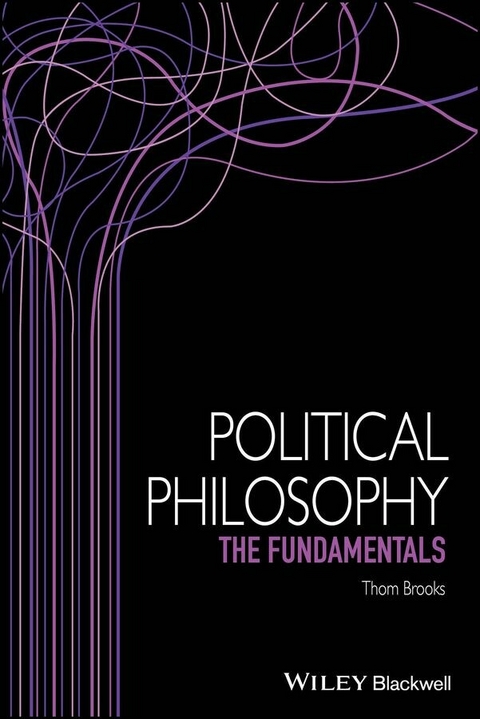
Political Philosophy (eBook)
256 Seiten
Wiley-Blackwell (Verlag)
978-1-118-60902-6 (ISBN)
A wide-ranging and up-to-date survey of the leading ideas and debates in political philosophy
Political Philosophy: The Fundamentals introduces core topics within the field by engaging students in seminal works in both contemporary philosophy and the history of political thought. Requiring no previous background in the subject, this clear and comprehensible textbook equips readers with the necessary context for understanding different philosophical perspectives.
Through eight succinct chapters, Thom Brooks highlights important contributions made from political philosophers from the past and present to connect the history of political thought with ongoing debates. Readers gain insights into various conceptions about the nature of freedom, different ways of understanding equality, longstanding debates over punishment, questions concerning the value of human rights, issues of global justice and severe poverty, approaches to handling climate change and much more.
Helping readers develop informed opinions on central issues, Political Philosophy: The Fundamentals:
- Discusses divergent views about the different forms and limits of freedom that philosophers have defended over time
- Provides a historical perspective of contemporary understandings of human rights and their origins in natural law and natural rights
- Illustrates the multiple ways that freedom has been understood, including commonalities and differences
- Examines various ways of implementing equality and assessing their merits
- Covers influential work by John Rawls that envisions a well-ordered society governed by principles of justice
Thom Brooks is Professor of Law and Government at Durham University and Visiting Fellow at Yale Law School. His edited publications include Global Justice: An Introduction, Climate Change for an Endangered World, Rawls's Political Liberalism and The Global Justice Reader, Revised Edition.
1
Freedom
1.1 Introduction
Freedom, or liberty, is widely recognized as having huge importance.1 The American Declaration of Independence says that we are all “created equal” with inalienable rights to “life, liberty and the pursuit of happiness” (United States 1776). Our freedoms are a foundation that political authority is built upon. However, if we should ask others what freedom is, there can be very different answers to questions about how it is defined and why it is valuable. So, what then is freedom? When can we be said to be free or unfree? Is freedom about our having options or in our achieving goals? How, if at all, can we justify any limits on freedom? This chapter discusses these questions.
We will begin by considering the foundational issue of how we might understand ourselves as “free.” This is followed by examining the relevance of having choice and options. The chapter then surveys three broad theories of freedom: negative freedom, positive freedom, and republican freedom. We next consider the possible importance of our convictions about how we relate to others for any theory about freedom. The chapter concludes considering the issue of paternalism and how some claim we might justify constraints on freedom.
It is worth noting that some of this discussion is abstract, or at least more so than later discussions on other topics in the following chapters. We will consider how we might know ourselves free and think about it using hypothetical examples that can seem anything but concrete at certain points. This book is aimed at students who are studying this topic for the first time. As we proceed, the process of thinking about freedom – as well as our other topics – will become easier as the reader becomes more familiar with the analytical approach taken. It goes without saying that if everything to know about freedom was obvious, there would be little point in having to explain different views that have been defended over the last few centuries. Indeed, it should be unsurprising that there is a diversity of views and longstanding debates over how we know we are free, what freedom is, and how it should be understood because the question of “what is freedom?” is essentially contested.
1.2 Knowing Freedom
When most students are asked about what freedom is, the issue of knowing whether they are free themselves is often overlooked. This is most likely because our freedom is presumed. The assumption is that we question how we are free, not if we are free, because we assume that we are. So, we rarely consider the matter of if we are free. So, let us start with this foundational issue.
Consider moving your hand or simply reading this sentence. How do you know that you are freely doing either action? Does it matter that you were asked to do it? Can you see these words and choose whether or not to understand them as they are read? Could you prove to somebody else that you, and only you, are choosing to freely move your hand – and that it was not predestined to happen nor under the control of nature nor a supernatural entity like God? Or are we under the control of our animal instincts? Is our freedom knowable, if it is possible?
These questions are abstract and difficult. Some might dismiss them as merely “academic” (in its usual pejorative sense) and claim the topic is unimportant because it lacks “real world” relevance. But, of course, it matters whether we are free or not in a practical sense. This is because our views on responsibility are often tied to our making free choices. If someone is not free to do something, we might not hold them responsible for whatever happens. It is important to know that we are free –– and not only how we might be free.
The 18th‐Century German philosopher Immanuel Kant addressed this issue. He was interested in understanding what the use of our reason could achieve and its limitations. Kant considered various thought experiments, including about the nature of freedom. His thought experiments are meant to show how we might best understand complex issues, such as whether or not we are free.
For example, Kant asks us to first consider the assumption that we are free. This is understood to mean the idea that we are the cause of our own activities.2 This means that we are free when we act autonomously, such as when our hand moves because we intended to make it move in a particular way that we choose. Or that we walk briskly or stop and stand still depending on whichever way that we happen to choose to do it. In these ways, we are free where the choice is ours and we enable that choice to happen. We act freely when exercising our “free will” (O’Connor and Franklin 2022).
Imagine that you are playing soccer. A teammate passes you the ball. You rush forward towards the opposing team’s net, kick the ball hard, and score a goal in the last minutes of the match. It is easy to imagine your teammates congratulating you for scoring. We can make sense of this if we understand that you are responsible for your actions and so acted freely. Your goal scoring is your achievement. It was not caused by anyone nor anything else. Assuming that you are free, it makes sense to congratulate you for what you did.
Now consider the same activity from a different point of view in comparison. Imagine that we are not the cause of our own activities. Instead, every action happens according to the laws of nature – or at the choosing of an all‐powerful God.3 When you receive the soccer ball, run down the pitch and kick it into the opposing net, it is your foot that touches the ball that scored the goal, but this was not caused by your free will; instead, it was predestined to happen, a natural reaction or the invisible hand of an almighty deity. Congratulating you for this event makes no sense in this context. You are instrumental to the goal – it was your foot that kicked the ball – but the cause was beyond you and, most importantly, not you. The goal is not an achievement of yours and so to celebrate you for making it happen would be to reward you for an achievement that was not yours.
This is the problem of free will: namely, how might we know we are free, if we are free? Many students will say that to imagine we are not the cause of kicking a ball or even reading this sentence does not make sense either. But this is Kant's point. His argument is that it seems improbable that we can prove through rational argument alone that we are (or are not) free. The use of our “pure” reason can only get us so far. Consider another hypothetical example. If a mischievous wizard, in a magical cave many miles away, was secretly controlling your movements and influencing your thoughts, we act at the wizard's bemusement without knowing that he is the true cause of what we do; in other words, we are unfree. So, how could we ever conclusively prove with complete certainty that this secret control of our mind and body is impossible? Or if you do not like wizard examples, suppose it is an alien with these powers controlling you from a distant planet unknown to humanity. How could you rationally prove its impossibility?
We have a situation where we cannot prove with perfect certainty either one side (we are free) or the other (we are not free). Kant calls this an antinomy of reason.4 This antinomy is an example, he argues, about where our reason alone cannot prove or disprove our actions are a cause of our freedom or a product of nature and unfree. Our use of reason alone brings us to a philosophical fork in the road. It may seem unclear which path we should take and why.5 We might all accept the philosophical fork in the road and agree that there is only one road to take. When we imagine a world where we are generally free or unfree, Kant argues that only a world where we are understood to be free – and our freedom is thereby assumed – can we make the best coherent sense of our world. If we assume our freedom and consider individuals as free, then it makes the best sense for us to congratulate them for great achievements or blame them for terrible wrongs.
A world without freedom is a world without praise or blame. It is a world where life might not make much sense at all. If whatever happens to us is never our achievement, then it would not make sense to see any merit or demerit in the actions of others. Whether someone passes a test, gains a qualification, performs unsuccessfully at a job interview, or kills others unprovoked in cold blood would all lack ethical meaning. These actions would be things that happen because they do; they just happen as mere happenings. There is no rationale to explain why.
Kant argues that we should assume that we are free to make best sense of our world.6 We assume our freedom in praising others for achievements or blaming them for committing wrongs. We celebrate a goal scored because we see it as an action caused by the free choice of the goal scorer. Or we punish wrongdoers who deliberately harm others precisely because their harm can be understood as the outcome of their choices. These assumptions may make intuitive sense, but it might leave some readers perplexed by the idea that our freedom might only be assumed, but not proven.
But there is an alternative view. It says that we can know we are free when our freedom is mutually recognized as such, as acting freely –...
| Erscheint lt. Verlag | 4.3.2025 |
|---|---|
| Reihe/Serie | Fundamentals of Philosophy |
| Sprache | englisch |
| Themenwelt | Geisteswissenschaften ► Philosophie ► Allgemeines / Lexika |
| Schlagworte | Political philosophers • Political philosophy debates • political philosophy democracy • political philosophy history • political philosophy introduction • political philosophy perspectives • political philosophy primer • political philosophy textbook |
| ISBN-10 | 1-118-60902-6 / 1118609026 |
| ISBN-13 | 978-1-118-60902-6 / 9781118609026 |
| Informationen gemäß Produktsicherheitsverordnung (GPSR) | |
| Haben Sie eine Frage zum Produkt? |
 EPUB (Adobe DRM)
Kopierschutz: Adobe-DRM
Adobe-DRM ist ein Kopierschutz, der das eBook vor Mißbrauch schützen soll. Dabei wird das eBook bereits beim Download auf Ihre persönliche Adobe-ID autorisiert. Lesen können Sie das eBook dann nur auf den Geräten, welche ebenfalls auf Ihre Adobe-ID registriert sind.
Details zum Adobe-DRM
Dateiformat: EPUB (Electronic Publication)
EPUB ist ein offener Standard für eBooks und eignet sich besonders zur Darstellung von Belletristik und Sachbüchern. Der Fließtext wird dynamisch an die Display- und Schriftgröße angepasst. Auch für mobile Lesegeräte ist EPUB daher gut geeignet.
Systemvoraussetzungen:
PC/Mac: Mit einem PC oder Mac können Sie dieses eBook lesen. Sie benötigen eine
eReader: Dieses eBook kann mit (fast) allen eBook-Readern gelesen werden. Mit dem amazon-Kindle ist es aber nicht kompatibel.
Smartphone/Tablet: Egal ob Apple oder Android, dieses eBook können Sie lesen. Sie benötigen eine
Geräteliste und zusätzliche Hinweise
Buying eBooks from abroad
For tax law reasons we can sell eBooks just within Germany and Switzerland. Regrettably we cannot fulfill eBook-orders from other countries.
aus dem Bereich