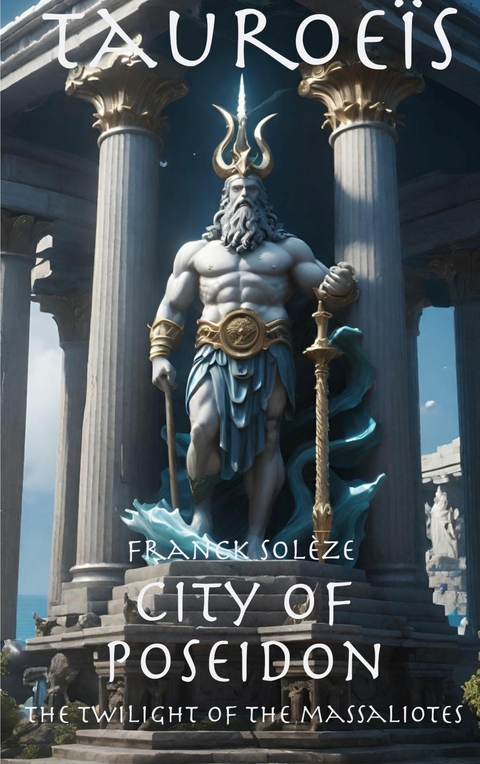
Tauroeïs city of Poseidon (eBook)
342 Seiten
Books on Demand (Verlag)
978-2-322-62128-6 (ISBN)
archaeologist and amateur researcher on the Massaliote Greek period on the French riviera
1
The beginnings of the Sanary temple sanctuary/ The reward
Oct 2023
Normally, when you write a book, you have finished your work. However, this was not the case with my research, because while I was writing Tauroeïs and not Tauroentum, I continued my surveys. It wasn't very far from my home, on the hill of Notre-Dame de Pitié, in the enclosure of the Portissol bastion that I had mapped earlier, which I thought at the time was filled with dwellings. I first found a large temple measuring 20x50 metres (no. 1 on the map on p. 321) at the top of the hillock, Chemin du Calvaire, the base still resting on a stepped plinth, but different in size from the plinth of the temple on the Pointe du Cougoussa on the Ile des Embiez. (see Tauroeïs not Tauroentum p 215) At first I was stopped by the private areas in which to carry out the surveys, then I remembered my good old technique of delimiting inaccessible buildings on the ground with the disturbances of the electromagnetic field in three dimensions, i.e. visible in the sky, to delimit the dimensions of the temple, both width and length. The stepped base is fifteen metres wide on the east, west and north sides, i.e. on the steepest slope, and five metres wide on the south side on the gentlest slope (this is the heart of the chapel of Notre-Dame de pitié). I'd always dreamt of mapping a temple from the inside, but this time the temple was accessible on foot, unlike the temple at Pointe du Cougoussa in Les Embiez, but on a private area. Nevertheless, I took advantage of an opportunity to see an owner in her garden to tell her about my research. I hadn't yet drawn up an overall plan of the boundaries of the temple and its base. Once this was done, I came back to put a letter in her letterbox to show her on the plan the points I needed to confirm on her property. But I'd been able to make the points in the meantime with the three-dimensional surveys. I just wanted to get into the temple, at least to the beginning of the temple, to map it from the inside. I still haven't had a reply from him yet, but the house is often closed, or at least I've never seen the window open since the day I spoke to him.
When I'd first started working on the hill, I'd had a few readings from the very beginning, further down, which I didn't understand. They didn't really catch my attention because I was focused on the temple at the top. I systematically go back to the site to finish the work, in order to understand what it's all about, otherwise it could be a step in the staircase that you lose and that could distort the rest. In the evenings, I used the geoportail and the day's data sheet to try and understand the structure of the building. I was able to work out a projection without a complete survey, and found a dimension of twenty metres, which is the approximate width of a temple like that of Poseidon found earlier: another temple? Lower down and the same size? The big temple at the top of the hill had just been slapped in the face, it wasn't alone any more. I projected the approximate fifty metre length onto the map and the end of the temple fell on a non-private road. The next day I went to check the projection and it was a total match. The electromagnetic field stopped exactly where it was supposed to. It was indeed a second large temple measuring 20 by 50 metres, certainly peristyle (surrounded by columns), but without a plinth under the base for this one. (n°4)
Two other surveys ten metres wide were still obscure to me, as they also ended in private property. On the satellite photo in the evening, I drew up a plan of the two large temples. The one at the top of the hill was almost parallel in its length to the cliff and the second was at an angle and lower down. The plan showed a straight road running parallel to the large temple at the top and about the same length as a 20x50 metre temple... I thought, why not a third temple? I went to check it out the next day and it was another total match. There it was, a third temple (no. 8). Of course, I was still thinking, "it's going to be hard to get everything accepted", but we all know now that I'm a long way from that. This temple was accessible on foot, inside on the road. You can imagine what I was like, a tiger hungry for residual frequencies, ready to growl if I was prevented from working. I marked out a few walls inside, the place where the statue stood, the prostration area facing it and a rectangular basin smaller than the one in the small in-antis temple of Heracles in the northern bastion of the eastern defensive belt of Le Brusc (see Tauroeïs and not Tauroentum p266). In the area of prostration before the statue, I felt residual frequencies of: woman and the sea.
I first found Amphitrite, Poseidon's wife, and then, using a second, more precise method recently found to elucidate the deities in the temples, I now think that it was Tethys, a titanid personifying marine fertility. These temples dedicated to the deities of the sea fit in perfectly with the fact that the Massaliotes conducted most of their trade by sea. Then I compared my readings with the1 plan of the temple of Hephaestus in Athens and it fitted perfectly. All I had to do was adjust the proportions of the Hephaestus, 13.7m x 30.7m, to the size of the temple, 20x50 metres, to find the same construction. I then realised that I no longer needed to enter private properties to plan the temples, as they were apparently based on the same model for this one. I should have thought of this earlier, but as I had said at the outset, I put my surveys first. I subtracted from the temple plan the position of the statue, either on the part called the Naos, or on the other temples to see if the statue areas were accessible, either in a private garden or on a public road. It would be in the garden of a private residence for the large upper temple and for the middle temple, it would either be in a private area or, if the entrance was on the other side, it would be on an accessible road. Its potential entrance, if the temple was in the same direction as the others, was opposite the surrounding wall of the Portissol bastion. Which wasn't really harmonious for the position of a temple, nor was it logical, so I had high hopes that the entrance would be reversed and that, as a result, the location of the statue would be on the road, and accessible.
The next day, of course, I raced to the spot marked roughly on the map and to within a few metres of it, given that the road is narrow, i.e. within a metre of a private area. Let's just say I was holding my breath, or rather I was holding my future joy. I found the residual frequencies of the statue of the deity to whom the temple was dedicated stuck to a wall of the residence. The prostration area (in the Naos) was in a private zone, which could provide additional information, as it was possible to find the intentions of the people who had come to pray there, as in the previous temple. I leaned against the wall. I could smell man, spear and chimera. Logically, I thought of Poseidon, so I immediately looked on my mobile and found Bellerophon, Poseidon's son, killing the chimera with his spear. Do you know what a happy man is? Now there's a definition. So it was a logical sequel to the first survey of the third great temple (no. 4). Logically, the great temple at the top of the hill should be that of Poseidon, but who knows? I can't establish anything without reading the site and the Greeks have already surprised me with things I thought I could rely on blindly (since checked). Three large temples measuring 20x50 metres was enormous, but I hadn't found the dwellings that could explain all these temples. It just didn't fit. In fact, it must have been a sanctuary, a place where people came to pray in complete safety, why not a refuge for the high priests and priestesses, or even where they were trained. A religious place within a fortress to ensure maximum security and tranquillity. It occurred to me that there must have been other temples since the rampart that closed off the area was still a long way off, and that the two ten-metre readings must also have been small temples measuring ten by thirty metres (in antis or prostyle) like those in the northern bastion of the Le Brusc fortress. For these two, I'll have to go into private areas, with the agreement of the owners of course, to check them out, but it's almost certain that this is also the case. They fit in perfectly with the logic of ascension. The temple of Tethys is ten metres above sea level, that of Belerephon twenty-four metres, and the highest on the hill, possibly Poseidon, is thirty-two metres. The two smaller temples (nos. 2 and 3) lie between the temple of Bellerophon and that of Poseidon.
In order to recognise the type of temple I was dealing with during my surveys, I had to round up the dimensions, approximately, ten by thirty, twenty by fifty, thirty by seventy as for the Parthenon, forty by ninety.
I thought that the statue area of the two small temples was in a private zone, but given the layout of the wall surrounding the bastion, there was a 50/50 chance that it was on the road. On the spot, I marked out the exact northern end of the two small temples by looking at the three-dimensional electromagnetic field. According to these readings, the statues were on the road if the entrance to the two temples was on the east side, and luckily that was the case. For the temple closest to Poseidon's I found Triton (no. 2), Poseidon's son, and for the one a little further down I found Tyché2 (no. 3), goddess of prosperity. I thought we were leaving the context of the sea, but no,...
| Erscheint lt. Verlag | 24.2.2025 |
|---|---|
| Sprache | englisch |
| Themenwelt | Geisteswissenschaften ► Geschichte |
| ISBN-10 | 2-322-62128-5 / 2322621285 |
| ISBN-13 | 978-2-322-62128-6 / 9782322621286 |
| Informationen gemäß Produktsicherheitsverordnung (GPSR) | |
| Haben Sie eine Frage zum Produkt? |
 EPUB (Wasserzeichen)
Größe: 3,5 MB
DRM: Digitales Wasserzeichen
Dieses eBook enthält ein digitales Wasserzeichen und ist damit für Sie personalisiert. Bei einer missbräuchlichen Weitergabe des eBooks an Dritte ist eine Rückverfolgung an die Quelle möglich.
Dateiformat: EPUB (Electronic Publication)
EPUB ist ein offener Standard für eBooks und eignet sich besonders zur Darstellung von Belletristik und Sachbüchern. Der Fließtext wird dynamisch an die Display- und Schriftgröße angepasst. Auch für mobile Lesegeräte ist EPUB daher gut geeignet.
Systemvoraussetzungen:
PC/Mac: Mit einem PC oder Mac können Sie dieses eBook lesen. Sie benötigen dafür die kostenlose Software Adobe Digital Editions.
eReader: Dieses eBook kann mit (fast) allen eBook-Readern gelesen werden. Mit dem amazon-Kindle ist es aber nicht kompatibel.
Smartphone/Tablet: Egal ob Apple oder Android, dieses eBook können Sie lesen. Sie benötigen dafür eine kostenlose App.
Geräteliste und zusätzliche Hinweise
Buying eBooks from abroad
For tax law reasons we can sell eBooks just within Germany and Switzerland. Regrettably we cannot fulfill eBook-orders from other countries.
aus dem Bereich