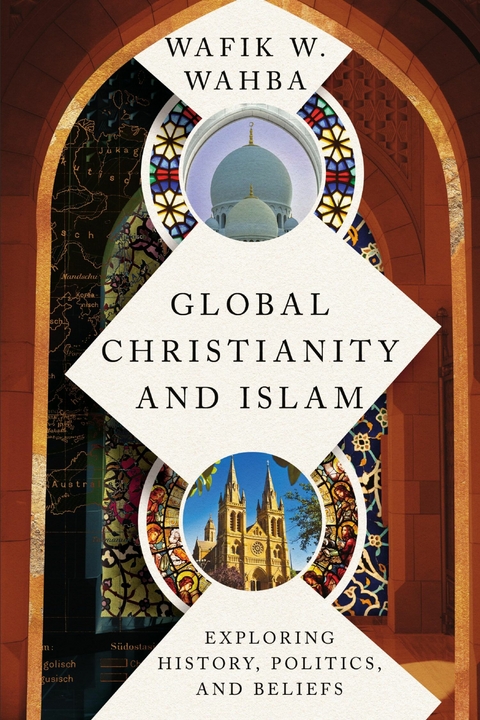
Global Christianity and Islam (eBook)
352 Seiten
IVP Academic (Verlag)
978-0-8308-8852-8 (ISBN)
Wafik W. Wahba is professor of Global Christianity at Tyndale University in Toronto, Canada. He has taught and lectured on global Christianity and Christian-Muslim relations in twenty-five countries, including in the United States, the Middle East, Africa, Asia, and South America. He has contributed to several publications, including Edinburgh Companion to Global Christianity, The Rowman and Littlefield Handbook of Christianity in the Middle East, and Cascade's series The Global Story of Christianity. He served on the editorial advisory board and contributed several entries to the Encyclopedia of Christianity in the Global South.
Wafik W. Wahba is professor of Global Christianity at Tyndale University in Toronto, Canada. He has taught and lectured on global Christianity and Christian-Muslim relations in twenty-five countries, including in the United States, the Middle East, Africa, Asia, and South America. He has contributed to several publications, including Edinburgh Companion to Global Christianity, The Rowman and Littlefield Handbook of Christianity in the Middle East, and Cascade's series The Global Story of Christianity. He served on the editorial advisory board and contributed several entries to the Encyclopedia of Christianity in the Global South.
Introduction
CHRISTIANITY AND ISLAM DOMINATE the global scene with over four billion adherents, more than half of the world’s population. It is expected that the number of Christians and Muslims will continue to grow in the twenty-first century and that both religions will gain converts from among other religious traditions. Meanwhile, advancements in communication technology through various means of social media and unprecedented access to physical mobility provide new levels of interaction among the world population, which in turn advances the spread of Christianity and Islam globally. The message of the Christian faith is being communicated around the clock in various languages through social media to millions of people worldwide. Islam is also gaining new ground in every continent through social media, migration, and economic advantages. While the number of Muslims has tripled in Europe and North America during the last three decades, thousands of Muslims are turning to Christianity in the Middle East and North Africa.1 Hardly a day passes without a reference to the impact of Christian and Islamic worldviews on politics, economics, and social interactions.
Religious identity and aspirations prove to be as powerful and appealing to people as political affiliations. Continuous turmoil in the Middle East and in other parts of the world is persistently affirming this reality. The renewed sense of religious identity is resulting in new religious affinities that transcend national borders and ethnicities. There is a cluster of integrated issues that one needs to explore to reach a wide-ranging understanding of the current dynamics in Christian-Muslim interactions globally. This book provides a comprehensive overview of Christianity and Islam that covers three interrelated areas: historical developments and encounters, the influence of religion on politics, and religious beliefs and worldviews. Exploring the variant narratives that shaped and continue to shape both Christianity and Islam is crucial to understanding current trends in Christian-Muslim interactions and their impact on future relations between the two communities globally.
PART ONE: HISTORICAL DEVELOPMENTS AND ENCOUNTERS
Christian and Muslim communities have coexisted in many parts of the world for thirteen centuries. The history of coexistence and interaction between the two religious communities is long and rich, carrying many layers of memories and events. Some memories are painful and discouraging; others are hopeful and promising. Lessons learned from times of accommodation and coexistence as well as times of conflict, misunderstanding, and hostility offer a framework for understanding current sociopolitical dynamics and their future impact. Learning from historical events can help us to avoid repeating the mistakes of the past.
Christianity and Islam developed differently through history, resulting in each religious tradition’s current cultural outlook. They emerged in different cultural contexts and had various means of expansion through the centuries. Christianity emerged in the Hellenistic culture of the Roman Empire, while Islam appeared in seventh-century Arabia. The early spread of Christianity was driven by preaching a gospel of forgiveness and reconciliation, while the remarkable lifestyle of early Christians attracted others to explore the new faith.
Despite enduring significant times of persecution, Christians were able to survive and transform the Roman Empire from within. For most of its history, the spread of the Christian faith came through missions activities. However, when Christianity became the official religion of the Byzantine Empire in the fourth century, the church’s mission and the state’s ambitions for control intertwined. By the ninth century and in response to the sweeping expansion of Islam, certain measures of forced Christianization were implemented in Europe. The Christianization of the New World took place in the context of colonization, starting from the fifteenth century, while the nineteenth century witnessed a noteworthy era of Christian missions to the whole world.
The early expansion of Islam during the seventh and eighth centuries was achieved through major military battles that toppled both the Byzantine and the Persian Empires while incorporating significant geographical territories across the ancient world. In later times, trade played a significant role in the expansion of Islam into Africa and Asia. Inviting people to embrace the faith (da’wa) resulted in converting millions around the globe. Migration, business, and trade also played a remarkable role in incorporating large territories and people into Islam.
By the eighth century, the Islamic empire had come into its golden era of scientific and social advancements, while Christians and Jews were major players in the advancement of society. The Islamic caliphate (empire) emerged victorious militarily in defeating both the Crusaders in the eleventh and twelves centuries and the Mongols in the thirteenth century. However, the Islamic empire was not able to maintain a steady progress in social and cultural development due to tendencies toward conservatism in its sociopolitical structure, which restricted non-Muslims from contributing to the advancement of society. Thoughtful consideration of such historical developments affirms the notion that social and cultural advances come about through collaborative efforts regardless of one’s religious tradition. When people are treated equally and given the opportunity to achieve their potential, society at large flourishes and advances. To the contrary, when people are restricted and marginalized, society suffers. Perceiving the “other” as a threat often results in mistrust and conflicts, while embracing the other usually results in better coexistence and enrichment. Examining patterns of intellectual cooperation between Christians and Muslims during the same era provides hope for better coexistence. Cooperation, not war, is ultimately a better way of coexistence.
The dominance of Islam over large parts of the ancient world, combined with the spread of Christianity across Europe by the turn of the millennium, triggered the notion of Western Christianity in the modern era. Historically speaking, however, Christians living under Islam in western Asia, the Middle East, and North Africa enjoyed majority status until the twelfth century. That Islam dominated over large swaths of the world from India to Spain did not result in the Islamization of indigenous Christians living across this vast territory instantly. The process of Islamization, and sometimes Arabization, in those regions resulted in majority-Muslim status only in the fourteenth century. Simultaneously, it must be noted that for almost a millennium, between the seventh and the sixteenth centuries, the Islamic empire (caliphate) challenged the very existence of Christian Europe. Only after the modernization of Europe and the collapse of the Ottoman Empire did Christianity start to gain influence on the world scene.
The current cultural outlook of Western Christianity was primarily shaped by the era of discovery (sixteenth century) and modernization (eighteenth century), while the global expansion of Christianity is credited to the significant missionary movement of the nineteenth and twentieth centuries. Southern Christianity, which is the dominant form of Christianity today, might differ in its historical development and cultural outlook from that of Western Christianity. Themes addressed in this study have been chosen carefully from among hundreds of historical events and encounters, and they serve as building blocks that help us navigate the historical and political developments of Christianity and Islam, leading into current interactions and perceptions. Historical analysis is not simply the study of the past; it is an explanation of the present.
PART TWO: RELIGION AND POLITICS
As the number of Muslims and Christians continues to grow globally, it is expected that their political orientation will continue to influence the sociopolitical and economic systems around the world. In theory, Christianity and Islam have different views on the role of religion in politics. However, both religions have used religious rhetoric, beliefs, and symbols to influence political decisions. While the starting point of Christianity involved the separation of religion and state, Islam affirms deen wa dawlah (religion and state) as an inseparable identity. Jesus’ words “My kingdom is not of this world” inspired early Christians to endure persecution from the state, and various Christian theologians through the centuries have reaffirmed the separation of the spheres of church and state. However, starting from the Byzantine and European models of Christendom, the church’s mission became entangled with the political agenda and the ambitions of the state. Even with the secularization of the West, the Christian ethos continued to influence the drive for democratic systems and the standards of human rights in many Western nations. It is safe to say that the Christian ethos still influences the sociocultural life in the West to some extent.
Affirming that Islam encompasses religion and politics, Islamic societies had different experiences with secularization. While some measures of secularization have been implemented (many Islamic societies are now considered semisecular), the notion of a secularized society is not fully embraced. Even today, many are not able to distinguish between secularized Western societies and Christianity. Political decisions...
| Erscheint lt. Verlag | 4.2.2025 |
|---|---|
| Verlagsort | Lisle |
| Sprache | englisch |
| Themenwelt | Geisteswissenschaften ► Religion / Theologie |
| Schlagworte | Christianity • Christianity and Islam • Comparative Religion • History • Intercultural Studies • Interfaith dialogue • Islam • muslim christian relations • Oil politics • Religious History • Religious Studies • The Crusades • Theology • World religions |
| ISBN-10 | 0-8308-8852-7 / 0830888527 |
| ISBN-13 | 978-0-8308-8852-8 / 9780830888528 |
| Informationen gemäß Produktsicherheitsverordnung (GPSR) | |
| Haben Sie eine Frage zum Produkt? |
 EPUB (Wasserzeichen)
DRM: Digitales Wasserzeichen
Dieses eBook enthält ein digitales Wasserzeichen und ist damit für Sie personalisiert. Bei einer missbräuchlichen Weitergabe des eBooks an Dritte ist eine Rückverfolgung an die Quelle möglich.
Dateiformat: EPUB (Electronic Publication)
EPUB ist ein offener Standard für eBooks und eignet sich besonders zur Darstellung von Belletristik und Sachbüchern. Der Fließtext wird dynamisch an die Display- und Schriftgröße angepasst. Auch für mobile Lesegeräte ist EPUB daher gut geeignet.
Systemvoraussetzungen:
PC/Mac: Mit einem PC oder Mac können Sie dieses eBook lesen. Sie benötigen dafür die kostenlose Software Adobe Digital Editions.
eReader: Dieses eBook kann mit (fast) allen eBook-Readern gelesen werden. Mit dem amazon-Kindle ist es aber nicht kompatibel.
Smartphone/Tablet: Egal ob Apple oder Android, dieses eBook können Sie lesen. Sie benötigen dafür eine kostenlose App.
Geräteliste und zusätzliche Hinweise
Buying eBooks from abroad
For tax law reasons we can sell eBooks just within Germany and Switzerland. Regrettably we cannot fulfill eBook-orders from other countries.
aus dem Bereich