


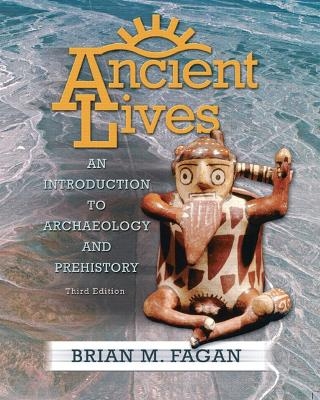
Ancient Lives
Routledge (Verlag)
978-0-13-222618-9 (ISBN)
- Titel erscheint in neuer Auflage
- Artikel merken
Ancient Lives is aimed at general courses in archaeology and prehistory that cover archaeological methods and theory, as well as world prehistory. The first half of the book covers the basic principles, methods, and theoretical approaches of archaeology. The second half is devoted to a summary of the major developments of human prehistory: the origins of humankind and the archaic world, the origins and spread of modern humans, the emergence of food production, and the beginnings of civilization. This is a book for complete beginners, written in a narrative style.
CONTENTS
Preface
Author’s Note
About the Author
Chapter 1 Introducing Archaeology and Prehistory
How Archaeology Began
The Discovery of Early Civilizations
Discovery: Austen Henry Layard at Nineveh
The Antiquity of Humankind
The Origins of Scientific Archaeology
Archaeology and Prehistory
Doing Archaeology: A Short Guide to Archaeological Diversity
Prehistory and World Prehistory
Major Developments in Human Prehistory
Why Are Archaeology and World Prehistory Important?
Mysteries of the Past
Doing Archaeology: Pseudoarchaeology, or You, Too, Can Be an Armchair Indiana Jones!
The Powerful Lure of the Past
Archaeology and Human Diversity
Archaeology as a Political Tool
Archaeology and Economic Development
Garbology
Who Needs the Past?
Site: Inyan Ceyaka Atonwan, Minnesota
Summary
Critical Thinking Questions
Key Terms and Sites
Chapter 2 The Record of the Past
The Goals of Archaeology
Constructing Culture History
Discovery: The Folsom Bison Kill Site, New Mexico
Reconstructing Ancient Lifeways
Site: The ’Ain Ghazal Figurines
Explaining Cultural Change
Doing Archaeology: An Archaeologist’s Ethical Responsibilities
Research Design
Data Acquisition
Analysis
Interpretation
Publication and Curation
What Is Culture?
The Archives of the Past: The Archaeological
Record
Preservation Conditions
A Waterlogged Site: Ozette, Washington
A Dry Site: Puruchucho-Huaquerones, Peru
Cold Conditions: Nevado Ampato, Peru
Volcanic Ash: Cerén, El Salvador
Context
Discovery: Tragedy at Cerén, El Salvador
Time and Space
The Law of Association
The Law of Superposition
Summary
Critical Thinking Questions
Key Terms and Sites
Chapter 3 Acquiring the Record
Discovery: Recording the Behistun Inscription, Iran
How Do You Find Archaeological Sites?
Accidental Discoveries
Deliberate Survey
Settlement Patterns and Settlement Archaeology
Site: Teotihuacán, Mexico
Remote Sensing and Geographic Information Systems (GIS)
How Do You Dig Up the Past?
The Ethical Responsibilities of the Excavator
Research Design and Problem-Oriented Excavation
Koster
Doing Archaeology: Archaeological Sites
Types of Excavation
Excavation as Recording
Relative Chronology
Chronometric Dating
Major Chronological Methods
Doing Archaeology: Dating the Past
Summary
Critical Thinking Questions
Key Terms and Sites
Chapter 4 How Did People Live?
Technologies of the Ancients
Doing Archaeology: Classifying Artifact Types
Stone
Doing Archaeology: Lithic Analysis
Bone and Antler
Wood
Clay (Ceramics)
Doing Archaeology: Ceramic Analysis
Metals and Metallurgy
Basketry and Textiles
Site: Ancient Wine at Abydos, Egypt
Subsistence: Making a Living
Doing Archaeology: Studying Ancient Subsistence
Animal Bones
Plant Remains
Doing Archaeology: Flotation Methods
Fishing and Fowling
Reconstructing Ancient Diet
Summary
Critical Thinking Questions
Key Terms and Sites
Part 2 Ancient Interactions
Chapter 5 Individuals and Interactions
Social Ranking
Doing Archaeology: The Law Code of Hammurabi
of Babylon, 1760 B.C.
Site: The Sepulcher of the Maya Lord Pacal, Palenque, Mexico
Gender: Men and Women
Grinding Grain at Abu Hureyra, Syria
The Engendered Past
Ethnicity and Inequality
Ideologies of Domination
Artifacts, Social Inequality, and Resistance
Discovery: War Casualties at Thebes, Egypt
Trade and Exchange
Types of Exchange and Trade
Sourcing
Doing Archaeology: Obsidian Sourcing
A Unique Portrait of Ancient Trade: The Uluburun Ship
Summary
Critical Thinking Questions
Key Terms and Sites
Chapter 6 Studying the Intangible
A Framework of Common Belief
Discovery: Shang Oracle Bones, China
Ethnographic Analogy and Rock Art
Doing Archaeology: Copying South African Rock Paintings
The Archaeology of Death
Artifacts: The Importance of Context
Site: The Shrine at Phylakopi, Greece
Doing Archaeology: The Ancient Maya World through Glyphs
Sacred Places
Astroarchaeology and Stonehenge
Southwestern Astronomy and Chaco Canyon
Summary
Critical Thinking Questions
Key Terms and Sites
Chapter 7 Explaining the Past
Culture History
Constructing Culture History
Synthesis
A Hierarchy of Archaeological Units
Doing Archaeology: A Hierarchy of Archaeological Entities
Descriptive Models of Cultural Change
Inevitable Variation
Cultural Selection
Invention
Diffusion
Migration
Analogy
Discovery: A Tale of Two Maya Women: Waka, Guatemala
Archaeology by Observation and Experiment
Ethnoarchaeology
Experimental Archaeology
Explaining Cultural Change
Cultural Systems and Cultural Processes
Doing Archaeology: Deductive and Inductive Reasoning
Processual Archaeology
Site: Guilá Naquitz Cave, Mexico
People, Not Systems
Cognitive-Processual Archaeology
The Issue of Complexity
Change and No Change
Summary
Critical Thinking Questions
Key Terms and Sites
Part 3 The World of the First Humans
Chapter 8 Human Origins
The Great Ice Age (1.8 Million to 15,000 Years Ago)
Early Primate Evolution and Adaptation
The Primate Order
“Coming Down from the Trees”
The Fossil Evidence for Human Evolution (7 Million to 1.5 Million Years Ago)
The Earliest Known Hominin: Toumaï, Sahelanthropus tchadensis
What Is Australopithecus?
Ardipithecus ramidus
Australopithecus anamensis and Australopithecus afarensis
Doing Archaeology: Potassium-Argon Dating
All Kinds of Australopithecines (3 Million to 2.5 Million Years Ago)
Gracile Australopithecines: Australopithecus africanus
Robust Australopithecines: A. aethiopicus, A. boisei,
and A. robustus
Australopithecus garhi
Early Homo: Homo habilis (2.5 Million to 2 Million Years Ago)
A Burst of Rapid Change?
Who Was the First Human?
The Earliest Human Technology
Site: Olduvai Gorge, Tanzania
Hunters or Scavengers?
Plant Foraging and Grandmothering
The Earliest Human Mind
The Development of Language
The Earliest Social Organization
Summary
Critical Thinking Questions
Key Terms and Sites
Ice Age Background
Homo ergaster in Africa
Homo erectus (c. 1.9 Million to c. 200,000 Years Ago)
The Earliest African Forms
Radiating out of Africa
Homo erectus in Asia
The Lifeway of Homo erectus
The Issue of Big-Game Hunting
Site: Boxgrove, England
Bamboo and Choppers in Tropical Forests
Language
Archaic Homo sapiens (c. 400,000 to 130,000
Years Ago)
The Neanderthals (c. 150,000 to 30,000 Years Ago)
The Origins of Modern Humans (c. 180,000
to 150,000 Years Ago)
Continuity or Replacement?
Molecular Biology and Homo sapiens
Doing Archaeology: DNA and Prehistory
Ecology and Homo sapiens
Out of Tropical Africa
Summary
Critical Thinking Questions
Key Terms and Sites
Part 4 Modern Humans Settle the World
Chapter 10 The Great Diaspora
The Late Ice Age World (50,000 to 15,000 Years Ago)
Doing Archaeology: Radiocarbon Dating
The Peopling of Southeast Asia and Australia (c. 50,000
to 15,000 Years Ago)
Subsistence
Cro-Magnon Technology
Cro-Magnon Art
Discovery: Grotte de Chauvet, France
Hunter-Gatherers in Eurasia (35,000 to 15,000 Years Ago)
East Asia (35,000 to 15,000 Years Ago)
Sinodonty and Sundadonty
Early Human Settlement of Siberia (Before 20,000 to 15,000 Years Ago)
The First Americans (Before 15,000 Years Ago to 11,000 B.C.)
Settlement before 30,000 Years Ago?
Site: Monte Verde, Chile
Settlement after 15,000 Years Ago?
The Clovis People (c. 11,200 to 10,900 B.C.)
Summary
Critical Thinking Questions
Key Terms and Sites
PART 5: The First Farmers and Civilizations
Chapter 11 The Earliest Farmers
After the Ice Age
Changes in Hunter-Gatherer Societies
Social Complexity among Hunter-Gatherers
Origins of Food Production
Discovery: Hunter-Gatherers at Koster, Illinois
Consequences of Food Production
The First Farmers in Southwestern Asia
Doing Archaeology: Domesticating Wheat and Barley
Egypt and the Nile Valley
Early Agriculture in Anatolia
Site: Ritual Buildings in Southeastern Turkey
European Farmers
Site: Easton Down and the Avebury Sacred Landscape, England
Early Agriculture in South and East Asia
The Indus Valley
Rice Cultivation in Southern China
First Farmers in Northern China
Navigators and Chiefs in the Pacific (2000 B.C. to Modern Times)
Summary
Critical Thinking Questions
Key Terms and Sites
Chapter 12 The First Civilizations
What Is a State-Organized Society?
Cities
Theories of the Origins of States
The Collapse of Civilizations
Early Civilization in Mesopotamia (5500 to 3100 B.C.)
Discovery: The Temple at Eridu, Iraq
The First Cities: Uruk
The Sumerians (c. 3100 to 2334 B.C.)
Doing Archaeology: The Sumerians
Ancient Egyptian Civilization
Predynastic Egypt: Ancient Monopoly? (5000 to 3100 B.C.)
Dynastic Egyptian Civilization (c. 3100 to 30 B.C.)
Site: The Step Pyramid at Saqqara
Doing Archaeology: Ahmose, Son of Ebana
Summary
Critical Thinking Questions
Key Terms and Sites
South Asia: The Harappan Civilization (c. 2700 to 1700 B.C.)
Mature Harappan Civilization
South Asia after the Harappans (1700 to 180 B.C.)
The Origins of Chinese Civilization (2600 to 1100 B.C.)
Royal Capitals
Royal Burials
Bronze Working
Shang Warriors
The War Lords (1100 to 221 B.C.)
Discovery: The Burial Mound of Emperor Shihuangdi, China
Southeast Asian Civilization (A.D. 1 to 1500)
The Angkor State (A.D. 802 to 1430)
Site: Angkor Wat, Cambodia
Summary
Critical Thinking Questions
Key Terms and Sites
Part 6 Ancient America
Chapter 14 Maize, Pueblos, and Mound Builders
North America after First Settlement
Site: The Olsen-Chubbock Bison Kill, New Mexico
Mesoamerica: Guilá Naquitz and Early Cultivation
The Earliest Maize
Andean Farmers
The North American Southwest (300 B.C. to Modern Times)
Doing Archaeology: Dendrochronology (Tree-Ring Dating)
Hohokam, Mogollon, and Ancestral Pueblo
Mound Builders in Eastern North America (2000 B.C. to A.D. 1650)
Adena and Hopewell
The Mississippian Tradition
Site: Moundville, Alabama
Summary
Critical Thinking Questions
Key Terms and Sites
Chapter 15 Mesoamerican Civilizations
The Olmec (1500 to 500 B.C.)
Ancient Maya Civilization (Before 1000 B.C. to A.D. 1519)
Beginnings (Before 1000 to 300 B.C.)
Kingship
Classic Maya Civilization (A.D. 300 to 900)
Doing Archaeology: The Hieroglyphic Stairway at Copán
The Classic Maya Collapse
Doing Archaeology: Studying the Maya Collapse at Copán
The Rise of Highland Civilization (1500 to
200 B.C.)
Teotihuacán (200 B.C. to A.D. 750)
Doing Archaeology: Life in Teotihuacán’s Barrios
The Toltecs (650 to 1200)
Tenochtitlán
Site: The Great Temple at Tenochtitlán
The World of the Fifth Sun
The Aztec State
The Spanish Conquest
Summary
Critical Thinking Questions
Key Terms and Sites
Chapter 16 Andean Civilizations
The Maritime Foundations of Andean Civilization
Coastal Foundations (2500 to 900 B.C.)
Caral
El Paraíso and Huaca Florida
The Early Horizon and Chavín de Huántar (900 to 200 B.C.)
The Initial Period
The Coast (After 1800 B.C.)
The Lake Titicaca Basin: Chiripa and Pukara (1000 B.C. to A.D. 100)
The Moche State (200 B.C. to A.D. 700)
Discovery: The Lords of Sipán, Peru
The Middle Horizon: Tiwanaku and Wari (600 to 1000)
Tiwanaku
Wari
The Late Intermediate Period: Sicán and Chimu (700 to 1460)
The Late Horizon: The Inka State (1476 to 1534)
Site: Cuzco, the Imperial Inka Capital
The Spanish Conquest (1532 to 1534)
Summary
Critical Thinking Questions
Key Terms and Sites
Part 7: On Being an Archaeologist
Archaeology as a Profession
Deciding to Become an Archaeologist
Gaining Fieldwork Experience
Career Opportunities
Academic Qualifications and Graduate School
Thoughts on Not Becoming a Professional Archaeologist
Our Responsibilities to the Past
A Simple Code of Archaeological Ethics for All
Summary
Critical Thinking Questions
Key Term
Glossary
References
Credits
Index
| Erscheint lt. Verlag | 7.8.2006 |
|---|---|
| Verlagsort | New York |
| Sprache | englisch |
| Maße | 203 x 254 mm |
| Themenwelt | Geisteswissenschaften ► Archäologie |
| ISBN-10 | 0-13-222618-9 / 0132226189 |
| ISBN-13 | 978-0-13-222618-9 / 9780132226189 |
| Zustand | Neuware |
| Informationen gemäß Produktsicherheitsverordnung (GPSR) | |
| Haben Sie eine Frage zum Produkt? |
aus dem Bereich


