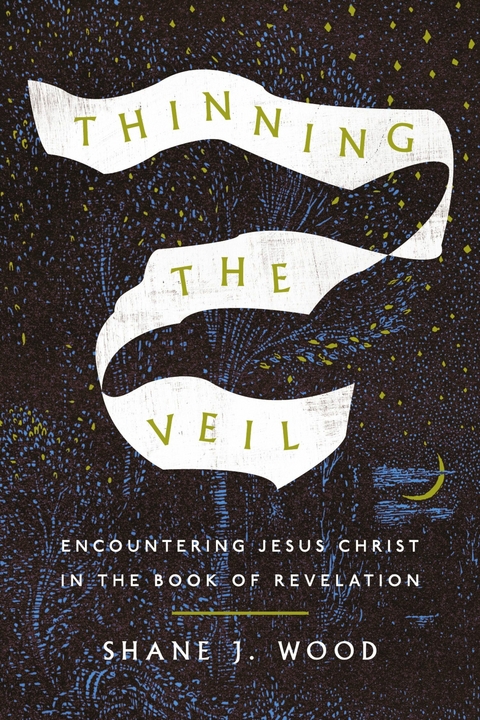
Thinning the Veil (eBook)
216 Seiten
IVP Academic (Verlag)
978-1-5140-0923-9 (ISBN)
Shane J. Wood (PhD, University of Edinburgh) is professor of New Testament and Its Origins at Ozark Christian College. In addition to speaking at churches and conferences worldwide, Shane produces a variety of audio, video, and written resources available at shanejwood.com. He is the author of Between Two Trees: Our Transformation from Death to Life and The Alter-Imperial Paradigm: Empire Studies and the Book of Revelation. Shane and his wife, Sara, have four children and live in southwest Missouri.
Shane J. Wood (PhD, University of Edinburgh) is professor of New Testament and Its Origins at Ozark Christian College. In addition to speaking at churches and conferences worldwide, Shane produces a variety of audio, video, and written resources available at shanejwood.com. He is the author of Between Two Trees: Our Transformation from Death to Life and The Alter-Imperial Paradigm: Empire Studies and the Book of Revelation. Shane and his wife, Sara, have four children and live in southwest Missouri.
Introduction
The Revelation of Jesus Christ
(Revelation 1:1)
[The Apocalypse] is a revelation of Jesus Christ. . . . It is a thoroughly
christological mystery, a possibility that arises first through
the incarnation. The Son possesses [this mystery] in its fullness,
one he can share with his believers and gives to John as first in love.
REVELATION DOESN’T START WHERE WE ASSUME. We expect prophetic utterances that predict the future. Maybe our future. Maybe someone else’s. Or maybe just the cataclysmic end of all things.
Yet, Revelation doesn’t begin here. It doesn’t situate the reader at the table of a cosmic fortuneteller ready to divine the Christian tea leaves designed to serve our desire to control and conquer what will be. No, Revelation overlooks our interests and sidesteps our questions, evading our expectations altogether in search of something greater. Something deeper. Something more along the lines of healing and transformation than fortunetelling and code cracking.
Revelation thins the veil separating heaven and earth to provide perspective and a path to overcome what’s broken in us, around us, and because of us. Revelation reaches into the recesses of our souls to confront the portions we’ve entrusted to the darkness instead of the light. Revelation unveils mysteries of healing located only when “in the Spirit” (Rev 1:10) and opposes the deceptions of death imprisoning Christian and non-Christian alike.2
Woven into the scenes of beasts, battles, and satanic suffering is a clarion call for all to “come.” To drink deep of the streams of living water. To taste the fruit of the tree of life. To join the choir of heaven singing songs of God’s redemption and reign. Not just in the future but in the here and now.
More than prediction, Revelation is an invitation. An invocation. An encounter with the Word become flesh, with the conqueror of death, with the crucified King. With the Son of Man seated at the right hand of the Father, who, by God’s grace, walks among the lampstands both comforting and confronting a world captivated by conflict.
The Last and the First
Last words of a loved one are treasures beyond measure. We race overnight to their deathbed, hoping to hear one last word. If, by God’s grace, they do speak, we gather each word into the box of our heart and label it “Fragile: Handle with care.”
I still cling to the last words my mentor ever said to me. I dust them off, especially on dark days, and recite them to remind me of my anchor. He was diagnosed with terminal cancer, and mere months before he passed, we stood by his car readied to venture home. We embraced, knowing this could be our last goodbye. Then, he stepped back, held my shoulders, and gently repeated three or four times, “Shane, just hold on to Jesus. Just hold on to Jesus.” We wiped our tears. Allowed the silence to speak love’s three words. And he drove away.
My grandma’s last words were more simple, if not more circuitous. Struggling with Alzheimer’s, she repeated the same dialogue with me several times, always beginning with, “Well, Shane-daner! When did you get here?” I’d tell her we just arrived. She’d look around the room, point at my daughter, and lean over with hushed tones, “Well, who is that young lady?”
Smiling, I’d respond, “Well, Mamaw, that’s my daughter Paige.”
Lunging back in her chair, she’d look at me exasperated (with a tinge of confusion), “No! You’re not old enough to have a daughter that age?”
I’d nod my head, smiling back (with a tinge of sadness). “Yep, that’s my baby girl.”
She’d laugh, shake her head, and softly say, “Well, I just can’t believe it.”
We’d pause for a moment or two. She’d reach for my hand, placing it between hers. With tears welling up, she’d whisper, “I’m really glad you’re here.”
Shortly thereafter, she’d look around the room, glance up at me, and her eyes would widen, “Well, Shane-daner! When did you get here?” Repeating the dialogue anew. Time and again. Grace upon grace.
Last words are as precious as they are rife with meaning. They capture a piece of our heart if not our curiosity. They direct our paths if not our questions. They are treasured and repeated, and serve as guides for what comes next.
Last words matter. And first words are no different.
I’ll never forget when my oldest son, Zion, said my name. It was the same electricity I’d feel when all four of my kids would gibber the same two syllables, “Da-da.” For weeks, he’d been jabbering and grunting, without any discernible patterns, but I was still straining and hoping he’d parrot my exaggerated pleas, “Say da-da. . . . Say daaaa-daaaa.”
Finally, it happened. Sitting in his highchair, looking intently at a piece of mashed food, with slobber soaking his onesie, without my prompting, amid his indiscernible gibberish, yet clearly and without question, I heard it: “Da-da.”
I jumped up and let out a cry that startled him to tears. But that’s okay; I was crying too. Moments later, after he and I both gathered ourselves, he said it again, “Da-da.” A name with variations I never tire of hearing. But the first time is simply precious. Because, like last words, first words matter.
Whether the words come in the opening scene or at the final bow, first and last words matter because they communicate what we value. What we cherish. Where our heart resides, and where our hope finds its home.
And the book of Revelation is no different.
First Words Matter
John begins Revelation with five words. Five words often forgotten as the revelation unfolds, lost in the chaos of commentaries, prophecy experts, and rapture debates. Five words that summarize the heart of this book and the blessed Seer on Patmos: “The revelation of Jesus Christ” (Rev 1:1).
John writes this letter in exile on the island of Patmos. In exile for testifying to “the Word of God and the testimony of Jesus” (Rev 1:9). In exile from the seven churches of Asia Minor (Rev 1:4, 11). Seven churches living life in the shadow of the Roman Empire, struggling with conflict and compromise, disorientation and despair. Seven churches desperate for a word from the Lord. Desperate for understanding and explanation. Desperate for a revelation of Jesus Christ.
For many interpreters, though, that simply isn’t enough. “Revelation must be more,” they implore. Somehow prediction seems far more satisfying than simply Jesus. A chronological road map of the future seems far more intriguing than depictions and declarations of Christ.
Several years ago, I was in Russia teaching Revelation. Over several sessions, I proclaimed the power of the first five words of this book, “The Revelation of Jesus Christ.” I emphasized the Word’s pervasiveness in the words of Revelation. I explained how whether we’re in the seals, the trumpets, or the bowls, or confronted by dragons, beasts, or false prophets, the goal is the same: reveal Jesus.
In the final session, however, the paterfamilias of the church unveiled his displeasure. Boris was a quintessential Russian: thick goatee, strong physique, and an oversized furry hat with optional flaps. When he spoke, others listened. His voice boomed with authority.
He began his “question” by pounding his fist on the table, flushing his cheeks with red strain. The interpreter translated the first line or two and then went silent as Boris increased his volume and pace. I quickly realized the interpreter was censoring this eruption for my sake. For three full minutes, everyone sat still as Boris unleashed his frustration with ever-increasing intensity.
And then the room fell silent.
No one moved.
Boris too.
Slowly, the interpreter turned to me and said, “Umm. . . . He says . . . well, ummm . . . if what you are saying is right, then . . . umm . . . then the book of Revelation is no different from any other book of the New Testament.”
Immediately, I replied, “Tell him he’s right.”
“What?!?!” the interpreter fired back.
“Tell him he’s right,” I restated. “That’s exactly what I’m saying. I’m saying the book of Revelation is doing the same thing as Matthew, as John, as Acts, as Romans, as 1 Peter: it’s revealing Jesus Christ.”
You see, first words matter. They express value. They guide our steps. They communicate the center of our hearts. Revelation begins not by accident but on purpose with these five words: the Revelation of Jesus Christ.
Why? Because in times of struggle, in times of rebellion, in times of spiritual, physical, or emotional conflict, what we need most is a revelation of Jesus Christ. A picture so pristine and crystalline that no guesses are necessary or debates possible or predictions needed. For the Alpha and the Omega, the Beginning and the End, is present, ready to walk with us, come what may.
The first words of the Apocalypse, then, are not to be discarded, overlooked, or ignored. They are our guide. They are the center of what follows. They express what John values, even if we...
| Erscheint lt. Verlag | 20.5.2025 |
|---|---|
| Verlagsort | Lisle |
| Sprache | englisch |
| Themenwelt | Geisteswissenschaften ► Religion / Theologie |
| Schlagworte | accessible • Apocalyptic Literature • Bible • Biblical Studies • divine • earth • End times • Eschatology • Guide • Heaven • Hope • John • Kingdom of God • left behind • Mystery • New Testament • Practical • practical application • Prophecy • Prophetic • Rapture • Spiritual |
| ISBN-10 | 1-5140-0923-4 / 1514009234 |
| ISBN-13 | 978-1-5140-0923-9 / 9781514009239 |
| Informationen gemäß Produktsicherheitsverordnung (GPSR) | |
| Haben Sie eine Frage zum Produkt? |
 EPUB (Wasserzeichen)
DRM: Digitales Wasserzeichen
Dieses eBook enthält ein digitales Wasserzeichen und ist damit für Sie personalisiert. Bei einer missbräuchlichen Weitergabe des eBooks an Dritte ist eine Rückverfolgung an die Quelle möglich.
Dateiformat: EPUB (Electronic Publication)
EPUB ist ein offener Standard für eBooks und eignet sich besonders zur Darstellung von Belletristik und Sachbüchern. Der Fließtext wird dynamisch an die Display- und Schriftgröße angepasst. Auch für mobile Lesegeräte ist EPUB daher gut geeignet.
Systemvoraussetzungen:
PC/Mac: Mit einem PC oder Mac können Sie dieses eBook lesen. Sie benötigen dafür die kostenlose Software Adobe Digital Editions.
eReader: Dieses eBook kann mit (fast) allen eBook-Readern gelesen werden. Mit dem amazon-Kindle ist es aber nicht kompatibel.
Smartphone/Tablet: Egal ob Apple oder Android, dieses eBook können Sie lesen. Sie benötigen dafür eine kostenlose App.
Geräteliste und zusätzliche Hinweise
Buying eBooks from abroad
For tax law reasons we can sell eBooks just within Germany and Switzerland. Regrettably we cannot fulfill eBook-orders from other countries.
aus dem Bereich