


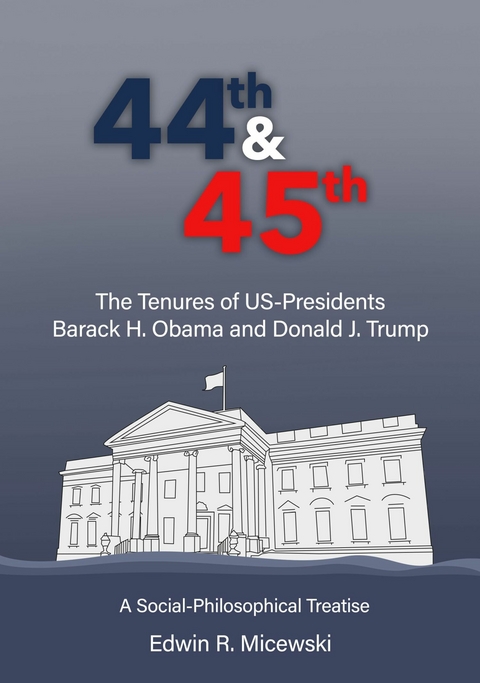
44th & 45th The Tenures of US-Presidents Barack H. Obama and Donald J. Trump (eBook)
170 Seiten
EdwinsEditorial (Verlag)
978-3-98995-478-6 (ISBN)
Social philosopher, security policy analyst, blogger, author
Social philosopher, security policy analyst, blogger, author
Ethics and Moral Philosophy
In the prior essay, I alluded to the relevance of non-scientific modalities of human experience, implying that the “re-enchantment” of our world stands out as a viable, if not necessary, task for contemporary philosophy. In this regard, it was now time to explain in more detail why the most significant issue of our time is not technological, scientific, or economic, but rather one of morality.
To explain this, I had to define key philosophical words, like transcendental and transcendent, and establish the framework of freedom and responsibility. I used the example of the capitalist economy to demonstrate the essential importance of morality in society and how responsibility, the inner moral sense through which human freedom realizes and ought to reveal itself, works.
The Crisis of Morality
(Edwin’s Editorial – Published March 31, 2015)
If society turns immanent (I use the term immanence in the Kantian epistemological tradition of everything that remains within the boundaries of possible experience) and loses its transcendent basis, its religious-metaphysical reference, it will perish.
In recent decades, Western society has taken a significant step down this path, and remedial attempts have been mostly ineffectual. Nonetheless, every civilization draws its cohesive strength from its religious base and perpetually regenerates itself through it. Any civilization must have a transcendent common denominator. Everything immanent, even science, is prone to competing and conflicting interpretations, which is why it cannot function as a consistent unifier. The paradox of this reality is that the faculty incapable of comprehending the transcendent, namely human reason, learns to recognize the necessity of the transcendent.
In sacred terms, the transcendent manifests itself in religion; in secular terms, the transcendent manifests itself in morality. As religion serves as the horizon of meaning and represents common and uniting values, morality (and by no means economy) is the underpinning category of immanent life routine.
As civilization crumbles when its religious underpinning is lost, so does social and political life when morality is lost. Every political crisis may be traced back to a moral crisis, or, more accurately, to the failure to identify and respond to the withering of morality in a timely manner.
Morality constitutes the crisis of responsibility, as only the moral human can bind itself to act responsibly because of an inner and voluntary disposition to do so. Whether one excels in the economy, is a teacher, contributes to society’s safety through law enforcement or military service, or works as a politician to improve the social conditions of his constituency, the quality of their accomplishments is determined by their morality, that is to say, their commitment to act responsibly.
The notion of freedom inextricably links the categories of morality and responsibility. Only if the human being is free to decide between alternatives to act can he take on responsibility for his actions and be held accountable for his doing (or not doing). Not being able to withdraw from this responsibility constitutes the intrinsic moral quality of being human.
Human freedom is about responsible freedom. Irresponsible freedom, epitomizing in unconstrained egocentrism, is mere arbitrariness and no freedom at all. True human freedom is finite freedom, limited by the conditions of social coexistence and all other individuals’ legitimate aspirations. Liberty must not be confused with independence from everything; rather, it must be considered as a choice to something.
Inappropriate use of freedom equals irresponsibility, which equals immorality. The absence of a personal and inner disposition to act righteously necessitates the enforcement of correct behavior from the outside. While morality cannot be imposed from the outside but rather arises from an intimate and inner desire to »ought« righteously, legality comes with law enforcement. Indeed, we cannot even imagine human statutory law without its intrinsic linkage to the power to enforce it.
Suppose we put these considerations into a political context. In that case, we find throughout history and the modern world governmental systems that allow for freedom and individual responsibility, and those collectivist forms of government that do not. Thus, the argument between capitalism and socialism is pointless because socialism is a collectivist form of governance, whereas capitalism is a type of economy. While relatively closed and collectivistic socialist societies are more likely to adopt the economic concept of planned-market economy, free and open democratic societies usually feature free-market economies as the typical hallmark of capitalism.
Capitalism can only thrive in a political context that allows for accountability – because there is both freedom and morality – and can only endure if proponents of the system are usually prone and ready to use their freedom to behave morally. Thus, the problem with capitalism is not a lack of legal rules, but rather its proponents’ irresponsibility–in other words, their immorality and human immaturity. Those who are unable to set limits for themselves in a self-legislating way must have correct conduct imposed upon them from the outside. But even existing rules and regulations cannot prevent inappropriate, dishonest, and criminal behavior. Only if the inner moral inclination, the stated feeling of responsibility, can be implanted and fulfilled can the political and economic systems of free and democratic societies and capitalism operate in the end.20
Generally, this ideational concept is empirically sound. On Wall Street, the one who acts primarily out of greed and the desire for personal enrichment demonstrates his moral immaturity to the same extent as the guy from Main Street who buys himself a home on a loan that he cannot afford. Both have failed to grasp the meaning and import of a free society, as well as the ensuing stakes and implications for the individual.
Responsibility is the price of freedom, and those who refuse to pay it do not deserve to be free. They should not be surprised that they are constantly subjected to rules, legal restrictions, and governmental intrusion. Although the subject of further consideration, it is evident that the ideal attitude toward life can only be attained through appropriate socialization and education processes.
All of the national and worldwide comparisons of mathematical, technical, and linguistic capabilities at the high school and college levels are meaningless if educational instruction does not result in autonomous judgmental ability and the capacity to acknowledge the significance and indispensability of responsibility as the existential manifestation of freedom in any social context.
The essential foundation of human coexistence on all levels of its manifestation—familial, social, political, and international— is morality, not economy, science, or technology. Whatever the latter achieve and intend for the advancement of humanity must be guided by the notions of goodness, of true humanness, and minimum decency toward one’s fellow man. Human responsibility is moral in nature.
Regardless of the innumerable evidence also to the contrary in world history and in our own lives, morality is, has always been, and will always be the bedrock of human existence, whether recognized and accepted or not. Although it can only be an approximation in an imperfect world, it must remain the guiding principle in our pursuit of it as the noble aim of appropriate human socialization and education.
In the field of ethics, the question of the legitimacy of action in the context of what we want to achieve with our actions (i.e., the objectives of action and the means used for it) plays a decisive role. Usually, in moral philosophy, actions that are aimed exclusively at the ends of actions are referred to as consequentialism.
This purely interest-based approach, which aims at unconditional success, is, of course, widespread in the political world and causes a lot of mischief there, as well as in private interrelations, if the use of means is not mitigated by moderating restrictions. These are explained in the following brief critique of consequentialism.
»The End Justifies All Means« – Consequentialism in Politics
(Edwin’s Editorial – Published November 22, 2013)
A quite enticing and seemingly reasonable, yet when driven too far, harming and destructive principle frequently dominates human behavior: the most unethical “the end justifies the means” maxim. Representatives of all ideological persuasions and political parties follow this alluring yet damaging principle in politics, adhering to a merely consequentialist approach.
While it is vital and understandable for us to aim for desired objectives and plan for the results of our activities, we must carefully consider the means and methods to achieve the intended outcome. Whatever ways we choose, they must always be judged against an unshakeable backdrop of idealistic concepts such as fairness, justice, impartiality, honesty, and integrity. While we may err in applying these dimensions, we demonstrate the willingness to take others’ rights into account and so regulate and moderate the use of means applied to one’s purpose.
The following elements and insights, to mention a few, can help to attenuate the often-pernicious impacts of radical consequentialism in domestic and foreign politics:
- Respective office’s dignity...
| Erscheint lt. Verlag | 3.5.2024 |
|---|---|
| Verlagsort | Vachendorf |
| Sprache | englisch |
| Themenwelt | Geisteswissenschaften ► Philosophie ► Metaphysik / Ontologie |
| Sozialwissenschaften ► Politik / Verwaltung ► Politische Theorie | |
| Schlagworte | Foreign Affairs • Illusory Reality • Impeachment • left • media propaganda • Mental Despotism • Morality • national security • Obama • Pandemic • Renunciation of Truth. • right • transatlantic • Transcendental idealism • Trump • Truth • US & Europe • US domestic politics |
| ISBN-10 | 3-98995-478-4 / 3989954784 |
| ISBN-13 | 978-3-98995-478-6 / 9783989954786 |
| Informationen gemäß Produktsicherheitsverordnung (GPSR) | |
| Haben Sie eine Frage zum Produkt? |
 EPUB (Wasserzeichen)
DRM: Digitales Wasserzeichen
Dieses eBook enthält ein digitales Wasserzeichen und ist damit für Sie personalisiert. Bei einer missbräuchlichen Weitergabe des eBooks an Dritte ist eine Rückverfolgung an die Quelle möglich.
Dateiformat: EPUB (Electronic Publication)
EPUB ist ein offener Standard für eBooks und eignet sich besonders zur Darstellung von Belletristik und Sachbüchern. Der Fließtext wird dynamisch an die Display- und Schriftgröße angepasst. Auch für mobile Lesegeräte ist EPUB daher gut geeignet.
Systemvoraussetzungen:
PC/Mac: Mit einem PC oder Mac können Sie dieses eBook lesen. Sie benötigen dafür die kostenlose Software Adobe Digital Editions.
eReader: Dieses eBook kann mit (fast) allen eBook-Readern gelesen werden. Mit dem amazon-Kindle ist es aber nicht kompatibel.
Smartphone/Tablet: Egal ob Apple oder Android, dieses eBook können Sie lesen. Sie benötigen dafür eine kostenlose App.
Geräteliste und zusätzliche Hinweise
Buying eBooks from abroad
For tax law reasons we can sell eBooks just within Germany and Switzerland. Regrettably we cannot fulfill eBook-orders from other countries.
aus dem Bereich


