


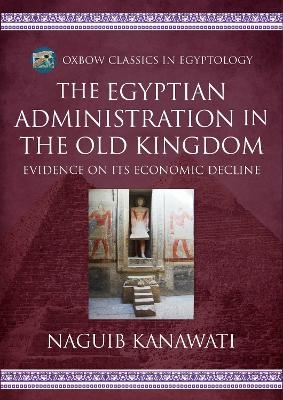
The Egyptian Administration in the Old Kingdom
Evidence on its Economic Decline
Seiten
2026
Casemate Publishers (Verlag)
979-8-88857-166-8 (ISBN)
Casemate Publishers (Verlag)
979-8-88857-166-8 (ISBN)
- Titel nicht im Sortiment
- Artikel merken
Facsimile edition of Naguib Kanawati’s 1977 authoritative assessment of the trends in the wealth of Old Kingdom officials based on analysis of the costliness of their tombs, and how this might reflect the long-believed economic decline.
A generally held belief is that there was a downward trend in the authority and power of the king and a corresponding increase in the influence of officials over the course of the Old Kingdom in Egypt. This could be seen reflected in the increasing size, complexity and lavishness of their tombs, the cost of which was generally met by the official himself. If the tomb owner died before completing his tomb, it was either finished by his son, or a close relative, or left in an unfinished state. It was most unusual for the king to provide an official with a complete tomb. The Old Kingdom administration was divided into three tiers of officials below the rank of Vizier, and the study analysed tombs of each class looking for trends that would indicate rank on the basis of costliness, and through time. It demonstrated a general downward trend in the financial resources among officials of the lower rank, with more fluctuating fortunes in the middle rank. This facsimile reissue of Kanawati’s authoritative study shows that the trend for the higher officials initially was up, followed by a general downward trend. Overall, by the end of the Fifth Dynasty the lower officials were unable to build tombs for themselves. The same happened to the middle ones early in the Sixth Dynasty, by the end of which the higher officials, including Viziers, did not have sufficient finance to construct their own tombs.
There is evidence that the administration at that time was inadequate: officials were dissatisfied and disinterested. While it is probable that it did not cause the downfall of the Old Kingdom, it resulted in a weak government, unable to cope with the wider economic and external problems of the end of the Sixth Dynasty.
A generally held belief is that there was a downward trend in the authority and power of the king and a corresponding increase in the influence of officials over the course of the Old Kingdom in Egypt. This could be seen reflected in the increasing size, complexity and lavishness of their tombs, the cost of which was generally met by the official himself. If the tomb owner died before completing his tomb, it was either finished by his son, or a close relative, or left in an unfinished state. It was most unusual for the king to provide an official with a complete tomb. The Old Kingdom administration was divided into three tiers of officials below the rank of Vizier, and the study analysed tombs of each class looking for trends that would indicate rank on the basis of costliness, and through time. It demonstrated a general downward trend in the financial resources among officials of the lower rank, with more fluctuating fortunes in the middle rank. This facsimile reissue of Kanawati’s authoritative study shows that the trend for the higher officials initially was up, followed by a general downward trend. Overall, by the end of the Fifth Dynasty the lower officials were unable to build tombs for themselves. The same happened to the middle ones early in the Sixth Dynasty, by the end of which the higher officials, including Viziers, did not have sufficient finance to construct their own tombs.
There is evidence that the administration at that time was inadequate: officials were dissatisfied and disinterested. While it is probable that it did not cause the downfall of the Old Kingdom, it resulted in a weak government, unable to cope with the wider economic and external problems of the end of the Sixth Dynasty.
Preface
Abbreviations
Part I
Introduction and method of research
Officials in the capital
Officials in the Provinces
Historical results and conclusions
Part II
Conspectus of tombs used
Notes
Appendices
I: Refinements in dating certain tombs
II: The dating of Q3r and Jdw
Bibliography
Index
| Erscheinungsdatum | 22.08.2024 |
|---|---|
| Sprache | englisch |
| Maße | 170 x 240 mm |
| Themenwelt | Geisteswissenschaften ► Archäologie |
| Geschichte ► Allgemeine Geschichte ► Altertum / Antike | |
| ISBN-13 | 979-8-88857-166-8 / 9798888571668 |
| Zustand | Neuware |
| Informationen gemäß Produktsicherheitsverordnung (GPSR) | |
| Haben Sie eine Frage zum Produkt? |
Mehr entdecken
aus dem Bereich

aus dem Bereich
ohne den ganzen langweiligen Kram
Buch | Hardcover (2025)
C.H.Beck (Verlag)
CHF 36,40
von den Anfängen bis zum Untergang
Buch | Hardcover (2025)
Alfred Kröner Verlag
CHF 48,95
von den Anfängen bis zur Spätantike
Buch | Softcover (2024)
C.H.Beck (Verlag)
CHF 16,80


