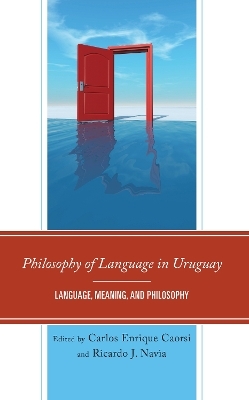
Philosophy of Language in Uruguay
Lexington Books (Verlag)
978-1-6669-6034-1 (ISBN)
In Europe, and later in the United States, the revitalization of the philosophy of language emerged from the need to address certain perplexities concerning formal disciplines and to work out certain complexities found within philosophy. In Uruguay, philosophy of language began with Carlos Vaz Ferreira as an analysis of the common and argumentative uses of language but then expanded to address typically philosophical questions. Edited by Carlos Enrique Caorsi and Ricardo J. Navia, Philosophy of Language in Uruguay: Language, Meaning, and Philosophy demonstrates the different directions in which philosophy of language has developed in Uruguay in the last twenty years, giving a representative picture of how philosophical approaches from a linguistic perspective have developed in this Latin American country. Uruguayan philosophy has a very small international presence, but it has long produced works within the philosophical explorations of language that are worthy of being better known. The contributors dissect these explorations through epistemology, linguistics, argumentation, and cognitive sciences to discover how philosophers of language such as Vaz Ferreira have grown to understand the complexities of language and how it affects us today.
Carlos Enrique Caorsi is professor of contemporary philosophy in the philosophy department at the University of the Republic of Uruguay (UDELAR). Ricardo J. Navia is professor of contemporary philosophy in the philosophy department at the University of the Republic of Uruguay (UDELAR).
Introduction: Philosophy of Language in Uruguay by Carlos E. Caorsi and Ricardo Navia
Part I: Truth, Meaning, and Interpretation
Chapter 1: Language and Reality in Vaz Ferreira by Carlos E. Caorsi
Chapter 2: Russell and Strawson on Definite Descriptions by Daniel Malvasio
Chapter 3: Meaning, Normativity, and the Effect of Triangulation by Ronald Teliz
Chapter 4: The Donald Davidson–Meredith Williams Debate on the Sociality and Normativity of Language by Ricardo Navia
Part II: Actual Debates
Chapter 5: Between Truth Relativism and Nonindexical Contextualism about Predicates of Personal Taste by Matías Gariazzo
Chapter 6: On Being Imperfectly Obliged to Maximal Charity in Argumentation by Ignacio Vilaró
Chapter 7: I Know What I Mean: First-person Authority in Speech and Thought by Ignacio Cervieri
Part III: Logical and Linguistic Analyses of Some Central Philosophical Problems
Chapter 8: Perceptual Verbs, Conceivability, and Quantifiers: George Berkeley’s Master Argument and Its Hidden Premise by Robert Calabria Díaz
Chapter 9: Language, Concepts, and the Nature of Inference by Matías Osta-Vélez
Chapter 10: On Temporal Representations: A Study from the Lexicon by Sylvia Costa, Federico de León, Ernesto Macazaga García, and Yamila Montenegro
Chapter 11: Linguistics in Philosophy: Following Vendler’s Footsteps by Ana Clara Polakof
| Erscheinungsdatum | 25.04.2024 |
|---|---|
| Reihe/Serie | Philosophy of Language: Connections and Perspectives |
| Co-Autor | Robert Calabria Díaz, Carlos Enrique Caorsi, Ignacio Cervieri |
| Zusatzinfo | 2 BW Illustrations, 8 Tables |
| Sprache | englisch |
| Maße | 161 x 236 mm |
| Gewicht | 531 g |
| Themenwelt | Geisteswissenschaften ► Philosophie ► Erkenntnistheorie / Wissenschaftstheorie |
| Geisteswissenschaften ► Philosophie ► Sprachphilosophie | |
| Geisteswissenschaften ► Sprach- / Literaturwissenschaft ► Sprachwissenschaft | |
| ISBN-10 | 1-6669-6034-9 / 1666960349 |
| ISBN-13 | 978-1-6669-6034-1 / 9781666960341 |
| Zustand | Neuware |
| Informationen gemäß Produktsicherheitsverordnung (GPSR) | |
| Haben Sie eine Frage zum Produkt? |
aus dem Bereich