


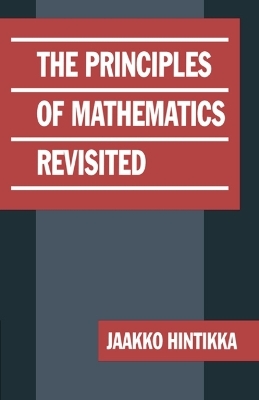
The Principles of Mathematics Revisited
Seiten
1998
Cambridge University Press (Verlag)
978-0-521-62498-5 (ISBN)
Cambridge University Press (Verlag)
978-0-521-62498-5 (ISBN)
This book, written by one of philosophy's pre-eminent logicians, argues that many of the basic assumptions common to logic, philosophy of mathematics and metaphysics are in need of change. Jaakko Hintikka proposes a new basic first-order logic and uses it to explore the foundations of mathematics. His innovative new logic will appeal to a wide variety of philosophers and mathematicians.
This book, written by one of philosophy's pre-eminent logicians, argues that many of the basic assumptions common to logic, philosophy of mathematics and metaphysics are in need of change. It is therefore a book of critical importance to logical theory. Jaakko Hintikka proposes a new basic first-order logic and uses it to explore the foundations of mathematics. This new logic enables logicians to express on the first-order level such concepts as equicardinality, infinity, and truth in the same language. The famous impossibility results by Gödel and Tarski that have dominated the field for the last sixty years turn out to be much less significant than has been thought. All of ordinary mathematics can in principle be done on this first-order level, thus dispensing with the existence of sets and other higher-order entities.
This book, written by one of philosophy's pre-eminent logicians, argues that many of the basic assumptions common to logic, philosophy of mathematics and metaphysics are in need of change. It is therefore a book of critical importance to logical theory. Jaakko Hintikka proposes a new basic first-order logic and uses it to explore the foundations of mathematics. This new logic enables logicians to express on the first-order level such concepts as equicardinality, infinity, and truth in the same language. The famous impossibility results by Gödel and Tarski that have dominated the field for the last sixty years turn out to be much less significant than has been thought. All of ordinary mathematics can in principle be done on this first-order level, thus dispensing with the existence of sets and other higher-order entities.
1. The functions of logic and the problem of truth definition; 2. The game of logic; 3. Frege's fallacy foiled: Independence-friendly logic; 4. The joys of independence: Some uses of IF logic; 5. The complexities of completeness; 6. Who's afraid of Alfred Tarski? Truth-definitions for IF first-order languages; 7. The liar belied: negation in IF logic; 8. Axiomatic set theory: Frankenstein's monster?; 9. IF logic as a framework for mathematical theorizing; 10. Constructivism reconstructed; 11. The epistemology of mathematical objects.
| Erscheint lt. Verlag | 28.4.1998 |
|---|---|
| Zusatzinfo | Worked examples or Exercises |
| Verlagsort | Cambridge |
| Sprache | englisch |
| Maße | 140 x 215 mm |
| Gewicht | 362 g |
| Themenwelt | Geisteswissenschaften ► Philosophie |
| Mathematik / Informatik ► Mathematik ► Allgemeines / Lexika | |
| ISBN-10 | 0-521-62498-3 / 0521624983 |
| ISBN-13 | 978-0-521-62498-5 / 9780521624985 |
| Zustand | Neuware |
| Informationen gemäß Produktsicherheitsverordnung (GPSR) | |
| Haben Sie eine Frage zum Produkt? |
Mehr entdecken
aus dem Bereich


aus dem Bereich
ein Übungsbuch für Fachhochschulen
Buch | Hardcover (2023)
Carl Hanser (Verlag)
CHF 23,75


