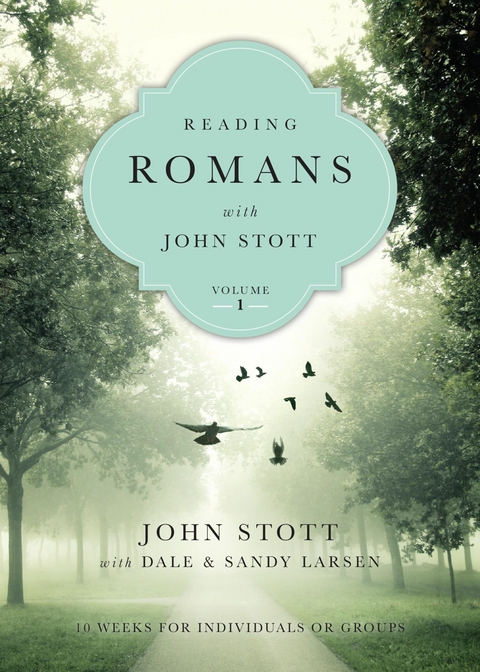
Reading Romans with John Stott (eBook)
159 Seiten
IVP Bible Studies (Verlag)
978-0-8308-9332-4 (ISBN)
John R. W. Stott (1921-2011) has been known worldwide as a preacher, evangelist and communicator of Scripture. For many years he served as rector of All Souls Church in London, where he carried out an effective urban pastoral ministry. A leader among evangelicals in Britain, the United States and around the world, Stott was a principal framer of the landmark Lausanne Covenant (1974). His many books have sold millions of copies around the world and in dozens of languages. Stott's best-known work, Basic Christianity, has sold two million copies and has been translated into more than 60 languages. Other titles include The Cross of Christ, Understanding the Bible, The Contemporary Christian, Evangelical Truth, Issues Facing Christians Today, The Incomparable Christ, Why I Am a Christian and Through the Bible Through the Year, a daily devotional. He has also written eight volumes in The Bible Speaks Today series of New Testament expositions.Whether in the West or in the Two-Thirds World, a hallmark of Stott's ministry has been expository preaching that addresses the hearts and minds of contemporary men and women. Stott was honored by Time magazine in 2005 as one of the '100 Most Influential People in the World' and was named in the Queen?s New Years Honours list as Commander of the Order of the British Empire.In 1969, Stott founded the Langham Trust to fund scholarships for young evangelical leaders from the Majority World. He then founded the Evangelical Literature Trust, which provided books for students, pastors and theological libraries in the Majority World. These two trusts continued as independent charities until 2001, when they were joined as a single charity: the Langham Partnership. Langham's vision continues today to see churches in the Majority World equipped for mission and growing to maturity in Christ through nurturing national movements for biblical preaching, fostering the creation and distribution of evangelical literature, and enhancing evangelical theological education.
Dale Larsen is a writer living in Rochester, Minnesota. He and his wife, Sandy, have written more than thirty books and Bible studies together including Living Your Legacy and more than ten LifeGuide® Bible studies. They have also coauthored eight N.T. Wright for Everyone Bible Study Guides with Wright. Sandy Larsen is a writer living in Rochester, Minnesota. She and her husband, Dale, have written more than thirty books and Bible studies together including Living Your Legacy and more than ten LifeGuide® Bible studies. They have also coauthored eight N.T. Wright for Everyone Bible Study Guides with Wright. John R. W. Stott (1921-2011) has been known worldwide as a preacher, evangelist and communicator of Scripture. For many years he served as rector of All Souls Church in London, where he carried out an effective urban pastoral ministry. A leader among evangelicals in Britain, the United States and around the world, Stott was a principal framer of the landmark Lausanne Covenant (1974). His many books have sold millions of copies around the world and in dozens of languages. Stott's best-known work, Basic Christianity, has sold two million copies and has been translated into more than 60 languages. Other titles include The Cross of Christ, Understanding the Bible, The Contemporary Christian, Evangelical Truth, Issues Facing Christians Today, The Incomparable Christ, Why I Am a Christian and Through the Bible Through the Year, a daily devotional. He has also written eight volumes in The Bible Speaks Today series of New Testament expositions.Whether in the West or in the Two-Thirds World, a hallmark of Stott's ministry has been expository preaching that addresses the hearts and minds of contemporary men and women. Stott was honored by Time magazine in 2005 as one of the "100 Most Influential People in the World" and was named in the Queen?s New Years Honours list as Commander of the Order of the British Empire.In 1969, Stott founded the Langham Trust to fund scholarships for young evangelical leaders from the Majority World. He then founded the Evangelical Literature Trust, which provided books for students, pastors and theological libraries in the Majority World. These two trusts continued as independent charities until 2001, when they were joined as a single charity: the Langham Partnership. Langham's vision continues today to see churches in the Majority World equipped for mission and growing to maturity in Christ through nurturing national movements for biblical preaching, fostering the creation and distribution of evangelical literature, and enhancing evangelical theological education.
1
Romans 1:1-17
Gospel Power
Servant and Apostle
Romans 1:1-4
1Paul, a servant of Christ Jesus, called to be an apostle and set apart for the gospel of God—2the gospel he promised beforehand through his prophets in the Holy Scriptures 3regarding his Son, who as to his earthly life was a descendant of David, 4and who through the Spirit of holiness was appointed the Son of God in power by his resurrection from the dead: Jesus Christ our Lord.
Paul begins his letter in a very personal way. He is evidently anxious from the start to establish a close relationship with his readers. He deviates from the letter-writing convention of his day by giving a much more elaborate description of himself than usual, in relation to the gospel. The probable reason is that he did not found the church in Rome. Nor has he yet visited it. He feels the need, therefore, to establish his credentials as an apostle and to summarize his gospel.
Paul identifies himself as “a servant of Jesus Christ, called to be an apostle and set apart for the gospel of God.” Paul’s twofold designation as slave (a better translation than servant) and apostle is particularly striking when these words are contrasted with one another. First, slave is a title of great humility; it expressed Paul’s sense of personal insignificance, without rights of his own, having been purchased to belong to Christ. Apostle, on the other hand, was a title of great authority; it expressed his sense of official privilege and dignity by reason of his appointment by Jesus Christ. Second, slave is a general Christian word (every disciple looks to Jesus Christ as Lord), whereas apostle is a special title reserved for the Twelve and Paul and perhaps one or two others such as James.
Paul now proceeds to give an analysis of the gospel, for which he has been set apart.
The origin of the gospel is God. The apostles did not invent it; it was revealed and entrusted to them by God. This conviction underlies all authentic evangelism. What we have to share with others is neither a miscellany of human speculations, nor one more religion to add to the rest, nor really a religion at all. It is rather “the gospel of God,” God’s own good news for a lost world.
The Old Testament looks forward to the gospel. Although God revealed the gospel to the apostles, it did not come to them as a complete novelty, because he had already promised it through his prophets in Old Testament Scripture. There is an essential continuity between the Old Testament and the New. Both bear witness to Jesus Christ.
The substance of the gospel is Jesus Christ. Paul makes references, direct or indirect, to the birth (descended from David), death (presupposed by his resurrection), resurrection from the dead, and reign (on David’s throne) of Jesus Christ. Here is a balanced statement of both the humiliation and the exaltation, the weakness and the power of God’s Son, his human descent traced to David, his divine sonship-in-power established by the resurrection and gift of the Spirit.
This is the Christ, weak and powerful, incarnate and exalted, who owns and rules our lives.
Grace and Peace
Romans 1:5-7
5Through him we received grace and apostleship to call all the Gentiles to the obedience that comes from faith for his name’s sake. 6And you also are among those Gentiles who are called to belong to Jesus Christ.
7To all in Rome who are loved by God and called to be his holy people:
Grace and peace to you from God our Father and from the Lord Jesus Christ.
As Paul goes on to state the purpose of his apostleship, he discloses further aspects of the gospel.
The scope of the gospel is all the nations. Paul defines its scope as “all the Gentiles.” This seems to imply that the Christians in Rome were predominantly Gentile. Paul affirms that the gospel is for everybody; its scope is universal. Paul himself was a patriotic Jew who retained his love for his people and longed passionately for their salvation. At the same time, he had been called to be the apostle to the Gentiles. If we are to be committed to world mission, we too will have to be liberated from all pride of race, nation, tribe, caste and class, and acknowledge that God’s gospel is for everybody, without exception and without distinction. This is a major theme of Romans.
The purpose of the gospel is the obedience of faith. In Romans, Paul insists more strongly than anywhere else that justification is through faith alone. Yet here he apparently writes that it is not by faith alone, but by obedience. Does the apostle contradict himself? No, we must give him credit for consistency of thought. This is the obedience that comes from faith, not the obedience of law. The proper response to the gospel is faith, indeed faith alone. Yet a true and living faith in Jesus Christ includes an element of submission (especially because its object is “Jesus Christ our Lord” [v. 4] or “the Lord Jesus Christ” [v. 7]) and leads inevitably into a lifetime of obedience.
Why did Paul desire to bring the nations to the obedience of faith? It was for the sake of the glory and honor of Christ’s name. The highest of all missionary motives is neither obedience to the Great Commission (important as that is) nor love for sinners who are alienated and perishing (strong as that incentive is, especially when we contemplate the wrath of God), but burning and passionate zeal for the glory of Jesus Christ. Before this supreme goal of the Christian mission, all unworthy motives wither and die.
Thankful for Their Faith
Romans 1:8-13
8First, I thank my God through Jesus Christ for all of you, because your faith is being reported all over the world. 9God, whom I serve in my spirit in preaching the gospel of his Son, is my witness how constantly I remember you 10in my prayers at all times; and I pray that now at last by God’s will the way may be opened for me to come to you.
11I long to see you so that I may impart to you some spiritual gift to make you strong—12that is, that you and I may be mutually encouraged by each other’s faith. 13I do not want you to be unaware, brothers and sisters, that I planned many times to come to you (but have been prevented from doing so until now) in order that I might have a harvest among you, just as I have had among the other Gentiles.
The apostle now tells his Roman readers frankly of his feelings toward them.
He thanks God for them all. The faith of the Romans is being reported all over the world. Wherever the church had spread, the news that there were Christians in the capital had spread also. Although Paul was not responsible for bringing the gospel to them, this does not inhibit him from giving thanks that Rome has been evangelized.
He prays for them. In Paul’s apostolic ministry, preaching and praying go together. He assures them that, even though most of them are unknown to him personally, he intercedes for them constantly and at all times. In particular, he prays that “now at last by God’s will,” that is, if it is God’s will, “the way may be opened” for him to come to them. Paul presumes neither to impose his will on God nor to claim to know what God’s will may be. Instead, he submits his will to God’s.
Paul longs to see the Christians in Rome, and he tells them why. He wants to impart to them some spiritual gift. He can hardly claim to be able to impart any spiritual gift himself. He appears to use the term in a more general sense. Perhaps he refers to his own teaching or exhortation, which he hopes to give them when he arrives. The statement seems indefinite, perhaps because he does not yet know what the Romans’ main spiritual needs will be.
No sooner has Paul dictated these words than he seems to sense their inappropriate one-sidedness, as if he has everything to give and nothing to receive. So he immediately explains (even corrects) himself: “that is, that you and I may be mutually encouraged by each other’s faith.” He knows about the reciprocal blessings of Christian fellowship, and although he is an apostle, he is not too proud to acknowledge his need of it. Happy is the missionary who goes to another country and culture in the same spirit of receptivity, anxious to receive as well as give, to learn as well as teach, to be encouraged as well as to encourage! And happy is the congregation who have a pastor of the same humble mind!
So far Paul has been prevented from visiting Rome. Exactly what has foiled him he does not say. Perhaps his evangelistic work in and around Greece had not yet been completed. Why had he tried to visit them? He now gives a third reason: “in order that I might have [RSV “reap”] a harvest among you.” Paul hopes to win some converts in Rome. It would be appropriate that the apostle to the Gentiles should engage in evangelistic reaping in the capital city of the Gentile world.
Gospel Debt
Romans 1:14-15
14I am obligated both to Greeks and non-Greeks, both to the wise and the foolish. 15That is why I am so eager to preach the gospel also to you who are in Rome.
Paul’s words “I am obligated” should properly be translated “I am a debtor.” There are two possible ways of getting into debt. The first is to borrow money from someone; the second is to be given money for someone by a third party. If a...
| Erscheint lt. Verlag | 5.8.2016 |
|---|---|
| Reihe/Serie | Reading the Bible with John Stott Series | Reading the Bible with John Stott Series |
| Co-Autor | Dale Larsen, Sandy Larsen |
| Verlagsort | Lisle |
| Sprache | englisch |
| Themenwelt | Geisteswissenschaften ► Religion / Theologie ► Christentum |
| Schlagworte | bible reading • bible reading plan • bible speaks today • Bible study • book of romans • daily devotional • Devotional • John Stott • John Stott Bible studies • Paul • read Romans • read the bible • Romans • romans 1-8 • Romans reading plan • small group |
| ISBN-10 | 0-8308-9332-6 / 0830893326 |
| ISBN-13 | 978-0-8308-9332-4 / 9780830893324 |
| Informationen gemäß Produktsicherheitsverordnung (GPSR) | |
| Haben Sie eine Frage zum Produkt? |
 EPUB (Wasserzeichen)
DRM: Digitales Wasserzeichen
Dieses eBook enthält ein digitales Wasserzeichen und ist damit für Sie personalisiert. Bei einer missbräuchlichen Weitergabe des eBooks an Dritte ist eine Rückverfolgung an die Quelle möglich.
Dateiformat: EPUB (Electronic Publication)
EPUB ist ein offener Standard für eBooks und eignet sich besonders zur Darstellung von Belletristik und Sachbüchern. Der Fließtext wird dynamisch an die Display- und Schriftgröße angepasst. Auch für mobile Lesegeräte ist EPUB daher gut geeignet.
Systemvoraussetzungen:
PC/Mac: Mit einem PC oder Mac können Sie dieses eBook lesen. Sie benötigen dafür die kostenlose Software Adobe Digital Editions.
eReader: Dieses eBook kann mit (fast) allen eBook-Readern gelesen werden. Mit dem amazon-Kindle ist es aber nicht kompatibel.
Smartphone/Tablet: Egal ob Apple oder Android, dieses eBook können Sie lesen. Sie benötigen dafür eine kostenlose App.
Geräteliste und zusätzliche Hinweise
Buying eBooks from abroad
For tax law reasons we can sell eBooks just within Germany and Switzerland. Regrettably we cannot fulfill eBook-orders from other countries.
aus dem Bereich