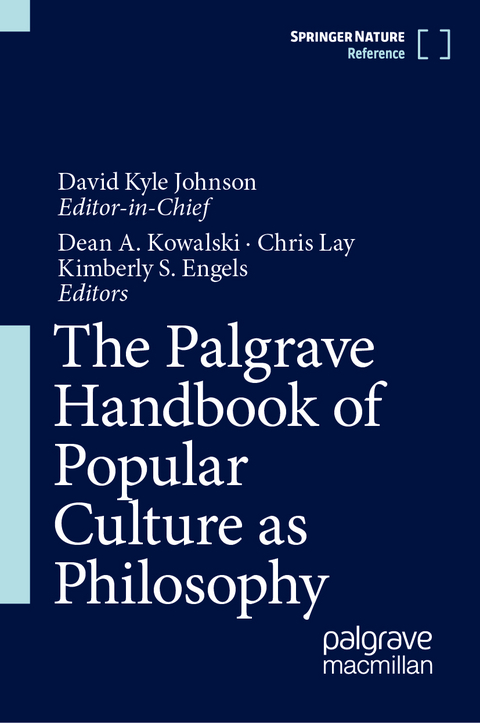
The Palgrave Handbook of Popular Culture as Philosophy
Springer International Publishing
978-3-031-24684-5 (ISBN)
Much philosophical work on pop culture apologises for its use; using popular culture is a necessary evil, something merely useful for reaching the masses with important philosophical arguments. But works of pop culture are important in their own right--they shape worldviews, inspire ideas, change minds. We wouldn't baulk at a book dedicated to examining the philosophy of The Great Gatsby or 1984--why aren't Star Trek and Superman fair game as well? After all, when produced, the former were considered pop culture just as much as the latter. This will be the first major reference work to right that wrong, gathering together entries on film, television, games, graphic novels and comedy, and officially recognizing the importance of the field. It will be the go-to resource for students and researchers in philosophy, culture, media and communications, English and history and will act as a springboard to introduce the reader to the other key literature inthe field.
David Kyle Johnson is Professor of Philosophy at Kings College, Pennsylvania, US. He has published extensively on philosophy and popular culture. His books include The Myths that Stole Christmas: Seven Misconceptions that Hijacked the Holiday (Humanist Press, 2015), Inception and Philosophy: Because It’s Never Just a Dream (editor) (Wiley-Blackwell, 2012) (This book has been translated into Chinese and is also available on Audible.com.), Introducing Philosophy Through Pop Culture: From Socrates to South Park, Hume to House (co-editor) (Wiley-Blackwell, 2010) and Heroes and Philosophy: Buy the Book, Save the World (editor) (Wiley-Blackwell, 2009). Johnson also presents a series of e-lectures on pop culture as philosophy for The Great Courses, a part of the Teaching Company. He has appeared on The Huffington Post Live, presented on his book Inception and Philosophy for the Authors@Google program at Google headquarters and writes a Blog for Psychology Today.
The Good Place as Philosophy: Moral Adventures in the Afterlife.-Twilight Zone as Philosophy 101.- Star Trek as Philosophy: Spock as Stoic Sage.- Star Trek: The Next Generation as Philosophy: Gene Roddenberry's Argument for Humanism.- Battlestar Galactica as Philosophy: Breaking the Biopolitical Cycle.- Black Sails as Philosophy: Pirates and Political Discourse.- Doctor Who as Philosophy: Four-Dimensionalism and Time Travel.- Breaking Bad as Philosophy.- The Handmaid's Tale as Philosophy: Autonomy and Reproductive Freedom.- Mister Rogers' Neighborhood as Philosophy: Children as Philosophers.- Futurama as Philosophy: Wisdom from the Ignorance of a Delivery Boy.- Firefly as Philosophy: Social Contracts, Political Dissent, and Virtuous Communities.- Arrested Development as Philosophy: Family First? What We Owe Our Parents.- The Doctor as Philosopher: The Collectivist-Realist Pacificism ofthe Doctor and the Quest for Social Justice.
| Erscheint lt. Verlag | 2.5.2024 |
|---|---|
| Mitarbeit |
Chef-Herausgeber: David Kyle Johnson |
| Zusatzinfo | XXXVIII, 2145 p. 5 illus., 3 illus. in color. In 3 volumes, not available separately. |
| Verlagsort | Cham |
| Sprache | englisch |
| Maße | 155 x 235 mm |
| Themenwelt | Geisteswissenschaften ► Philosophie |
| Sozialwissenschaften ► Soziologie | |
| Schlagworte | Doctor Who • Inception • Philosophy • popular culture • Star Trek |
| ISBN-10 | 3-031-24684-5 / 3031246845 |
| ISBN-13 | 978-3-031-24684-5 / 9783031246845 |
| Zustand | Neuware |
| Informationen gemäß Produktsicherheitsverordnung (GPSR) | |
| Haben Sie eine Frage zum Produkt? |
aus dem Bereich