Urbanism of Roman Siscia
Access Archaeology (Verlag)
978-1-78969-623-3 (ISBN)
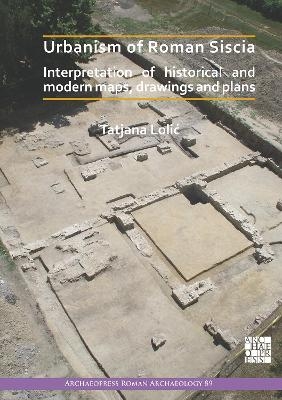
Urbanism of Roman Siscia: Interpretation of historical and modern maps, drawings and plans presents a comprehensive picture of the structure of Roman Siscia. The information has been obtained from the processing of the data from every archaeological excavation, and the analysis and interpretation of all available historical and modern documents. The position of Siscia at the confluence of the rivers Sava, Kupa and Odra below the present-day town of Sisak, is documented in the antique literary sources and in cartography through the Middle Ages, to modern times, when the site became the subject of archaeological excavations beginning in the second part of the 19th century. In the 19th century and the first decades of the 20th century, the basic outline of Roman Siscia was identified with town walls, public buildings, shrines, water supply system, cemeteries and the main roads that connected the city with other Roman towns. An older settlement, Segestica, dating from prehistory, was identified on the right bank of the Kupa River. The excavations carried out from the 1950s to 1990s were connected with the construction of the infrastructure and development of modern Sisak. These excavations confirmed the basic elements of the perimeter and urban elements of Roman Siscia: a Roman ditch and the town wall were discovered in several places, as well as an orthogonal street network, public buildings, houses, and other elements of the Roman city. This volume provides a comprehensive starting point for all future work on the Roman city.
Tatjana Lolić is Head of Sector in the Croatian Ministry of Culture. She studied Archaeology and History of Art and received her doctoral degree in Archaeology from the University of Zagreb; She undertook specialist study in Architectural Conservation at ICCROM, Rome, Italy, and has the title of docent at the University of Zagreb where she has been guest lecturer for ten years. She is experienced in the coordination and supervision of archaeological excavations and conservation projects in Croatia and has published extensively on Roman Siscia.
Foreword ;
1. Introduction ;
2. Location and urban topography of siscia according to literary sources ;
3. History of the archaeological research ;
3.1. Excavations in the 19th and the first half of the 20th century ;
3.2. Archaeological research in the period 1945–1979 ;
3.3. Archaeological research in the period 1980–2020 ;
3.4. Similar works (syntheses) ;
4. Cartographic sources ;
4.1. Classical and medieval cartography featuring symbolical depictions of Siscia ;
4.2. Cartography of Luigi Ferdinando Marsigli ;
4.3. Cartography in the 18th to 20th centuries ;
5. Archaeological interpretation ;
5.1. Block 1: Bana Jelačića Sq.–V. Nazora Promenade–S. S. Kranjčevića St ;
5.2. Block 2: S. S. Kranjčevića St–A. i S. Radića St–I. Kukuljevića Sakcinskog St– Rimska St–Šetnica ;
5.3. Block 3: A. i S. Radića St–S. S. Kranjčevića St – I. Kukuljevića Sakcinskog St-A. Starčevića St ;
5.4. Block 4: A. i S. Radića St–A. Starčevića St–I. Kukuljevića Sakcinskog St–F. Lovrića St ;
5.5. Block 5: I. Kukuljevića Sakcinskog St–A. i S. Radića St–Matije Gupca St–Ljudevita Posavskog Sq ;
5.6. Block 6: A. i S. Radića St–I. Kukuljevića Sakcinskog St–A. Starčevića St–Ljudevita Posavskog Sq.–Matije Gupca St ;
5.7. Block 7: A Starčevića St– I. Kukuljevića Sakcinskog St– Matije Gupca St–F. Lovrića St ;
5.8. Block 8: Rimska St–Matije Gupca St–Ljudevita Posavskog Sq.–A. i S. Radića St–Frankopanska St ;
5.9. Block 9: A. i S. Radića St–Ljudevita Posavskog Sq.–A. Starčevića St–Matije Gupca St– Frankopanska St ;
5.10. Block 10: A. Starčevića St–Frankopanska St–Matije Gupca St– F. Lovrića St ;
5.11. Block 11: Frankopanska St–Rimska St–N. Šipuša St–Biskupa Kvirina St ;
5.12. Block 12: Kralja Zvonimira St–N. Šipuša St–F. Hefelea St–Biskupa Kvirina St–the Segestica factory premises ;
5.13. Block 13: the Kupa River from the Odra Bridge to the Old Bridge ;
5.14. Block 14: Pogorelec (the right bank of the Kupa)–the Old Bridge–J. J. Strossmayera St–the New Bridge ;
5.15. Block 15: Sisak Novi, J. J. Strossmayera St–A. Cesarca St–I. Gundulića St ;
5.16. Block 16: Pogorelec, the west part ;
6. Conclusion ;
6.1. Modern context of the site, the state of research and documentation ;
6.2. Early development of the urban area of Siscia ;
6.3. Developed town matrix of the Flavian period ;
6.4. Development of administrative and public functions during Antonine dynasty ;
6.5. The status of Siscia and major construction projects in the period of Severan dynasty ;
6.6. The capital of the Roman province of Pannonia Savia ;
Literary sources ;
Bibliography
| Erscheinungsdatum | 07.06.2022 |
|---|---|
| Reihe/Serie | Archaeopress Roman Archaeology |
| Zusatzinfo | 263 figures, 12 plans, 1 map (colour throughout) |
| Verlagsort | Oxford |
| Sprache | englisch |
| Maße | 205 x 290 mm |
| Gewicht | 1280 g |
| Themenwelt | Geisteswissenschaften ► Archäologie |
| Geschichte ► Allgemeine Geschichte ► Altertum / Antike | |
| ISBN-10 | 1-78969-623-2 / 1789696232 |
| ISBN-13 | 978-1-78969-623-3 / 9781789696233 |
| Zustand | Neuware |
| Informationen gemäß Produktsicherheitsverordnung (GPSR) | |
| Haben Sie eine Frage zum Produkt? |
aus dem Bereich