


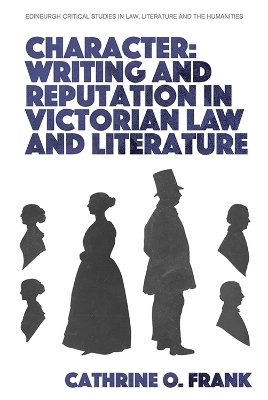
Character, Writing, and Reputation in Victorian Law and Literature
Seiten
2021
Edinburgh University Press (Verlag)
978-1-4744-8570-8 (ISBN)
Edinburgh University Press (Verlag)
978-1-4744-8570-8 (ISBN)
Drawing on primary sources including novels, Victorian periodical literature, legislative debate, case law and legal treatise, Cathrine O. Frank traces the ways conventions of literary characterisation mingled with character-centred legal developments to produce a jurisprudential theory of character that extends beyond the legal profession.
Why would Hawthorne and Eliot grant their fallen women an anachronistic right to silence that could only worsen their punishment? Why did Bronte and Gaskell find gossip such a useful source of information when lawyers excluded it as hearsay? How did Trollope’s work as an editor influence his preoccupation throughout his novels with libel? Drawing on a range of primary sources including novels, Victorian periodical literature, legislative debate, case law, and legal treatise, Cathrine O. Frank traces the ways conventions of literary characterisation mingled with character-centred legal developments to produce a jurisprudential theory of character that extends beyond the legal profession. She explores how key categories and representational strategies for imagining individual personhood also defined communities and mediated relations within them, in life and in fiction.
Why would Hawthorne and Eliot grant their fallen women an anachronistic right to silence that could only worsen their punishment? Why did Bronte and Gaskell find gossip such a useful source of information when lawyers excluded it as hearsay? How did Trollope’s work as an editor influence his preoccupation throughout his novels with libel? Drawing on a range of primary sources including novels, Victorian periodical literature, legislative debate, case law, and legal treatise, Cathrine O. Frank traces the ways conventions of literary characterisation mingled with character-centred legal developments to produce a jurisprudential theory of character that extends beyond the legal profession. She explores how key categories and representational strategies for imagining individual personhood also defined communities and mediated relations within them, in life and in fiction.
Cathrine O. Frank is Professor of English and Coordinator of the Interdisciplinary Studies in the Humanities major, University of New England, Maine, USA
Introduction: Character-Building: Narrative Theory, Narrative Jurisprudence and the Idea of Character
Incriminating Character: Revisiting the Right to Silence in Adam Bede and The Scarlet Letter
Gossip, Hearsay, and the Character Exception: Reputation on Trial in The Tenant of Wildfell Hall and R v. Rowton
Defamation of Character: Anthony Trollope and the Law of Libel
Dignity, Disclosure and the Right to Privacy: The Strange Characters of Dr. Jekyll and Dorian Gray
The English Dreyfus Case: Status as Character in an Illiberal Age
Works Cited
| Erscheinungsdatum | 11.01.2022 |
|---|---|
| Reihe/Serie | Edinburgh Critical Studies in Law, Literature and the Humanities |
| Verlagsort | Edinburgh |
| Sprache | englisch |
| Maße | 156 x 234 mm |
| Themenwelt | Geisteswissenschaften ► Sprach- / Literaturwissenschaft ► Anglistik / Amerikanistik |
| Geisteswissenschaften ► Sprach- / Literaturwissenschaft ► Literaturgeschichte | |
| Geisteswissenschaften ► Sprach- / Literaturwissenschaft ► Literaturwissenschaft | |
| Recht / Steuern ► Allgemeines / Lexika | |
| Recht / Steuern ► EU / Internationales Recht | |
| ISBN-10 | 1-4744-8570-7 / 1474485707 |
| ISBN-13 | 978-1-4744-8570-8 / 9781474485708 |
| Zustand | Neuware |
| Informationen gemäß Produktsicherheitsverordnung (GPSR) | |
| Haben Sie eine Frage zum Produkt? |
Mehr entdecken
aus dem Bereich



aus dem Bereich
Affektordnungen des Sozialen in der Gegenwartsliteratur
Buch | Softcover (2025)
De Gruyter (Verlag)
CHF 62,90


