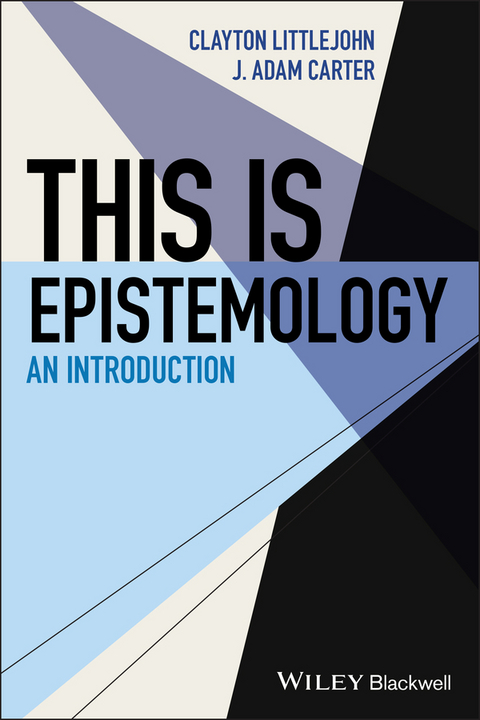
This Is Epistemology (eBook)
John Wiley & Sons (Verlag)
978-1-119-68037-6 (ISBN)
What is knowledge? Why is it valuable? How much of it do we have (if any at all), and what ways of thinking are good ways to use to get more of it? These are just a few questions that are asked in epistemology, roughly, the philosophical theory of knowledge. This is Epistemology is a comprehensive introduction to the philosophical study of the nature, origin, and scope of human knowledge. Exploring both classic debates and contemporary issues in epistemology, this rigorous yet accessible textbook provides readers with the foundation necessary to start doing epistemology.
Organized around 11 key subtopics, and assuming no prior knowledge of the subject, this volume exposes readers to diverse, often contentious perspectives-guiding readers through crucial debates including Hume's problem of induction, Descartes' engagement with radical skepticism, rationalist and empiricist evaluations of a priori justification, and many more. The authors avoid complex technical terms and jargon in favor of an easy-to-follow, informal writing style with engaging chapters designed to stimulate student interest and encourage class discussion. Throughout the text, a wealth of up-to-date references and links to online resources are provided to enable further investigation of an array of epistemological topics.
A balanced and authoritative addition to the acclaimed This is Philosophy series, This is Epistemology is a perfect primary textbook for philosophy undergraduates, and a valuable resource for general readers with interest in this important branch of philosophy.
J. Adam Carter is a Reader in Epistemology at the University of Glasgow, UK. He has published more than 10 books and 100 articles on epistemology, including articles in the Philosophers' Annual and in journals such as Nous, Philosophy and Phenomenological Research, Philosophical Studies, Analysis, Philosophical Quarterly and the Australasian Journal of Philosophy.
Clayton Littlejohn is a Professor at the Dianoia Institute of Philosophy at Australian Catholic University in Melbourne. He has published extensively in epistemology and ethical theory.
J. Adam Carter is a Reader in Epistemology at the University of Glasgow, UK. He has published more than 10 books and 100 articles on epistemology, including articles in the Philosophers' Annual and in journals such as Nous, Philosophy and Phenomenological Research, Philosophical Studies, Analysis, Philosophical Quarterly and the Australasian Journal of Philosophy. Clayton Littlejohn is a Professor at the Dianoia Institute of Philosophy at Australian Catholic University in Melbourne. He has published extensively in epistemology and ethical theory.
Acknowledgements
Introduction
1 The Regress Problem
2 Perception
3 The A Priori
4 Inference
5 On Knowing the Truth
6 Memory
7 Testimony
8 Kinds of Knowledge
9 Internalism vs. Externalism
10 The Ethics of Belief
11 Skepticism
References
Index
INTRODUCTION
I.1 What Is Epistemology?
I.1 If you catch an epistemologist in a pithy moment, and you ask “So, what is epistemology?” they might say something like this: “Epistemology is the branch of philosophy that concerns the nature and scope of human knowledge.” This isn't a bad answer. Epistemologists do care about what knowledge is (i.e. its nature). As a case in point, just look at their track record: since about the early 1960s, epistemologists have left a paper trail that includes just about every attempt you can think of to fill in this blank:1
S knows that p if and only if2 ________.
So, epistemologists clearly do care (a lot – that's decades of effort!) about what knowledge is, about its nature. In case you're wondering, for the purposes of the above puzzle, “S” can be any person (including yourself) and “p” can be any proposition. A “proposition” – the kind of thing we assert and deny, and which is capable of being true and false – is often represented by a “that” clause;3 for example, you might know that it is raining or that Scotland is north of England. Filling in the above blank requires specifying the necessary and sufficient conditions for anyone's knowing any proposition – viz. the conditions for propositional knowledge.
I.2 Does the puzzle seem easy? Prior to a famous paper in the early 1960s at least,4 the following answer to the puzzle seemed good enough:
A subject, S, knows that a proposition, p, is true iff (i) p is true, (ii) S believes that p, and (iii) S is justified in believing that p (e.g. believes p on the basis of good reasons).
The problem – which most all epistemologists now agree – is that the above answer is in fact not good enough! We won't spoil the fun of why just yet (hint: see Chapter 5), and the cases that demonstrate this are admittedly a bit tricksy. But the short of it is this: knowledge requires something more than just true belief that is backed by good reasons. It is, to put it very mildly, annoying to not have a clear view of what this “extra thing” is. And epistemologists have been working hard to find it – while, as we'll see, some more pessimistic (or, perhaps, realistic, depending on one's perspective) epistemologists have suggested it's a mistake even to try to dismantle knowledge into its constituent parts.5
I.3 The above project, at any rate, is an example of the more general idea that epistemology is “about” the nature of knowledge. We also noted that a perfectly typical answer to the “What is epistemology?” question mentions the scope of knowledge, apart from its nature. What's this about?
I.4 Suppose for one optimistic moment that we could solve the above puzzle and say, definitively, what conditions are necessary (and sufficient!) for knowing a given proposition. We might then confidently say we know what knowledge is. Even so, a separate matter is whether we actually have any of the stuff. This is the “scope” question. Do we have any knowledge, and if so, how much?
I.5 One jarring answer to the “scope” question proceeds as follows: “No! No one knows anything.” Or, a bit more qualified: “No one knows anything about the world around them.”6 The mouthpiece of this jarring answer is a shapeless, nameless foe we usually call “the skeptic.” (The skeptic goes by other names, including Descartes – but that's probably a bit misleading.7 Never mind!) So why bother with the skeptic? More generally: why even pay attention to ridiculous positions, such as the position that we lack any knowledge, something we seem to have plenty of. (Compare: if someone tried to argue that the earth is flat, would you even attempt to prove it is not? Isn't the skeptic, in trying to say we don't know anything, arguing for something equally as silly?)
I.6 In short (and unlike in the situation where someone attempts to prove to you that the earth is flat), the skeptic actually has some very powerful arguments at her disposal, arguments powerful enough that they can make you a bit uncomfortable even thinking about them.
I.7 We'll briefly tease you with one of them, with the caveat that things are much more complicated than they initially seem, and it will take a careful reading of Chapter 11 to see just why. Anyway, and more to the point: please put your hand (if you have one) directly in front your face. What do you see? It looks just like a hand. On the assumption that ambient lighting conditions are normal and that you're not drugged or otherwise mentally incapacitated, it's plausible to suppose that whatever the conditions for knowing a proposition are (e.g. whatever a correct solution to the above “S knows that p if and only if ___” puzzle would be) you surely satisfy these conditions when you're looking at your hand in broad daylight at point‐blank range.
I.8 Now, here's where the skeptic comes in. The skeptic begins by inviting us to consider what initially will sound like a ridiculous scenario (these scenarios get called “skeptical hypotheses”). Let's work with this one:
Simulation
Although you think things are mostly normal, and that you're looking at your hand (while intermittently reading the Introduction of an epistemology book), you're wrong; you are in fact a handless brain in a vat, whose every experience is controlled by a computer program designed by an evil scientist. The computer is right now implementing a phase of its program which requires you to suffer the illusion of having a hand and holding it up in front of your face.8
If the situation described in Simulation (rather than what you think is going on) is what's really going on, then, obviously, your belief “Here is a hand” is not true but false. And here's why this matters for your present situation: since you can't know your hand is in front of you right now unless your hand really is in front of you, then it looks like you can't know that your hand is in front of you unless you know that you are not currently in the situation described by Simulation.9 But – and this is where things get sticky – can you really know that you're not in that scenario? You might try pinching yourself as a “test.” But a moment's reflection indicates that that's not a good test: after all, if Simulation were true, then it would seem exactly like you were pinching yourself even if you weren't. A bit more sober reflection indicates this point generalizes to other things we might try to do as tests, which suggests we can't very effectively appeal to any of our experiences in order to satisfactorily rule out the Simulation hypothesis. But if you can't appeal to your experiences as a way of ruling out the Simulation hypothesis, then how exactly can you know it doesn't hold? And – as the skeptic then asks – if you can't know that this situation (incompatible with your having a hand) isn't the situation that's actually playing out right now, then how can you know you have a hand (or, for that matter, any of the other empirical propositions you take yourself to know)?
I.9 We don't mean to upset the reader here. Perhaps you can figure out a way to know you're not a handless brain in a vat, and if that's the case, then all's good. We mention the thought experiment only as a way of showing how the matter of the scope of human knowledge is a question of interest to epistemologists: we think we surely have some knowledge, but proving this in an intellectually respectable way seems to require that we have something compelling to say in response to challenges from the skeptic, and that's easier said than done.
I.10 Let's take a step back and regroup. You, the reader, will now hopefully have some idea what an epistemologist is getting at when he/she tells you that epistemology is about the “nature and scope of human knowledge.” The only problem is that epistemology is about way more than just that. (And if an epistemologist tells you otherwise, they're lying!)
I.11 It's a bit tricky to explain exactly what else epistemology is without simply showing you. And so, This Is Epistemology is our best attempt to do just this – to show you. We have selected 11 key “subtopics” that epistemologists often argue with each other about, and in each case, we do our best to tell all sides of the story. Whether or not we’ve succeeded in this aim, we've certainly told many sides of many stories in this book (some might wonder: did we tell too many?) – and the result is that the chapters are lengthier than is typical. There are already quite a few short introductions to epistemology on the market, and it's fair to say that this is not one of them. What we lack in brevity we hope to have overcome in comprehensiveness.
I.12 In the next section, we describe briefly what each of the 11 chapters is about. But before proceeding to do that, we want to first say at least...
| Erscheint lt. Verlag | 27.4.2021 |
|---|---|
| Reihe/Serie | This is Philosophy |
| This is Philosophy | This is Philosophy |
| Sprache | englisch |
| Themenwelt | Geisteswissenschaften ► Philosophie ► Allgemeines / Lexika |
| Geisteswissenschaften ► Philosophie ► Erkenntnistheorie / Wissenschaftstheorie | |
| Schlagworte | a priori • epistemic justification • epistemic transmission • Epistemologie • Epistemology • epistemology debates • Epistemology Ethics • epistemology introduction • epistemology principles • epistemology problems • epistemology textbook • Erkenntnistheorie • Philosophie • Philosophy • regress problem • skepticism |
| ISBN-10 | 1-119-68037-9 / 1119680379 |
| ISBN-13 | 978-1-119-68037-6 / 9781119680376 |
| Informationen gemäß Produktsicherheitsverordnung (GPSR) | |
| Haben Sie eine Frage zum Produkt? |
 EPUB (Adobe DRM)
Kopierschutz: Adobe-DRM
Adobe-DRM ist ein Kopierschutz, der das eBook vor Mißbrauch schützen soll. Dabei wird das eBook bereits beim Download auf Ihre persönliche Adobe-ID autorisiert. Lesen können Sie das eBook dann nur auf den Geräten, welche ebenfalls auf Ihre Adobe-ID registriert sind.
Details zum Adobe-DRM
Dateiformat: EPUB (Electronic Publication)
EPUB ist ein offener Standard für eBooks und eignet sich besonders zur Darstellung von Belletristik und Sachbüchern. Der Fließtext wird dynamisch an die Display- und Schriftgröße angepasst. Auch für mobile Lesegeräte ist EPUB daher gut geeignet.
Systemvoraussetzungen:
PC/Mac: Mit einem PC oder Mac können Sie dieses eBook lesen. Sie benötigen eine
eReader: Dieses eBook kann mit (fast) allen eBook-Readern gelesen werden. Mit dem amazon-Kindle ist es aber nicht kompatibel.
Smartphone/Tablet: Egal ob Apple oder Android, dieses eBook können Sie lesen. Sie benötigen eine
Geräteliste und zusätzliche Hinweise
Buying eBooks from abroad
For tax law reasons we can sell eBooks just within Germany and Switzerland. Regrettably we cannot fulfill eBook-orders from other countries.
aus dem Bereich