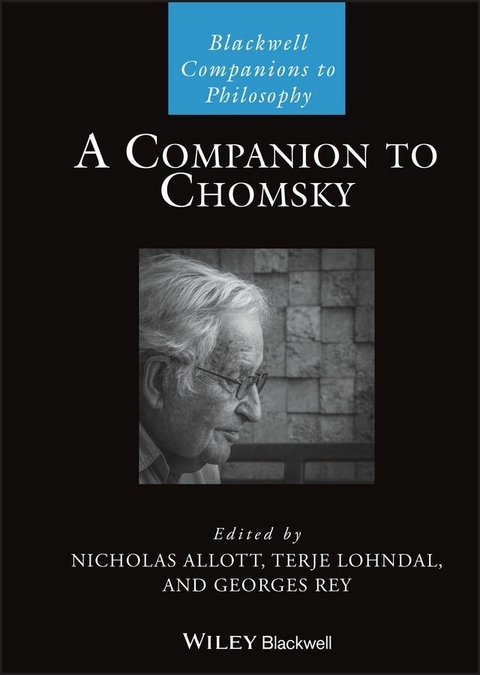
A Companion to Chomsky (eBook)
John Wiley & Sons (Verlag)
978-1-119-59868-8 (ISBN)
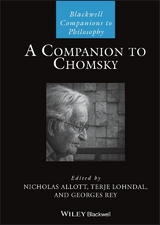
A COMPANION TO CHOMSKY
Widely considered to be one of the most important public intellectuals of our time, Noam Chomsky has revolutionized modern linguistics. His thought has had a profound impact upon the philosophy of language, mind, and science, as well as the interdisciplinary field of cognitive science which his work helped to establish. Now, in this new Companion dedicated to his substantial body of work and the range of its influence, an international assembly of prominent linguists, philosophers, and cognitive scientists reflect upon the interdisciplinary reach of Chomsky's intellectual contributions.
Balancing theoretical rigor with accessibility to the non-specialist, the Companion is organized into eight sections-including the historical development of Chomsky's theories and the current state of the art, comparison with rival usage-based approaches, and the relation of his generative approach to work on linguistic processing, acquisition, semantics, pragmatics, and philosophy of language. Later chapters address Chomsky's rationalist critique of behaviorism and related empiricist approaches to psychology, as well as his insistence upon a 'Galilean' methodology in cognitive science. Following a brief discussion of the relation of his work in linguistics to his work on political issues, the book concludes with an essay written by Chomsky himself, reflecting on the history and character of his work in his own words.
A significant contribution to the study of Chomsky's thought, A Companion to Chomsky is an indispensable resource for philosophers, linguists, psychologists, advanced undergraduate and graduate students, and general readers with interest in Noam Chomsky's intellectual legacy as one of the great thinkers of the twentieth century.
Nicholas Allott is Senior Lecturer in English Language at the University of Oslo. His work focuses on pragmatics, inference and rationality in communication, word meaning and lexical modulation, legal language and interpretation, and the philosophy of linguistics. His publications include Chomsky: Ideas and Ideals (with Neil Smith) (2016).
Terje Lohndal is Professor of English Linguistics at NTNU Norwegian University of Science and Technology and Adjunct Professor at UiT The Arctic University of Norway. His main areas of research are comparative grammar, multilingualism, and the history of generative linguistics. He has published numerous papers, and several books, among them, Phrase Structure and Argument Structure (2014).
Georges Rey is Professor of Philosophy at the University of Maryland at College Park. He has written extensively on the foundations of cognitive science, including more than sixty articles and two books, Contemporary Philosophy of Mind (1997) and Representation of Language: Philosophical Issues in a Chomskyan Linguistics (2020).
A COMPANION TO CHOMSKY Widely considered to be one of the most important public intellectuals of our time, Noam Chomsky has revolutionized modern linguistics. His thought has had a profound impact upon the philosophy of language, mind, and science, as well as the interdisciplinary field of cognitive science which his work helped to establish. Now, in this new Companion dedicated to his substantial body of work and the range of its influence, an international assembly of prominent linguists, philosophers, and cognitive scientists reflect upon the interdisciplinary reach of Chomsky's intellectual contributions. Balancing theoretical rigor with accessibility to the non-specialist, the Companion is organized into eight sections including the historical development of Chomsky's theories and the current state of the art, comparison with rival usage-based approaches, and the relation of his generative approach to work on linguistic processing, acquisition, semantics, pragmatics, and philosophy of language. Later chapters address Chomsky's rationalist critique of behaviorism and related empiricist approaches to psychology, as well as his insistence upon a "e;Galilean"e; methodology in cognitive science. Following a brief discussion of the relation of his work in linguistics to his work on political issues, the book concludes with an essay written by Chomsky himself, reflecting on the history and character of his work in his own words. A significant contribution to the study of Chomsky's thought, A Companion to Chomsky is an indispensable resource for philosophers, linguists, psychologists, advanced undergraduate and graduate students, and general readers with interest in Noam Chomsky's intellectual legacy as one of the great thinkers of the twentieth century.
Nicholas Allott is Senior Lecturer in English Language at the University of Oslo. His work focuses on pragmatics, inference and rationality in communication, word meaning and lexical modulation, legal language and interpretation, and the philosophy of linguistics. His publications include Chomsky: Ideas and Ideals (with Neil Smith) (2016). Terje Lohndal is Professor of English Linguistics at NTNU Norwegian University of Science and Technology and Adjunct Professor at UiT The Arctic University of Norway. His main areas of research are comparative grammar, multilingualism, and the history of generative linguistics. He has published numerous papers, and several books, among them, Phrase Structure and Argument Structure (2014). Georges Rey is Professor of Philosophy at the University of Maryland at College Park. He has written extensively on the foundations of cognitive science, including more than sixty articles and two books, Contemporary Philosophy of Mind (1997) and Representation of Language: Philosophical Issues in a Chomskyan Linguistics (2020).
Notes on Contributors
David Adger is Professor of Linguistics at Queen Mary University of London. He is the author of a number of monographs and articles on syntactic theory and its connections with other aspects of language. He was coeditor of the journal Syntax for seven years, and is coeditor of Oxford Studies in Theoretical Linguistics, which he founded in 2001. He was President of the Linguistics Association of Great Britain from 2015 to 2020. His latest book is Language Unlimited: The Science Behind Our Most Creative Power (OUP).
Artemis Alexiadou is a Professor of English Linguistics at the Humboldt University in Berlin and Vice‐Director of the Leibniz‐Centre General Linguistics (ZAS). She has published on the syntax of noun phrases and nominalization, transitivity alternations, word order variation, Case and the EPP, and language mixing.
Nicholas Allott is a Senior Lecturer in English language at the University of Oslo. He works on pragmatics; inference and rationality in communication; word meaning and lexical modulation; legal language and interpretation; and the philosophy of linguistics, particularly cognitively realistic approaches such as generative grammar and relevance theory. His publications include Chomsky: Ideas and Ideals (3rd ed. 2016) and The Responsibility of Intellectuals: Reflections by Noam Chomsky and others after 50 years (2019).
Mark Baker is a Distinguished Professor of Linguistics and Cognitive Science at Rutgers University, having received his PhD in Linguistics in 1985 from MIT. He specializes in the syntax and morphology of less‐studied languages, particularly those of the Americas, Africa, and Asia, seeking to bring together generative‐style theories, data collected from fieldwork, and typological comparison in a way that illuminates all three. He has written five research monographs and one book for a popular audience, The Atoms of Language (2001).
Lisa Lai‐Shen Cheng is a Professor of Linguistics at Leiden University. Her primary research interests are comparative syntax, and the interfaces (syntax and semantics, and syntax and phonology). Recent publications include “Wh‐question or wh‐declarative? Prosody makes the difference” (with Yang and Gryllia) in Speech Communication; and “(In)direct reference in the phonology‐syntax interface under phase theory” (with Bonet, Downing, and Mascaró) in Linguistic Inquiry.
Joshua Cohen is on the Faculty at Apple University; Distinguished Senior Fellow in Law, Philosophy, and Political Science at University of California, Berkeley; and co‐editor of Boston Review. He is co‐author, with Joel Rogers, of On Democracy (1983) and Associations and Democracy (1995), and author of Philosophy, Politics, Democracy (2009); The Arc of the Moral Universe (2010); and Rousseau: A Free Community of Equals (2011). He is also co‐editor of the Norton Introduction to Philosophy (second edition, 2018).
John Collins is a Professor of Philosophy at the University of East Anglia. He mainly researches in the philosophy of language and the foundations of generative linguistics. He is the author of three monographs: Chomsky: A Guide for the Perplexed (2008), The Unity of Linguistic Meaning (2011), and Linguistic Pragmatism and Weather Reporting (2020).
Stephen Crain is a Distinguished Professor of Linguistics at Macquarie University, Australia. His framework for research is the biolinguistic approach to language, and he investigates the relationship between logic and child language from a crosslinguistic perspective.
Brian Dillon is an Associate Professor in the Department of Linguistics at the University of Massachusetts, Amherst. He is a psycholinguist whose primary research interest is in real‐time sentence processing. His research seeks to better understand how comprehenders use syntactic information during language comprehension, using both cross‐linguistic experimental investigation and computational modeling.
Elly van Gelderen is a syntactician interested in language change. She teaches at Arizona State University. Her work shows how regular syntactic change (grammaticalization and the linguistic cycle) provides insight in the Faculty of Language. Publications include The Linguistic Cycle: Language Change and the Language (2011), Clause Structure (2013), Syntax (2017), and The Diachrony of Meaning (2018).
Iain Giblin is a Scholarly Teaching Fellow at Macquarie University, Sydney. His main research interest is child language acquisition with a focus on syntax and semantics.
Michael Glanzberg is a Professor of Philosophy at Rutgers University. He works on a number of topics in philosophy of language, logic, and the foundations of linguistic theory. He is a co‐author of Formal Theories of Truth and the editor of The Oxford Handbook of Truth.
James Griffiths holds the position of Junior Professor of English Linguistics at the University of Tübingen. Specializing in syntax and how it interacts with pragmatics, morphology, and phonology, his main research interest to date has been the distribution of parenthesis and ellipsis within and across languages. His longer articles on this topic have been published in the highly regarded journals Linguistic Inquiry, Natural Language and Linguistic Theory, and Syntax.
Tim Hunter is an Associate Professor in the Department of Linguistics at the University of California, Los Angeles. Much of his research focus on syntax and its interfaces with experimental psycholinguistics and with semantics, from a computational perspective.
Lila Gleitman taught at the University of Pennsylvania from 1972 until 2001, where she is currently Professor Emerita in the Department of Psychology. From 2000–2010 she was a visiting faculty at the Cognitive Science Institute (RUCCS) at Rutgers University. She is the (co‐)author of innumerable books and articles on language acquisition. In 2017 she was a recipient of the David E. Rumelhart Prize for Contributions to the Theoretical Foundations of Human Cognition. She is also a member of the National Academy of Sciences.
Steven Gross is a Professor of Philosophy at Johns Hopkins University, with secondary appointments in Cognitive Science and in Psychological and Brain Sciences. He has published on a variety of topics in philosophy of language, philosophy of mind, and the foundations of the mind‐brain sciences. His most recent publications have focused on perceptual consciousness and on cognitive penetration. Current projects include “anti‐Bayesian” updating in vision and whether linguistic meaning is perceived or computed post‐perceptually.
Tanja Kupisch is a Professor of Linguistics at the University of Konstanz and Adjunct Professor at UiT, The Arctic University of Norway. Her research is primarily concerned with early bilingualism during childhood and adulthood, and especially the development of migrant and indigenous languages. Research domains include phonology and syntax. Current projects include ethnic policies and the acquisition of rhetorical questions.
Dave Kush is an Assistant Professor of Psycholinguistics at the University of Toronto and an Adjunct Professor at NTNU, Norwegian University of Science and Technology. His research interests sit at the intersection of psycholinguistics and syntactic theory.
Joseph Levine is a Professor of Philosophy at the University of Massachusetts, Amherst. Prof. Levine specializes in philosophy of mind, particularly the problem of consciousness. He has published one monograph, Purple Haze: The Puzzle of Consciousness, one edited collection, Quality and Content: Essays on Consciousness, Representation, and Modality, and many articles, including ‘Materialism and Qualia: The Explanatory Gap.’
Diane Lillo‐Martin is a Board of Trustees Distinguished Professor of linguistics at the University of Connecticut, and a Senior Research Scientist at Haskins Laboratories. Her research interests include the acquisition of American Sign Language by deaf and hearing children in monolingual and bimodal bilingual contexts, and how analyses of the grammatical structure of ASL contribute to understanding linguistic universals.
Terje Lohndal is a Professor of English Linguistics at NTNU, Norwegian University of Science and Technology, and Adjunct Professor at UiT, The Arctic University of Norway. His main areas of research are comparative grammar, including research on multilingualism, and the history of generative linguistics.
Eloi Puig‐Mayenco holds a Lecturer Position at King's College London. His research focuses on bi‐/multilingualism during the lifespan. Specifically, he is interested in how previously acquired languages affect the initial stages and subsequent development of additive sequential multilingualism in childhood and adulthood.
Gereon Müller is a Professor of General Linguistics at Universität Leipzig. His main research interest is grammatical theory, with a special focus on syntax and morphology. An underlying assumption that guides his research is that both these systems are organized...
| Erscheint lt. Verlag | 30.4.2021 |
|---|---|
| Reihe/Serie | Blackwell Companions to Philosophy |
| Blackwell Companions to Philosophy | Blackwell Companions to Philosophy |
| Sprache | englisch |
| Themenwelt | Geisteswissenschaften ► Philosophie ► Allgemeines / Lexika |
| Geisteswissenschaften ► Philosophie ► Sprachphilosophie | |
| Geisteswissenschaften ► Psychologie | |
| Schlagworte | Chomsky cognitive science • Chomsky companion • Chomsky critique • Chomsky essays • Chomsky framework • Chomsky influence • Chomsky issues • Chomsky linguistics • Chomsky methodology • Chomsky, Noam • Chomsky philosophy • Chomsky program • Chomsky scholarship • Chomsky syntax • Cognitive Psychology • Kognitive Psychologie • Linguistics • Linguistics Special Topics • Philosophie • Philosophy • Philosophy of Language • Psychologie • Psychology • Spezialthemen Sprachwissenschaften • Sprachphilosophie • Sprachwissenschaften |
| ISBN-10 | 1-119-59868-0 / 1119598680 |
| ISBN-13 | 978-1-119-59868-8 / 9781119598688 |
| Informationen gemäß Produktsicherheitsverordnung (GPSR) | |
| Haben Sie eine Frage zum Produkt? |
 EPUB (Adobe DRM)
Kopierschutz: Adobe-DRM
Adobe-DRM ist ein Kopierschutz, der das eBook vor Mißbrauch schützen soll. Dabei wird das eBook bereits beim Download auf Ihre persönliche Adobe-ID autorisiert. Lesen können Sie das eBook dann nur auf den Geräten, welche ebenfalls auf Ihre Adobe-ID registriert sind.
Details zum Adobe-DRM
Dateiformat: EPUB (Electronic Publication)
EPUB ist ein offener Standard für eBooks und eignet sich besonders zur Darstellung von Belletristik und Sachbüchern. Der Fließtext wird dynamisch an die Display- und Schriftgröße angepasst. Auch für mobile Lesegeräte ist EPUB daher gut geeignet.
Systemvoraussetzungen:
PC/Mac: Mit einem PC oder Mac können Sie dieses eBook lesen. Sie benötigen eine
eReader: Dieses eBook kann mit (fast) allen eBook-Readern gelesen werden. Mit dem amazon-Kindle ist es aber nicht kompatibel.
Smartphone/Tablet: Egal ob Apple oder Android, dieses eBook können Sie lesen. Sie benötigen eine
Geräteliste und zusätzliche Hinweise
Buying eBooks from abroad
For tax law reasons we can sell eBooks just within Germany and Switzerland. Regrettably we cannot fulfill eBook-orders from other countries.
aus dem Bereich