


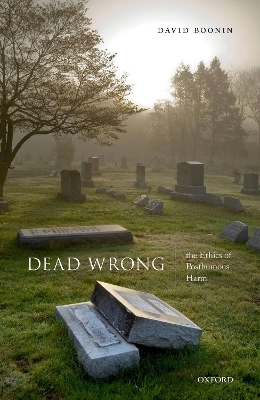
Dead Wrong
The Ethics of Posthumous Harm
Seiten
2019
Oxford University Press (Verlag)
978-0-19-884210-1 (ISBN)
Oxford University Press (Verlag)
978-0-19-884210-1 (ISBN)
It is possible for an act to wrongfully harm a person, even if that person is dead. David Boonin explains the puzzle of posthumous harm and examines its ethical implications for such issues as posthumous organ removal, posthumous publication of private documents, damage to graves, and posthumous punishment.
It is possible for an act to wrongfully harm a person, even if the act takes place after the person is dead. David Boonin defends this view in Dead Wrong and explains the puzzle of posthumous harm. In doing so, he makes three central claims. First, that it is possible for an act to wrongfully harm a person while they are alive even if the act has no effect on that person's conscious experiences. Second, that if this is so, then frustrating a person's desires is one way to wrongfully harm a person. And third, that it is possible for an act to wrongfully harm a person even if the act takes place after the person is dead. Over the course of the book, Boonin introduces the significance of posthumous harm, deals with each of his three main claims in turn, responds to the objections that might be raised against the book's thesis, and examines some of the ethical implications for issues such as posthumous organ and gamete removal, posthumous publication of private documents, damage to graves and corpses, and posthumous punishment and restitution.
It is possible for an act to wrongfully harm a person, even if the act takes place after the person is dead. David Boonin defends this view in Dead Wrong and explains the puzzle of posthumous harm. In doing so, he makes three central claims. First, that it is possible for an act to wrongfully harm a person while they are alive even if the act has no effect on that person's conscious experiences. Second, that if this is so, then frustrating a person's desires is one way to wrongfully harm a person. And third, that it is possible for an act to wrongfully harm a person even if the act takes place after the person is dead. Over the course of the book, Boonin introduces the significance of posthumous harm, deals with each of his three main claims in turn, responds to the objections that might be raised against the book's thesis, and examines some of the ethical implications for issues such as posthumous organ and gamete removal, posthumous publication of private documents, damage to graves and corpses, and posthumous punishment and restitution.
David Boonin is Professor of Philosophy at the University of Colorado Boulder and Director of the Department's Center for Values and Social Policy. He is also the editor of Public Affairs Quarterly. Boonin received his BA from Yale University in 1986 and his PhD from the University of Pittsburgh in 1992. He taught at Georgetown University (1992-4) and Tulane University (1994-8) before taking up his current position at CU in 1998. He also held a visiting position for a semester as an Erskine Fellow at the University of Canterbury in Christchurch, New Zealand, in 2006.
1: Introduction
2: Unfelt Harm
3: From Unfelt Harm to Unsatisfied Desire
4: From Unsatisfied Desire to Posthumous Harm
5: From Posthumous Harm to Posthumous Wrongs
| Erscheinungsdatum | 18.10.2019 |
|---|---|
| Verlagsort | Oxford |
| Sprache | englisch |
| Maße | 160 x 235 mm |
| Gewicht | 468 g |
| Themenwelt | Geisteswissenschaften ► Philosophie ► Ethik |
| ISBN-10 | 0-19-884210-4 / 0198842104 |
| ISBN-13 | 978-0-19-884210-1 / 9780198842101 |
| Zustand | Neuware |
| Informationen gemäß Produktsicherheitsverordnung (GPSR) | |
| Haben Sie eine Frage zum Produkt? |
Mehr entdecken
aus dem Bereich

aus dem Bereich
Buch | Hardcover (2025)
Suhrkamp (Verlag)
CHF 32,15


