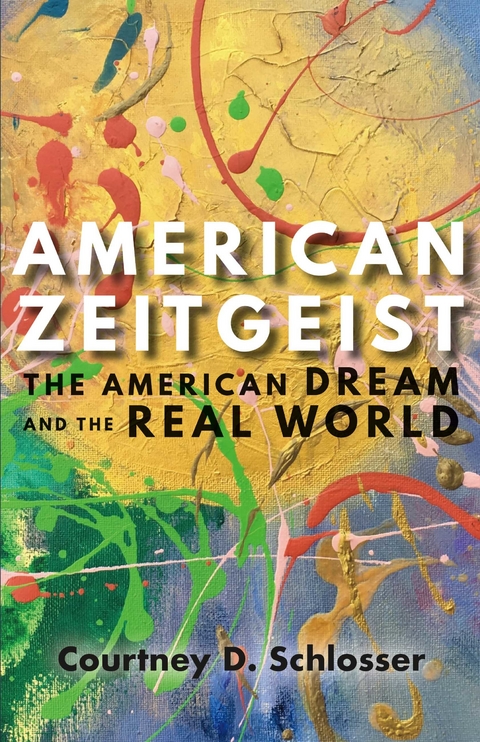
American Zeitgeist (eBook)
494 Seiten
Bookbaby (Verlag)
978-1-5439-5889-8 (ISBN)
The American Dream is alive despite the systemic violence, injustice and inequality of society. However, pragmatic philosophy, the love of nature, and transcendental values embody a more realistic and naturalistic view of the world. American Capitalism conflicts with the ideals of democracy and the myths of society. Conservative beliefs about evolution, global climate change and the moral, political and economic problems of society maintain the status quo. A divided country tears at the fabric of justice, equality and compassion. A passionate sense of reality inspires this book. The path forward needs a simpler way of living informed by ethics, a sacred sense of the real world, and freedom from suffering for all beings. Life, liberty and the pursuit of happiness, for all the people, remain the supreme ideals of American democracy. We need not give up on The American Dream, if The People, All the people, have an equal opportunity for self-realization in the real world.
I have decided to begin this book about the liberation from ignorance, violence and suffering with American Pragmatic Philosophy and the human predicament. The phrase human predicament exists everywhere human beings are born, live and die, in cyclic nature and existence. Change is universal in nature and existence since it is synonymous with motion—from the movements of subatomic particles in all forms, to the movements of the stars, galaxies and the universe. If anything is eternal or unchanging, we can only sense it from our limited point-of-view since we are mortal and finite beings.
No one knows for certain why there is something rather than nothing or how the universe actually began and evolved. But we do have myths, theories and hypotheses that are the result of intuition and the interpretation of incomplete data.
Knowledge is something very special and unique among humans; and although other animals have knowledge essential for survival, breeding and caring for their species, their knowledge is not as complex, technical or abstract as our own; but then what do we really know about other animals and the working of their minds? We know that other animals, once domesticated, are very loyal to their owners and have an instinctive empathy for the emotions of their owners. But unless we have learned the nonverbal cues and unspoken languages of our loyal pets we cannot really communicate with them in the ways that we can with each other.
The structures and functions of our body and mind are hugely complex and inscrutable. We each live in our own sense and experience of an infinitely greater world; yet we each create our meaning and feeling of the world from the first-person point-of-view or perspective. In philosophy, phenomenology is the theory of consciousness or the view we each create our own sense of the world through the processes and acts of the body, mind and soul. Unifying feeling or experience of the world is the structure and function of consciousness; and the maxim that consciousness is always a consciousness of something in nature and real world.
Yet William James—one of three classical American Pragmatists—has written: “no single point of view can ever take in the whole scene; and to a mind possessed of the love of unity at any cost, it will, no doubt, remain forever unacceptable.” It is a realization that most serious students of philosophy realize early in their study of human experience, knowledge and meaning. (1)
We are born in our skin, the living boundary of our bodies, and live out our days and years to our inevitable ending in the same, aging skin—in solitude. Whether we live for fifty or a hundred years, ‘aging, sickness and death’ is the unavoidable destiny that we will all experience. No philosophy, science or society can change our fate as a living organism; aging is inevitable, sickness is inevitable, and death is inevitable. Yet there is the faith that many have in an afterlife and it is all the certainty that any can have—short of the experience of rebirth.
Liberation—an active going forth into the world—is the opposite action of one who turns his back upon the world, like a recluse, a hermit or a buddha. Yet paired oppositions complement one another in the matrix of existence; and there is no turning back to the beginning of our journey through space and time, except through the imagination of the mind. In this text, I am suggesting that we have many lives to live in ways that we can only imagine before the light disappears.
Experience and Knowledge
We perceive reality superficially when we only use our senses. Sense realism gives us an experience of the world at the level of appearance, appearances gained from the five powers of sensation—seeing, hearing, smelling, tasting and touching. Of these senses, touching or the kinesthetic sense of reality is the most primitive which ants, worms and birds have. Without this sense, we would probably bump into or collide with physical things bodily much more than we now do; and without the other four senses aiding us in locating our body in space and place in relation to other people and the physical things of the world, the world of personal experience would cease to exist for us and everything would appear utterly meaningless.
Indeed, such is the predicament of one who only believes in the outer senses of experience without the necessity of an inner potentiality which most call mind, consciousness or the soul. Experience or the world in general only appears meaningful due to the continuous presence of the human mind. However, a more meaningful story is to imagine ourselves as citizens of the cosmos. Furthermore, there is the narrative of the universal aesthetic continuum that connects our present situation as sentient beings with the totality of what-is or universal being.
The fuller, deeper awakening to who we are comes at once from the mind, our most vital, invisible potentiality for experiencing and creating meaning in life. The mind is present in everything that we do, consciously or not, in our waking states of being and in sleeping as seen in dream states and in our meditations or moments of deep concentration. But the mind is also and most importantly present in our use of the senses; otherwise we would not derive any meaning from what we experience in the first place.
Thus, meaning arises quite naturally and directly from the contact that our senses make with reality, both inwardly and outwardly. If we say, as we must, that meaning or understanding arises from the mind, there is no absolute separation between what is out-there, in the real world and what is in-here in the elusive world of subjectivity and the mind. In philosophy, this view is present in phenomenology or a theory of mind and consciousness that places the mind in the contexts of nature, society and the cosmos. Yet the mind is most vitally and immediately present in sensory, emotional and intellectual experiences of all kinds.
It is in this latter context of human identity that we have the potentialities of existing in at least three most basic dimensions: as natural, social, and universal beings. Realistically; we cannot ignore our natural identity since we are Earth-bound creatures that live in a society with a national identity—whether we love it or not; and as importantly, everyone lives in the universe, in a particular galaxy of stars called the Milky Way, and live by the light, energy and Life-force of one star—the sun.
Language, Culture and Meaning
Language or the potential of speaking and hearing, writing and reading that involves the use that the mind makes of abstract symbols like words and numbers. We often think or feel and sense something before we speak about it; but for those who are in the habit of speaking, thought and feeling may follow upon the act of speaking, listening to others speak, or reading words and mathematical symbols upon a page or screen. In most people, language intimately connects us to the mind’s Presence and the rest of the universe.
The social and cultural uses of language have evolved in quite complex ways and continue to do so as we grow, individually and collectively, in the world. For example, our present globalized society connects in ways that we can only begin to understand thanks to our ability to communicate with others through our language system. If we just consider the world-wide web of information technology and the light-speed of our communications network, the complexity of relationships between individuals, institutions and nations have taken a quantum leap in the last few decades. And it is the language systems, platforms and aps of computer technology that have made much of this possible.
The other big change in human evolution has been the awakening of the mind to experience, meaning and illusion. Without the development of the rudiments of language systems, about ten thousand years ago, it is doubtful that humankind would be as intellectually, technological and culturally developed as it now is in many parts of the world. Thus, we cannot entirely separate our potentiality in learning language from creating higher, deeper and more abstract ways of communicating beyond our roles in society. Yet, for all that, we are biological organisms, first and foremost, with bodies and minds that went through eons of growth and development, mutation and adaptation that we have some understanding of, thanks to archeological evidence and observations of living species.
Finally meaning arises naturally from the human mind and its myriad connections with the neural brain and body. Everything that we do, say, think or feel contributes to the virtual reality of the mind. In terms of human identity, we still have the most to learn since the actual way in which the brain awakens the actions, thoughts and feelings of the mind is a great mystery to neuro-scientists and meta-psychologists alike. How does the brain awaken the mind or is it the other way around? Either way, awareness is a fact of existence as certainly as are...
| Erscheint lt. Verlag | 15.1.2019 |
|---|---|
| Sprache | englisch |
| Themenwelt | Geisteswissenschaften ► Philosophie ► Ethik |
| ISBN-10 | 1-5439-5889-3 / 1543958893 |
| ISBN-13 | 978-1-5439-5889-8 / 9781543958898 |
| Informationen gemäß Produktsicherheitsverordnung (GPSR) | |
| Haben Sie eine Frage zum Produkt? |
 EPUB (Ohne DRM)
Größe: 3,4 MB
Digital Rights Management: ohne DRM
Dieses eBook enthält kein DRM oder Kopierschutz. Eine Weitergabe an Dritte ist jedoch rechtlich nicht zulässig, weil Sie beim Kauf nur die Rechte an der persönlichen Nutzung erwerben.
Dateiformat: EPUB (Electronic Publication)
EPUB ist ein offener Standard für eBooks und eignet sich besonders zur Darstellung von Belletristik und Sachbüchern. Der Fließtext wird dynamisch an die Display- und Schriftgröße angepasst. Auch für mobile Lesegeräte ist EPUB daher gut geeignet.
Systemvoraussetzungen:
PC/Mac: Mit einem PC oder Mac können Sie dieses eBook lesen. Sie benötigen dafür die kostenlose Software Adobe Digital Editions.
eReader: Dieses eBook kann mit (fast) allen eBook-Readern gelesen werden. Mit dem amazon-Kindle ist es aber nicht kompatibel.
Smartphone/Tablet: Egal ob Apple oder Android, dieses eBook können Sie lesen. Sie benötigen dafür eine kostenlose App.
Geräteliste und zusätzliche Hinweise
Buying eBooks from abroad
For tax law reasons we can sell eBooks just within Germany and Switzerland. Regrettably we cannot fulfill eBook-orders from other countries.
aus dem Bereich