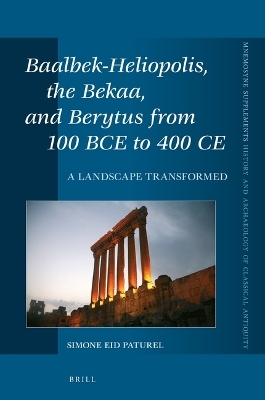
Baalbek-Heliopolis, the Bekaa, and Berytus from 100 BCE to 400 CE
Brill (Verlag)
978-90-04-40058-0 (ISBN)
The aim of this monograph is to understand the extent to which the landscape of Roman Berytus and the Bekaa valley is a product of colonial transformation following the foundation of Colonia Iulia Augusta Felix Berytus in 15 BCE. The book explores the changes observed in the cities of Berytus and Heliopolis, as well as the sites at Deir el-Qalaa, Niha, and Hosn Niha. The work fundamentally challenges the traditional paradigm, where Baalbek-Heliopolis is seen as a religious site dating from as early as the Bronze Age and associated with the worship of a Semitic or Phoenician deity triad and replaces it with a new perspective where religious activity is largely a product of colonial change.
Simone Eid Paturel studied Spanish and Latin American literature at Paris-Sorbonne University, Egyptology at the Institut Kheops in Paris, History and Archaeology (BA) and Philosophy (MA) at the University of London. She completed her PhD in 2014 at the University of Newcastle. Her research is focused on the landscape archaeology of the ancient city of Baalbek-Heliopolis and its environs from 100 BCE to 400 CE.
Acknowledgements
List of Figures and Tables
1 Introduction
1.1 The Aims of This Monograph
1.2 Objectives
1.3 Chronological and Geographical Range
1.4 Topography and Geographical Setting
1.5 Structure of the Monograph
2 Sources, Historiography, Method & Theory
2.1 Introduction
2.2 Sources and Historiography
2.3 Method and Theory
2.4 Conclusion
3 From Hellenistic Kingdoms to Roman Authority in the Levant
3.1 Introduction
3.2 The Hellenistic Kingdoms in the Levant
3.3 The Ituraeans and the Ituraean Principality
4 Pre-Hellenistic and Hellenistic Berytus
4.1 Introduction
4.2 Palaeolithic–Chalcolithic Activity (through 3000 BCE)
4.3 Bronze Age (3000 BCE–1200 BCE)
4.4 Iron Age (1200 BCE–323 BCE)
4.5 Hellenistic (323 BCE–15 BCE)
4.6 Conclusion: Pre-Roman Berytus
5 Pre-Hellenistic and Hellenistic Baalbek and the Bekaa
5.1 Introduction
5.2 The Names Baalbek and Heliopolis
5.3 Prehistoric and Hellenistic Baalbek
5.4 The Prehistoric and Hellenistic Bekaa and Ituraean Territories
5.5 Conclusion and Interpretation
6 Roman Berytus
6.1 Introduction
6.2 The Cardo Maximus and Colonnaded Decumani
6.3 Public Buildings and Religious Architecture
6.4 Domestic Architecture
6.5 Commerce
6.6 Funerary Practice
6.7 Conclusions: The “Reconstruction” of Berytus
7 Deir el-Qalaa
7.1 Introduction
7.2 The Sacred Area at Deir el-Qalaa
7.3 The Settlement Area
7.4 The Deities and the Inscriptions
7.5 Conclusions
8 The Sanctuaries of Niha and Hosn Niha
8.1 Introduction
8.2 Niha
8.3 Hosn Niha
8.4 Conclusion: Ancient Nihata and Hosn Niha
9 The Religious Landscape of Baalbek in the Roman Period
9.1 Introduction
9.2 Early Roman Baalbek: 15 BCE–Mid-second Century
9.3 The Later Roman Empire: From the Mid-second Century to the Fourth Century
9.4 Funerary Practice in Baalbek and Douris
9.5 Conclusion: A Double Transformation
10 Life in the Colonia from Epigraphic, Numismatic, and Iconographic Evidence
10.1 Introduction
10.2 The Heliopolitan “Triad”
10.3 Baalbek-Heliopolis and Imperial Patronage
10.4 Euergetism by Private Citizens
10.5 Veterans and the Roman Army
10.6 Civilians, Public Officials, and Families
10.7 Voting Tribes
10.8 Conclusions: Life at Baalbek and in the Bekaa
11 Landscape and Religious Architecture in the Colonia
11.1 Introduction
11.2 The Temples of Baalbek in the Landscape
11.3 The Temples of Niha in the Landscape
11.4 Deir el-Qalaa
11.5 Conclusion
12 Conclusion
12.1 Conclusions on Berytus, Deir el-Qalaa, Niha, and Baalbek-Heliopolis
12.2 Colonia Iulia Augusta Felix Berytus: A Latin Intrusion in the Near East?
Appendix A: Location Tables for Beirut Excavations
Appendix B: Macrobius I.23.10–26
Glossary
Bibliography
Index
| Erscheinungsdatum | 13.08.2019 |
|---|---|
| Reihe/Serie | Mnemosyne, Supplements, History and Archaeology of Classical Antiquity ; 426 |
| Verlagsort | Leiden |
| Sprache | englisch |
| Maße | 155 x 235 mm |
| Gewicht | 695 g |
| Themenwelt | Geisteswissenschaften ► Archäologie |
| Geschichte ► Allgemeine Geschichte ► Altertum / Antike | |
| ISBN-10 | 90-04-40058-3 / 9004400583 |
| ISBN-13 | 978-90-04-40058-0 / 9789004400580 |
| Zustand | Neuware |
| Informationen gemäß Produktsicherheitsverordnung (GPSR) | |
| Haben Sie eine Frage zum Produkt? |
aus dem Bereich