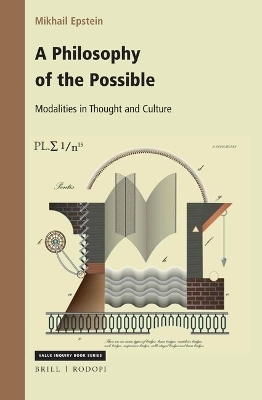
A Philosophy of the Possible
Brill (Verlag)
978-90-04-39833-7 (ISBN)
In this book, Mikhail Epstein offers a systematic theory of modalities (the actual, possible, and necessary), as applied to the discourse of philosophy in its post-Kantian and especially post-Derridean perspectives. He relies on his own experience of living in the USSR and the US, dominated respectively by imperative and possibilist modalities. Possibilism assumes that a thing or event acquires meaning only in the context of its multiple possibilities, inviting counterfactual and conditional modes of description. The author focuses on the creative potentials of possibilistic thinking and its heuristic value. The book demonstrates the range of modal approaches to society, culture, ethics, and language, and outlines potentiology as a new philosophical discipline interacting with ontology and epistemology.
Mikhail Epstein, Ph.D. (1990), Academy of Sciences, USSR; S.C.Dobbs Professor of Cultural Theory and Russian literature at Emory University (USA). He has published 35 books and hundreds of articles in philosophy and cultural and literary studies translated into 23 languages.
Preface
Introduction: Fundamental Concepts of the Theory of the Possible
1 The Problem of Modalities in Contemporary Thought
2 A Preliminary Definition of the Modality of the Possible
3 The Ontological Status of Possible Worlds. Nominalism and Realism
4 The Principle of “Fullness” and the Problem of Realization of Possibilities
5 Duality and “Demonism” of the Possible
6 A Possibilistic Approach to the Possible
7 The Plan of the Book
Part 1: The Possible in Philosophy
1 Criticism and Activism
2 Philosophy and Reality
3 Change of Modalities in the History of Philosophy
4 Philosophy as Possibilistic Thinking
5 The Area of the Thinkable: the Value of Thinking in Itself
6 Theory, Utopia, and Hypothesis
7 Catharsis of Thinking
8 Personified Thinking
9 Possible and Impossible: Aporia of Thinking
10 Language, Thinking, and Signifiability
11 Universals as Potentials: Conceptualism
12 From the General to the Concrete and Universal
13 Multiplication of Entities
14 Philosophy as Parody and Grotesque
Part 2: The Fate of Metaphysics: from Deconstruction to Possibilization
Introduction to Part 2
Section 2.1: Reverse Metaphysics: Critique and Deconstruction
15 Beyond Being and Nothingness: the Feeling of the Possible
16 A World View, Not a Point of View: “A Net with No Knots”
17 The Possible in Jean Derrida
18 The Metaphysics of Deconstruction: the Main Terms
19 The Radical Nature of Difference: Profit and Transcendence
20 Center and Structure
21 Reverse Metaphysics: the Other, the Play, and the Writing
22 Différance and the Tao
Section 2.2: Construction and Possibilization
23 From Deconstruction to Construction
24 Construction and Creativity
25 De- and Con-
26 Potentiation as Method: Eros of Thinking
27 What is “The Interesting”? Proposed Criteria
28 Small Metaphysics: the Unique
Part 3: The Worlds of the Possible
Introduction to Part 3
29 Society
30 Culture
31 Ethics
32 Psychology
33 Religion
Conclusion
Appendix
To be Able, to be, and to Know. A System of Modalities
1Definitions of Modality
A Typical Definitions
B The Specific Definition
2Оntic Modalities (Modalities of Being)
A “To Be” and “To Be Able” in the Ontological and Modal Perspectives
B Existence and Non-existence
C The Possible and the Contingent
D The Impossible and the Necessary
E Strong and Weak Modalities
F The General Scheme of Ontic Modalities
G Supermodalities: The Due and the Miraculous
3Еpistemic Modalities (Modalities of Knowledge)
4Pure (Potentialistic) Modalities
A Active Voice (Capacity, Need)
B Passive Voice (Permission, Coercion)
C Second-order Modalities
(1)Will and Power
(2)Desire and Love
5The Final Tables of Modalities
6Modal Categories in Various Disciplines
A Be Able – Possess – Have Value. Modality in Economics
B Necessity and Immortality: Modality in Eschatology
7Potentiology: Prospects for the New Discipline
Index of Names
Index of Subjects
| Erscheinungsdatum | 28.06.2019 |
|---|---|
| Reihe/Serie | Contemporary Russian Philosophy ; 333 |
| Verlagsort | Leiden |
| Sprache | englisch |
| Maße | 155 x 235 mm |
| Gewicht | 723 g |
| Themenwelt | Geisteswissenschaften ► Philosophie ► Erkenntnistheorie / Wissenschaftstheorie |
| ISBN-10 | 90-04-39833-3 / 9004398333 |
| ISBN-13 | 978-90-04-39833-7 / 9789004398337 |
| Zustand | Neuware |
| Informationen gemäß Produktsicherheitsverordnung (GPSR) | |
| Haben Sie eine Frage zum Produkt? |
aus dem Bereich