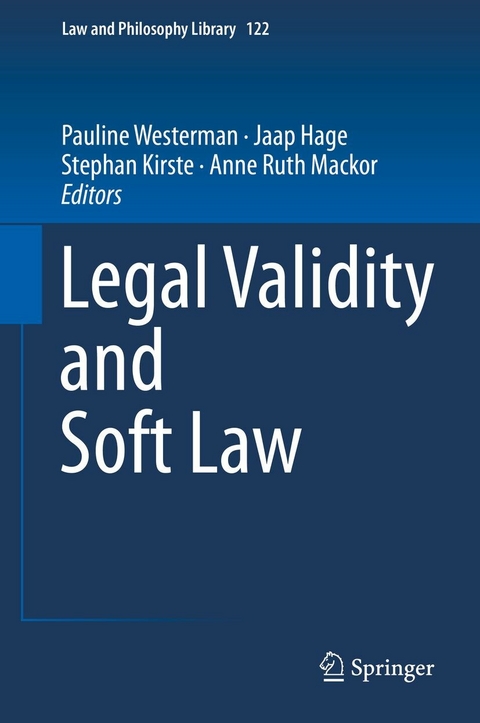
Legal Validity and Soft Law (eBook)
VIII, 266 Seiten
Springer International Publishing (Verlag)
978-3-319-77522-7 (ISBN)
Chapter 6 is available open access under a Creative Commons Attribution 4.0 International License via link.springer.com.
Jaap Hage studied Law and Philosophy at Leiden University. After working as an assistant professor at the Faculty of Law in Leiden, he became associate professor and in 2011 full professor of Jurisprudence at the University of Maastricht. His research interests include legal logic, basic legal concepts, methodology of legal science, and neurolaw. His main publications include the monographs 'Reasoning with Rules' and 'Studies in Legal Logic', and as co-editor the edited volumes 'Concepts in Law' and 'An Introduction to Law'.
Stephan Kirste studied law, history and philosophy and finished his juridical doctor with summa cum laude at the University of Freiburg (Germany) with a dissertation on time and law and his habilitation at the University of Heidelberg (Germany) with a book on public administrative law, receiving a venia legend for public law, philosophy of law, sociology of law and history of constitutional law. He became Professor of Law at the University of Heidelberg in 2006 (Extra-Ordinarius) and received a chair for for European Public Law and Legal Philosophy at the German Speaking Andrassy University Budapest in 2008, where he was Dean of the Faculty for Comparative Legal and State Sciences until his call to Salzburg in 2012. Since 2010 he is president of the German Section of the International Association for Legal and Social Philosophy (IVR). His fields of interest concern in particular: Theory of jurisprudence (esp. interdisciplinary of the science of law); Theory of law (esp. law and time); ethics of law (esp. human rights, human dignity, justice); Comparative constitutional law (esp. Brazil, USA); history of legal thought.
Anne Ruth Mackor studied law and philosophy in Leiden and Groningen and obtained her PhD in 1997 (Meaningful and Rule-guided Behavior: a Naturalistic Approach). From 2004 until 2014 she was Socrates professor of Professional Ethics at the Faculties of Philosophy and Theology, University of Groningen and from 2010 until present she is professor of Professional Ethics, especially of Legal Professions at the Faculty of Law, University of Groningen. Among others she has written about soft law, more in particular about the validity of judicial codes of conduct. In 2015 she was the external advisor both of the Judiciary and the Public Prosecution of Surinam for their Code of Conduct.
Pauline Westerman obtained her PhD in 1997 cum laude on The Disintegration of Natural Law Theory: From Aquinas to Finnis, (Brill Leiden, 1998); later awarded a Praemium Erasmianum). Appointed in 2001 Professor Philosophy of Law, University of Groningen and (until 2009) Free University Amsterdam. Since 2007 attached to the Academy for Legislation, in The Hague as Program-Manager Research. From 2009 General Editor of Legisprudence, International Journal for the Study of Legislation, Hart Publishing, Oxford, currently called Theory and Practice of Legislation (Taylor and Frances). In 2010 she was elected as member of the Royal Dutch Academy of Sciences, section Law. In 2018 her book Outsourcing the Law: a Philosophical Perspective on Regulation was published (Elgar).
Jaap Hage studied Law and Philosophy at Leiden University. After working as an assistant professor at the Faculty of Law in Leiden, he became associate professor and in 2011 full professor of Jurisprudence at the University of Maastricht. His research interests include legal logic, basic legal concepts, methodology of legal science, and neurolaw. His main publications include the monographs ‘Reasoning with Rules’ and ‘Studies in Legal Logic’, and as co-editor the edited volumes ‘Concepts in Law’ and ‘An Introduction to Law’. Stephan Kirste studied law, history and philosophy and finished his juridical doctor with summa cum laude at the University of Freiburg (Germany) with a dissertation on time and law and his habilitation at the University of Heidelberg (Germany) with a book on public administrative law, receiving a venia legend for public law, philosophy of law, sociology of law and history of constitutional law. He became Professor of Law at the University of Heidelberg in 2006 (Extra-Ordinarius) and received a chair for for European Public Law and Legal Philosophy at the German Speaking Andrassy University Budapest in 2008, where he was Dean of the Faculty for Comparative Legal and State Sciences until his call to Salzburg in 2012. Since 2010 he is president of the German Section of the International Association for Legal and Social Philosophy (IVR). His fields of interest concern in particular: Theory of jurisprudence (esp. interdisciplinary of the science of law); Theory of law (esp. law and time); ethics of law (esp. human rights, human dignity, justice); Comparative constitutional law (esp. Brazil, USA); history of legal thought. Anne Ruth Mackor studied law and philosophy in Leiden and Groningen and obtained her PhD in 1997 (Meaningful and Rule-guided Behavior: a Naturalistic Approach). From 2004 until 2014 she was Socrates professor of Professional Ethics at the Faculties of Philosophy and Theology, University of Groningen and from 2010 until present she is professor of Professional Ethics, especially of Legal Professions at the Faculty of Law, University of Groningen. Among others she has written about soft law, more in particular about the validity of judicial codes of conduct. In 2015 she was the external advisor both of the Judiciary and the Public Prosecution of Surinam for their Code of Conduct. Pauline Westerman obtained her PhD in 1997 cum laude on The Disintegration of Natural Law Theory: From Aquinas to Finnis, (Brill Leiden, 1998); later awarded a Praemium Erasmianum). Appointed in 2001 Professor Philosophy of Law, University of Groningen and (until 2009) Free University Amsterdam. Since 2007 attached to the Academy for Legislation, in The Hague as Program-Manager Research. From 2009 General Editor of Legisprudence, International Journal for the Study of Legislation, Hart Publishing, Oxford, currently called Theory and Practice of Legislation (Taylor and Frances). In 2010 she was elected as member of the Royal Dutch Academy of Sciences, section Law. In 2018 her book Outsourcing the Law: a Philosophical Perspective on Regulation was published (Elgar).
Chapter 1: What Is Validity? Lessons From Soft Law (Jaap Hage).- Chapter 2: Concept and Validity of Law (Stephan Kirste).- What is legal validity and is it important? Some critical remarks about the legal status of soft law (Anne-Ruth Mackor).- Chapter 4: Validity: The Reputation Of Rules (Pauline Westerman).- Chapter 5: Sources of Validity (Matthieu Carpentier).- Chapter 6: Unpacking Legal Validity (Paolo Sandro).- Chapter 7: Critical Remarks on Alf Ross’s Probabilistic Concept of Validity (Katarzyna Eliasz).- Chapter 8: A Fuller Understanding of Legal Validity and Soft Law (Bart van Klink).- Chapter 9: Sovereignty And Validity (Antonia Waltermann).- Chapter 10: A Short Note On Validity Of Rules Guiding Informal Markets (Yugank Goyal).- Chapter 11: Legal Validity, Soft Law and International Human Rights Law (Mátyás Bódig).- Chapter 12: Validity in positive law (Dietmar von der Pfordten).
| Erscheint lt. Verlag | 5.12.2018 |
|---|---|
| Reihe/Serie | Law and Philosophy Library | Law and Philosophy Library |
| Zusatzinfo | VIII, 266 p. 4 illus. |
| Verlagsort | Cham |
| Sprache | englisch |
| Themenwelt | Geisteswissenschaften |
| Recht / Steuern ► Allgemeines / Lexika | |
| Schlagworte | Alf Ross’s Probabilistic Concept of Validity • Concept and Validity of Law • Efficacy of Law • Juridical Acts • Law as Social Phenomenon • Legal Positivism • Legal Validity • Legal Validity, Soft Law and International Human Rights Law • Philosophy of Law • Soft Law • Sources of law • Sources of Legal Validity • Sovereignty And Validity • Validity in Positive Law • Validity of Rules Guiding Informal Markets |
| ISBN-10 | 3-319-77522-7 / 3319775227 |
| ISBN-13 | 978-3-319-77522-7 / 9783319775227 |
| Informationen gemäß Produktsicherheitsverordnung (GPSR) | |
| Haben Sie eine Frage zum Produkt? |
 PDF (Wasserzeichen)
DRM: Digitales Wasserzeichen
Dieses eBook enthält ein digitales Wasserzeichen und ist damit für Sie personalisiert. Bei einer missbräuchlichen Weitergabe des eBooks an Dritte ist eine Rückverfolgung an die Quelle möglich.
Dateiformat: PDF (Portable Document Format)
Mit einem festen Seitenlayout eignet sich die PDF besonders für Fachbücher mit Spalten, Tabellen und Abbildungen. Eine PDF kann auf fast allen Geräten angezeigt werden, ist aber für kleine Displays (Smartphone, eReader) nur eingeschränkt geeignet.
Systemvoraussetzungen:
PC/Mac: Mit einem PC oder Mac können Sie dieses eBook lesen. Sie benötigen dafür einen PDF-Viewer - z.B. den Adobe Reader oder Adobe Digital Editions.
eReader: Dieses eBook kann mit (fast) allen eBook-Readern gelesen werden. Mit dem amazon-Kindle ist es aber nicht kompatibel.
Smartphone/Tablet: Egal ob Apple oder Android, dieses eBook können Sie lesen. Sie benötigen dafür einen PDF-Viewer - z.B. die kostenlose Adobe Digital Editions-App.
Buying eBooks from abroad
For tax law reasons we can sell eBooks just within Germany and Switzerland. Regrettably we cannot fulfill eBook-orders from other countries.
aus dem Bereich